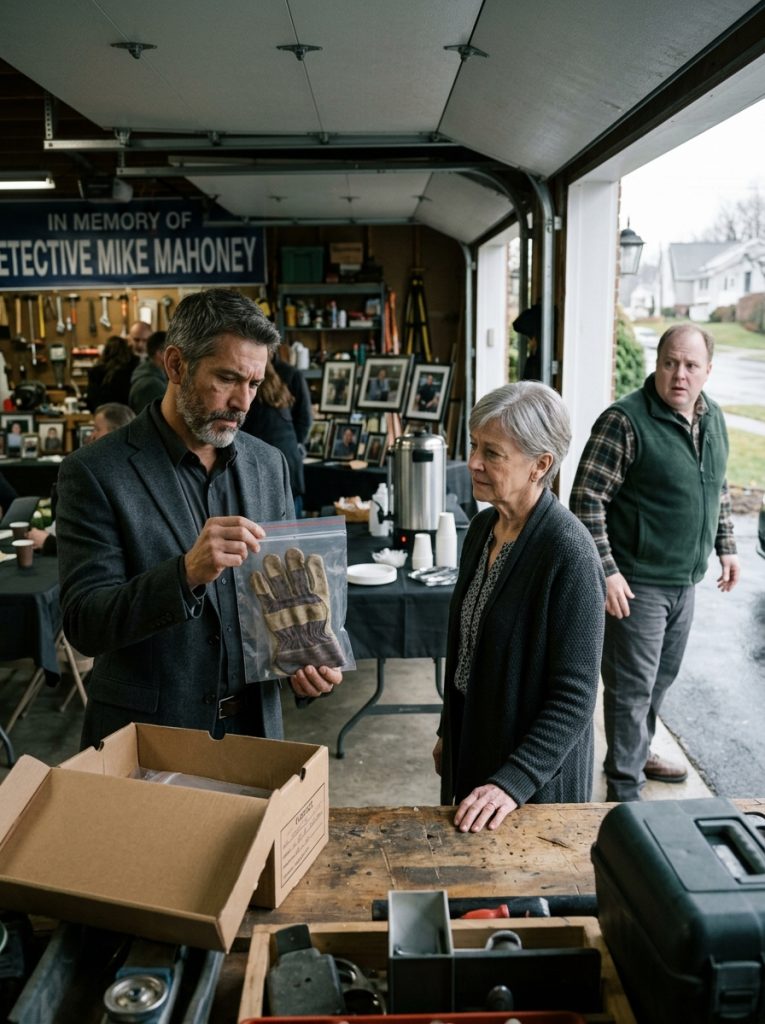
For a moment, nobody in that garage understood what they were looking at except me and Rick.
Maggie Mahoney did, a little. She’d lived with the case at her dinner table for nine years; she knew her husband had kept something. But the rest of them — the neighbors, the off-duty cops, the cousins holding paper plates — just saw a man who’d been to prison holding up a dirty old glove in a bag, and a memorial getting strange.
It was Rick’s face that gave it away. A guilty man can hold a pose in a courtroom for years. He cannot hold it in his dead accomplice’s garage when the thing he buried comes back up out of the ground.
“Frank tested everything twice,” Maggie said into the quiet, almost to herself. “He never believed the fire was you, Daniel. He said the glove didn’t fit your hand, and then it disappeared from the evidence room before the trial, and he couldn’t prove who’d pulled it. It ate at him until the day he retired. He bagged it the night before they reassigned him. Said the lab would catch up someday, even if the department wouldn’t.”
The lab caught up.
It took eleven weeks. The Innocence clinic that had freed me still had my case file open, and they knew exactly what to do with a properly bagged, chain-documented piece of evidence that the original prosecution had sworn was lost. The inside of a glove is an intimate place. It holds the sweat and the skin of the hand that wore it. The outside of that glove had been at the scene of the fire that killed our neighbor, Mr. Whitlock. The state had always known that. What they’d never had — what had conveniently vanished before twelve people decided my life — was any way to test whose hand had been inside it.
Now they had it.
The DNA inside that glove was not mine.
It was Rick’s. My sister’s husband. The man who had married into our family the year before the fire, who had “stood by Carmen” through my whole imprisonment, who had sat at her kitchen table and helped raise my daughter to call him something close to “Dad.” The man who, it turned out, had owed money to the wrong people, had set a fire for the insurance on a building Mr. Whitlock managed, and had let it run out of control — and then, when the investigators started circling, had made sure the evidence pointed at the brother-in-law nobody would miss. The ex-con’s brother. The one with the record from when he was nineteen. The easy story.
He’d worn gloves so he’d leave nothing behind. He never once considered that the nothing he left behind was on the inside.
I think about that arrogance a lot now. Rick spent nine years being the dependable one — the brother-in-law who showed up, the man who “held the family together” while I was gone. He went to my daughter’s recitals. He carved the turkey at the table that used to be mine. He had built an entire life on top of that fire, and he’d done it so thoroughly that even I, sitting in a cell, had sometimes felt grateful to him for being there when I couldn’t be. That’s the part that still turns my stomach. Not only that he framed me. That he made me thank him for it, in letters, from prison, year after year.
I’d love to tell you the truth set everything right. It set the record right. There’s a difference, and I learned it the hard way over nine years, and I learned it again in the months after.
Rick was arrested. He’ll stand trial for what he did to Mr. Whitlock and for what he did to me, and the prosecutors who once worked so hard to bury me are now working just as hard the other direction, which I’m told is supposed to feel like justice. Mostly it feels like watching a machine run in reverse and noticing, for the first time, that it was always just a machine.
My sister, Carmen, is her own kind of wreckage. She married the man who put her brother in prison and then raised her daughter beside him for nine years, and she has to live inside that sentence now for the rest of her life. The first time she came to see me after the results came back, she couldn’t speak. She just stood in my doorway and shook. I won’t tell you I had grace ready for her. I didn’t. Some days I still don’t. But she’s my sister, and the fire took enough of our family without taking the two of us too, so we are doing the slow, ugly, unglamorous work of trying to find each other again on the far side of what Rick did to all of us. Mostly it feels like watching a machine run in reverse and noticing, for the first time, that it was always just a machine.
My mother is still gone. She died in my third year inside, believing the appeals would come too late, believing — I’ll never know how much — that maybe her son had done a terrible thing. The truth came nine years too late for her. No log, no glove, no verdict reaches into the ground.
But.
There was a girl at that memorial I haven’t told you about. Seventeen years old, in the back, where I’d been trying to stand. My daughter, Sofia. Carmen had brought her, not knowing what the day would hold. Sofia had spent her whole conscious life being told, in a hundred small ways, that her father was a man who’d done something unforgivable, and she’d built her life around the careful distance that belief required. She’d flinched from me for months since my release. I’d stopped reaching, because reaching only made her flinch.
When the room understood — when Rick edged toward that garage door and a retired sergeant quietly stepped into it, when Maggie said her piece, when the shape of nine years finally rotated into focus for everyone standing there — Sofia did not run to me. It wasn’t a movie. She just looked at me across that garage for a long, long time, the way you look at a word you’ve been mispronouncing your whole life and are only now hearing said correctly.
And then, as people started to murmur and Maggie started to cry and Rick’s whole world came apart in real time, my daughter crossed the floor, and she did not say “Dad,” because that word belongs to the years we lost and you don’t get to skip to it.
She just took my hand.
That’s all. She took my hand and she held it, and I held hers, and neither of us said anything, because there was nothing to say that her hand wasn’t already saying.
Nine years. A glove in a dead man’s garage. A retired detective who couldn’t prove it in time to save my life but cared enough to save the truth for after he was gone. A brother-in-law’s DNA on the inside of the one thing he thought he’d gotten rid of.
People ask if I forgive Rick. I don’t have an answer that fits on a card. What I have is a daughter’s hand, finally, in mine. What I have is a town that crosses the street the other way now, ashamed. What I have is Frank Mahoney’s careful block handwriting on an evidence bag, the only apology I ever got from anyone in a uniform, and the only one that ever mattered.
I wrote Maggie Mahoney a letter after the results came back. I told her that her husband had been the one person in nine years who looked at me and saw a man instead of a verdict, and that he’d kept the truth alive on a shelf in his garage long after everyone else had filed it away under closed. She wrote back two lines. “He’d have liked you. He always said the quiet ones get railroaded, because nobody ever bothers to listen.”
It came too late to give me back my years.
It came exactly in time to give me back my name.
And it turns out a man can build a whole second life on that — on a true name, and a daughter’s hand, and a dead detective who refused to throw away the truth just because the system already had.