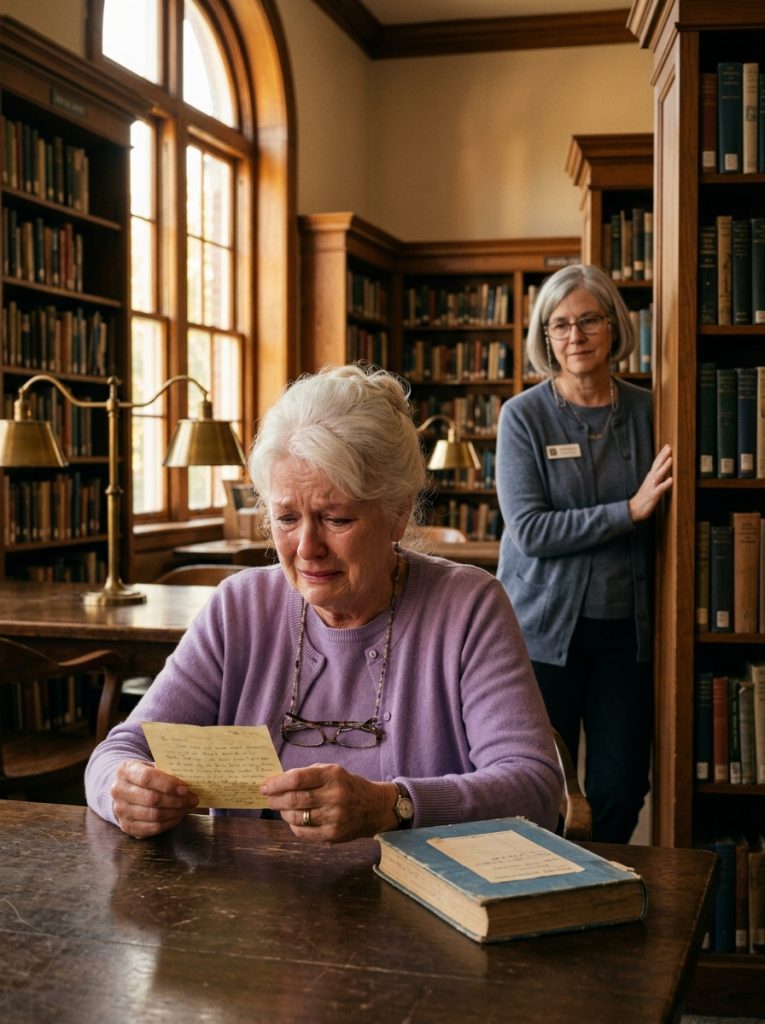
“Is he still alive?” Peg asked me. “Sam. Do you know?”
That was the question I didn’t know how to answer. So I told her the only honest thing.
“I don’t know. But I think we could find out together, if you want to.”
She wanted to.
We sat at the dark wood table by the window, the blue book between us, and Peg told me her half of a story I’d only held one corner of.
She was nineteen in 1974. Sam Briggs was twenty, about to ship out. They’d grown up three streets apart. He was shy in a way that made him funny, she said — he’d checked out the same book six times just so he’d have a reason to talk to her at the desk.
The morning he left, she came to the library to find him and he was already gone. She didn’t know about the note. She never thought to look inside her own favorite book on the shelf.
“I waited,” she said. “I wrote him every week. For two years.” Her hands twisted in her lap. “Then the letters started coming back. Return to sender. I thought he’d asked them to do that. I thought he’d met someone over there and didn’t have the heart to tell me.” She looked at the note again. “All this time I thought he forgot me. And he was asking me to wait.”
The letters came back, we figured out later, because Sam’s family had moved while he was deployed, and the forwarding lapsed, and a teenage girl’s letters were not the thing a busy post office chased down. A misunderstanding made of nothing but bad timing and silence.
It took us a week to find the rest.
I’m a librarian; finding things is most of the job. We pulled the old town directories, a 1973 high-school yearbook with Sam’s gap-toothed grin in the back row of the wrestling team, a microfilm reel of the county paper that smelled like a basement. Peg sat beside me at the reader and narrated a boy I’d never met, until I felt like I’d known him too.
Sam Briggs came home from the war in 1976. He’d been wounded — walked with a limp the rest of his life. He came back to a town where the girl he’d loved had, by then, married someone else, because two years of returned letters will do that to a heart. He never knew about the note on the shelf. He thought she’d moved on without a backward glance.
He never married. He worked at the lumberyard two towns over for forty years. He kept to himself. He died four years ago, in the spring, of a quiet heart.
I watched Peg take that in. I braced for it to break her.
It didn’t, quite. It did something stranger and softer.
“He didn’t forget me,” she said. Her voice shook, but underneath the shaking was something that had been waiting fifty years to set itself down. “All this time I was angry at a boy who was lying in a hospital, writing to an empty house. He didn’t forget me at all.”
There’s no version of this where it isn’t too late. I won’t pretend there is. They lost the whole life they might have had. Fifty years, gone to a forwarding address and a note that fell asleep between two pages.
But Peg said the strangest gift was the truth itself. That for half a century she’d carried a small ugly stone — he didn’t want me — and the note had reached in and replaced it with a different one. Heavier in some ways. But clean.
She asked if she could keep the note. I told her it had always been hers; it just took a while to be delivered.
Before she left, she asked me one more thing. Where he was buried.
I drove her out the next Saturday. It’s a small cemetery two towns over, the lumberyard town. We found him under a maple that was just coming into leaf.
She didn’t say much. She set the blue book against the headstone — I’d quietly checked it out to her, permanently; some books don’t come back, and this one had earned the right to stay gone.
Then she leaned down, close to the stone, and she answered him.
“Yes,” she said. “The answer was always going to be yes.”
Back at the library, I did the last thing the story needed.
I took the old due-date card out of its paper sleeve. Fifty years overdue, one final stamp.
Under the column where the borrower signs, in the careful hand of a boy who was too shy to say it out loud, was a single name: Sam.
I wrote one word beside it, in pencil, soft, so it looked like it had always been there.
Received.