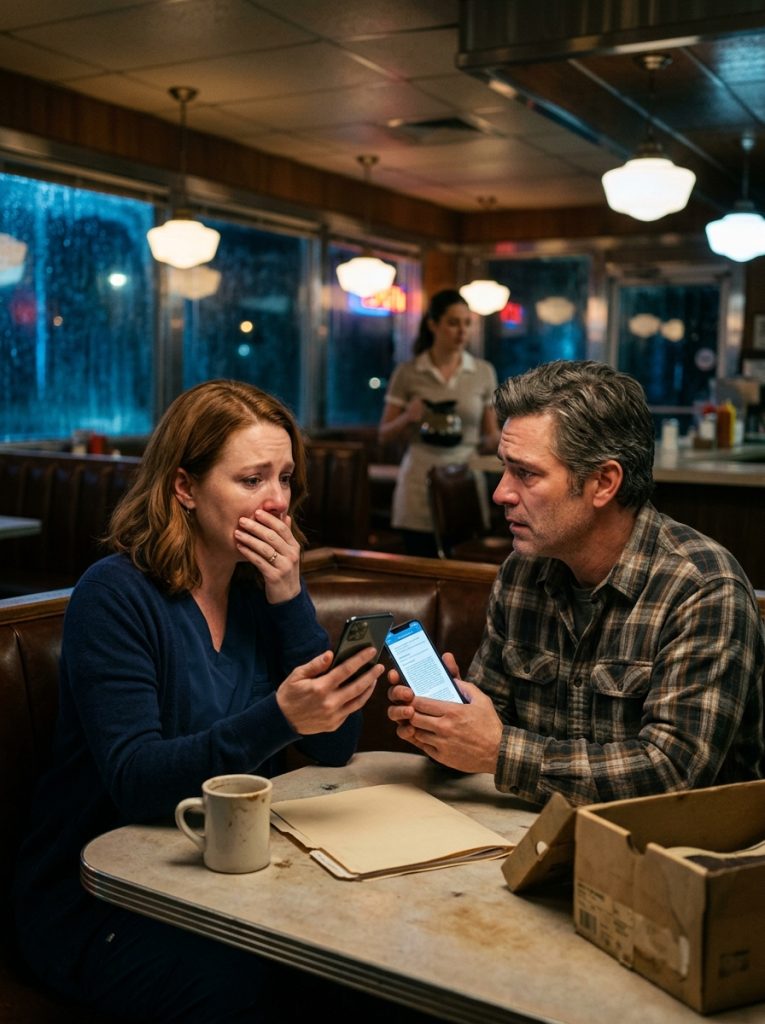
Adam set the shoebox on the diner table between our two coffees, and his carpenter’s hands were as unsteady as mine.
We’d just met for the first time in our lives, two strangers who shared a mother neither of us could ask about anymore. Now there was a battered box where a conversation should have been.
“I almost didn’t bring it,” he said. “I found it three years ago, when my adoptive mom passed. It was in her closet, labeled with my name. She’d had it the whole time and never told me.” He swallowed. “I think she was scared of what it would do to me.”
“What’s in it?”
“Letters,” Adam said. “From Margaret. Our mother. Dozens of them. All addressed to me. None of them ever sent.”
I put my hand to my mouth.
“Read one,” he said. “Please. I’ve read them a hundred times. I need to watch someone else read them. I need to know I’m not crazy for how they make me feel.”
I lifted the lid. The letters were soft with handling, the ink faded. The earliest one was dated forty-two years ago. I unfolded it with the care you’d give a newborn.
“My darling boy,” it began. “Today you are one month old somewhere I’m not allowed to know, and I have already broken every promise I made them about letting you go.”
I couldn’t breathe.
The story came out of those letters slowly, the way the truth always does.
Our mother — Margaret — had been seventeen when she got pregnant with Adam. It was a different time, a stricter family, a small town with a long memory. Her parents — the grandparents I’d thought I knew, the ones in the framed photos on Dad’s wall — had decided for her. The baby would be given up. Quietly. No discussion. She wasn’t even allowed to hold him for long before they took him to be adopted.
She wrote him a letter that first month. And the next month. And every month after, for years. She never had an address to send them to. The adoption was closed, sealed, final. So she just kept writing into the dark, telling her lost son about her life, apologizing, promising she was looking.
“I tell myself you have a good family,” one letter said. “I tell myself they sing to you. On the hard nights I tell myself you’ll find me someday, and I’ll have all these words ready, so you’ll know you were never, ever thrown away. You were taken. There’s a difference, and I need you to know the difference.”
I was sobbing in a diner booth in Marysville. The waitress quietly refilled our coffees and pretended not to see.
“There’s more,” Adam said softly. “Keep going. Get to the ones from after I was eight.”
The later letters changed. They mentioned a husband. A new town. And then — a baby girl.
“I had a daughter today,” our mother wrote, when I would have been a newborn. “I named her Claire. When the nurse put her in my arms, I wept so hard the doctors thought something was wrong. They didn’t understand. I was holding your sister, and you weren’t there to meet her, and you didn’t even know she existed. I promised her, while she slept, that if I never found you, I’d find a way to make her the bridge. I don’t know how yet. But blood remembers. I have to believe blood remembers.”
I set the letter down because my hands couldn’t hold it anymore.
She knew. Our mother knew about both of us, carried both of us, grieved one and raised the other, and never once told me I had a brother. Because telling me meant explaining a wound her own parents had carved into her at seventeen and made her swear to hide.
“That’s why your dad got weird on the phone,” Adam said gently. “He knew. He must have known.”
I called my father from the parking lot that night, shaking, the box under my arm.
“You knew,” I said. “About Adam. About all of it.”
There was a long silence. Then, quietly: “Your mother told me before we married. It was the great grief of her life, Claire. Her parents made her promise to never speak of it. By the time those two were gone and she was free to look, the trail was forty years cold, and she was sick, and she was scared that if she found him and you found out how it all happened, you’d think less of her.” His voice broke. “She made me promise to protect her memory. I’ve spent four years not knowing if that promise was the right one or the worst thing I ever did.”
“It was the worst thing you ever did,” I said. But I wasn’t angry. I was just sad, the deep kind. “She didn’t need protecting, Dad. She needed her kids.”
“I know,” he whispered. “I know that now.”
Here is what we did with the truth.
Adam and I drove, together, to our mother’s grave the following weekend. It was the first time he’d ever stood there. I’d visited a hundred times and never known I was visiting alone for both of us.
He brought the box. We read her the letters out loud, taking turns, all of them, start to finish. It took hours. It got dark. We didn’t stop.
When we finished, Adam knelt and pressed his hand flat against the grass.
“I got them, Mom,” he said. “Forty years late. But I got them. And I found her. You were right. Blood remembers.”
The last letter in the box was dated three weeks before she died. Her handwriting had gone thin and wandering by then, but the words were steady.
“If you are reading these,” she wrote, “then it worked, and somehow you found each other, and I am so sorry I am not there to see your faces in the same room. Be gentle with your father. He kept a promise that cost him more than you will ever know. Be gentle with each other. And Claire, if it’s you reading this aloud — and I think it will be — thank you for being the bridge. I always knew you would be.”
Adam couldn’t finish that one. I read it for both of us, into the dark, with my brother’s hand still flat against our mother’s grave.
I have a brother now. Forty-two years old, salt-and-pepper hair, hands that build things, a laugh that is my laugh, that was her laugh.
He has a wife named Donna and two kids who call me Aunt Claire like they’ve been doing it their whole lives. My kids and his kids met at a barbecue in July and were inseparable by sundown. Cousins who almost never existed, chasing each other around a backyard, while Adam and I watched from the porch and didn’t say much, because some things don’t need saying.
My father comes to those barbecues now. He and Adam are careful with each other, two men learning a relationship that skipped forty years of practice. But last time, I watched Dad show Adam an old photo album, pointing out which features came from which side, filling in the blanks our mother never got to. It’s not forgiveness, exactly. It’s something quieter and more useful. It’s repair.
I keep the shoebox at my house now. Adam and I agreed it should live with the daughter, since the letters are how she planned to build the bridge. On the anniversary of her death, we open it and read a few. We’ve started writing our own, too — letters to her, telling her about the grandkids, the barbecues, the way it all turned out.
We’ll never send those either. But that was never the point.
Some letters aren’t written to be received.
They’re written so that love has somewhere to go while it waits.
And ours waited forty years, in a closet, in the dark, until two strangers with the same hazel eyes finally sat down in a diner and opened the lid.