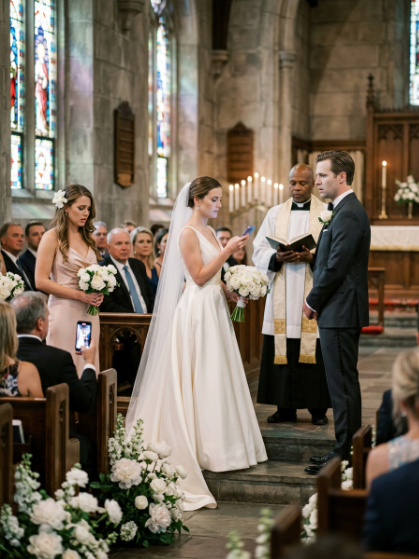
I didn’t read the whole livestream aloud.
I read just enough.
I lifted my phone to the microphone Reverend Calloway had been holding, and in a voice that reached the back of that stone chapel, I read the caption Brielle had typed under the video with her own hands.
“Last single hour. Don’t tell the bride. 😉”
Three hundred people heard it at the same time. The sound they made wasn’t a gasp. It was a long, low exhale, like a room remembering how to breathe.
Then I lowered the phone. The rest of what was still playing was not something my grandmother needed to see.
Spencer lunged toward me. “Nora, that was nothing. It was a stupid mistake. It didn’t mean anything—”
“You streamed it, Spencer.” My voice didn’t climb. “To your group chat. An hour ago. While I was forty feet down the hall getting into my dress.”
His mouth opened and closed.
Brielle was sobbing into her gardenia. “Nora, please. I never meant for it to—”
“Don’t,” I said. Quiet. It landed harder than a scream.
Here is the part none of them understood, standing in a chapel they all believed a generous Vance had paid for.
I paid for it.
Every cent.
The Vances had spent two years calling me “Spencer’s lucky little find.” A schoolteacher, they thought. Sweet, plain, grateful. They never once asked what my mother had left me, or what I’d done with it.
What I’d done with it was build a company. Quietly. Three logistics depots and a software contract, run through a holding name that didn’t carry mine.
I never told Spencer the size of it. I wanted to be chosen for my heart, the way my mother always warned me to wait for.
So when his mother pushed a prenup at me six weeks before the wedding — one that quietly assigned “shared marital ventures” to a Vance family trust — I didn’t fight her.
I smiled. And I took it to my own attorney, Ruth.
Ruth read it twice and set it down. “Nora,” she said, “they’re not marrying you. They’re acquiring you.”
She rewrote it. Every clause. The version Spencer’s mother signed, beaming, in front of her lawyer, did the opposite of what she thought it did. It documented — in dated, notarized lines — exactly whose money funded this wedding, the down payment on the condo Spencer had already half-furnished, and the “loan” his father took against a depot he believed he’d soon control.
That was the document I almost tore in half. I’m so glad I signed it instead.
So I stood at that altar, three hundred faces turned toward me, and I made it very simple.
“This wedding was paid for by me,” I said. “The suite where this happened. The condo Spencer moved his things into last week. The deposit his father borrowed against. All mine. All on paper. All notarized.”
I slid the ring off my finger.
“You didn’t trap a defenseless woman,” I said, and I set the ring gently on the open prayer book in Reverend Calloway’s hands. “You signed a contract with one.”
Spencer’s father stood up in the third row. The color was gone from his face too. He understood ledgers, that man. He understood exactly what I’d just said about the depot.
His mother did not. “She’s bluffing,” she hissed, half-rising in her silver. “She’s a teacher—”
“Call the bank Monday,” I said. “Ask whose name is on the note.”
I picked up my bouquet. White ranunculus. I’d chosen them myself, paid for them myself, like everything else.
I handed it to my grandmother on my way down the aisle.
I did not run. I want that on the record. My heels were steady on the old stone, all the way to the great wooden doors, while behind me a chapel full of guests slowly turned to watch the Vances instead of me.
The marriage was annulled within the month — never consummated, never valid, the certificate void. Spencer’s father lost the depot he’d borrowed against; the note was called and he couldn’t cover it. The condo sold; I kept the gain. Brielle’s wedding invitation to her own ceremony, that fall, was returned by half the people who’d been in that chapel.
Spencer called me eleven times the first week. I didn’t answer until the last one.
“Why didn’t you just tell me who you were?” he said. He sounded so wounded. So genuinely confused. “We could have had everything.”
“I did tell you who I was,” I said. “I was the woman who paid for it all and never once mentioned it. That was the test. You just didn’t know you were taking it.”
I hung up.
I keep the prenup in a drawer now, the real one, with Ruth’s signature beside mine. Sometimes I take it out and read the line my late mother would have loved best — the one that proves the lace gown, the chapel, the whole beautiful trap, belonged to me from the very first stitch.
Outside the chapel that day, the Savannah sun was high and the live oaks were dripping moss, and for the first time in two years I drove away from the Vances with both hands easy on the wheel.