The man in the gray suit let the silence stretch until you could hear the folding chairs creak.
Then he told three hundred people that twenty-six years ago, he was a kid who ate free lunch and got shoved out of the line for it.
“I know what that cafeteria sounds like,” he said. “I know what it sounds like when the laughing is about you.”
I gripped my program so hard it bent.
“My name is Marcus Ellison,” he said. “Three weeks ago I became the superintendent of this district. And before I sat behind a desk and read reports about ‘school climate,’ I wanted to see it. So I did what I’ve done in every district I’ve served. I took off the tie. I bought a tray. And I ate lunch with the kids.”
A murmur ran through the room. The principals at the front tables shifted in their seats.
“For a week, nobody knew who I was. Which is exactly how you learn the truth about a school. You watch who gets ignored. You watch who looks away.”
He found me in the back row again.
“On my second day, a lunchroom worker named Rosa Delgado handed me a bowl of chili and asked if I’d eaten enough. She didn’t know me from anyone. She just saw a man sitting alone and decided I shouldn’t go hungry. I watched her do that for every kid who came through her line. Especially the ones with empty trays and no money.”
My eyes burned. I hadn’t told anyone I covered those plates. I didn’t think anyone saw.
“And on my third day,” Mr. Ellison said, “I watched something I will carry for the rest of my career.”
He told them about Tuesday.
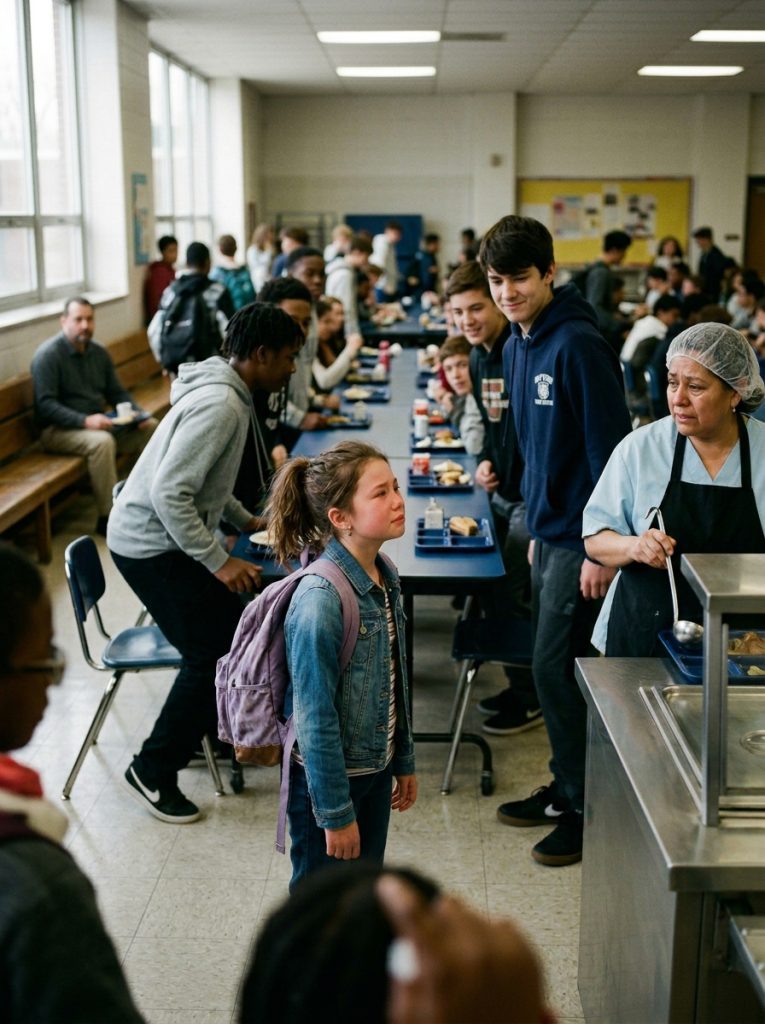
He told them about Lily Park — twelve years old, the smallest kid in the room — who had been tormented for weeks while adults found other directions to look.
He told them how she stood up. How she didn’t shout. How she just said, you don’t get to do this anymore.
And how, one chair at a time, an entire cafeteria of children stood up with her.
“Do you understand what that takes?” he asked the room. “Grown adults sign petitions they’re afraid to sign. And a room full of twelve-year-olds found their courage in four seconds because one girl found hers first.”
He asked Lily to stand.
She was sitting with her mother three tables from me, and she went red to her ears, and she stood up in the same secondhand denim jacket she wore every day.
The room rose for her. Again. A second standing, weeks after the first.
This time the people clapping were adults who should have protected her all along.
“Lily,” Mr. Ellison said, “this district is starting a student dignity program in every school we run. Students will lead it. And it’s going to carry your name, if your mother says yes, because you showed us how it’s done before we ever wrote the policy.”
Lily’s mother was crying too hard to do anything but nod.
Then he turned to me.
“Mrs. Delgado. Rosa. Would you come up here, please.”
I have served lunch in that district for thirty years. I have never once been asked to come to the front of anything.
My legs barely worked. Rosa Delgado, hairnet woman, walking up the center aisle of a banquet in her good cardigan.
“This is the person who fed me when she thought I was nobody,” Mr. Ellison told the room. “Which means she feeds every child in that building like they’re somebody. We have been calling people like Rosa ‘support staff,’ as if kindness is a side job.”
He shook my hand with both of his.
“Effective this fall, Mrs. Delgado will lead our new district nutrition and student-care initiative — a paid role, with a real title and a real desk — because no child in our schools should go hungry while we have someone this good already doing the work for free.”
I couldn’t speak. I just held his hand and shook.
There was more, after. There always is.
The two lunch monitors who’d looked away every day were quietly reassigned, and required to retrain. Trevor and his friends were enrolled in the first session of the new program — not expelled, Mr. Ellison was firm about that. “We don’t throw children away,” he said. “We teach them.” Trevor’s mother thanked Lily’s mother by the dessert table, and the two of them cried into the same napkins.
But here’s what I keep.
A week later, a new kid came through my line. Shoulders up around his ears. No money on his account.
Before I could even slide him a plate, the girl behind him — Lily — said, “It’s okay. Mrs. Delgado’s got you. And if anybody gives you trouble, you come find me.”
I served them both, my throat tight, my ladle steady.
Thirty years behind that glass, and I finally understand what I was really serving all along.
It was never just lunch. It was the message that somebody saw them.
And now the whole school knows to stand.