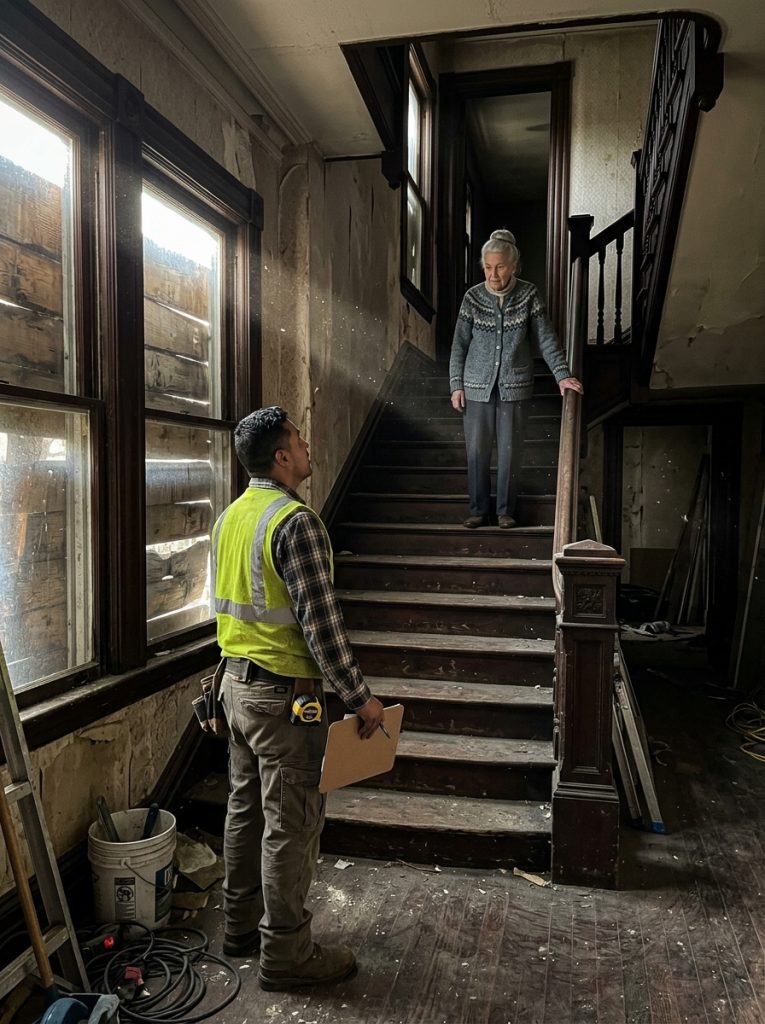
The young man’s name was Marco. He sat down on the bottom step, because there was no furniture left in the foyer to offer him, and he listened, because something in my voice told him this was not a fight he understood yet.
I told him about Walter.
I told him that in 1962, when we bought the house, Walter did something I thought was strange at the time. He was a careful man, a worrier, the kind who couldn’t sleep until a thing was made safe. And he’d grown up watching his own mother get put out of her home after his father died, with nowhere to go and no say in it. It marked him. He swore it would never happen to me.
So when we bought the house, Walter went to a lawyer — an expense we could barely afford — and he had the ownership structured so that, no matter what ever happened, I would have a recorded life estate. The legal right to live in this house until the day I die. He paid extra for it. He insisted on it. I remember teasing him: “Walter, we just bought the place, why are you already planning my old age?” And he said, “Because someday I won’t be here to take care of you, Ellie, and I need to know the house still will.”
I went up to the attic and brought down the proof. A yellowed, framed document that had hung on my attic wall for decades, beside our wedding photo. The recorded life estate, dated 1962, Walter’s signature beside the lawyer’s seal. I’d kept it framed not because I understood its legal weight, but because it was the most romantic thing my practical husband ever did. A love letter written in legal language.
Marco read it. He was quiet for a long time. Then he took out his phone and made some calls — to his title company, to the lawyer who’d handled the auction. I sat in the window seat Walter built and watched the light move across the floor and waited.
It turned out Walter, my worried Walter, had protected me even better than I knew.
A tax sale can take a property. But a properly recorded life estate is an interest in the home that a buyer generally takes subject to — and on top of that, the law requires that everyone with a recorded interest be properly notified before a sale. The framed paper on my attic wall meant I had a recorded interest. And no one had ever notified me, because the city had treated the house as abandoned and never checked who actually held a right to live there.
Marco hadn’t bought a house he could empty. He’d bought a house with an eighty-one-year-old woman legally entitled to live in it until she died — and a sale process that hadn’t been done right.
I watched his face as he understood it. I braced for anger. I’d half expected, the whole time, that he’d lawyer up and grind a frightened old woman down, the way the world usually grinds people like me down.
He didn’t.
He set down his clipboard, and he looked around at the boarded windows and the sagging porch and the banister worn smooth by a dead man’s hands, and this thirty-eight-year-old stranger in a work vest put his face in his hands for a moment. When he looked up, his eyes were wet.
“My grandmother,” he said. “She lost her house. After my grandfather passed. We couldn’t stop it. I was a kid. I used to tell myself that when I grew up and worked in houses, I’d never be the guy who did that to somebody.” He laughed, broken. “And here I am. The guy with the clipboard, telling a woman her home is mine.”
“You didn’t know,” I said gently.
“I know now,” he said.
Here is the part that I think about every day, the part that makes me cry the good kind of tears.
Marco could have walked away. He could have tried to fight the life estate, or pressured me to take a buyout and leave, or simply written off his losses and moved on to the next flip. Instead, he did something I never expected from a stranger.
He helped me.
He found me a legal aid attorney who untangled the tax mess — turns out the sale could be unwound given the improper notice, and Walter’s old planning meant there were even some protections and exemptions for elderly homeowners I’d never known to claim. The auction was reversed. The back taxes, once someone actually sat down with me and the right programs, turned out to be far more manageable than the frightening letters had made them seem. I’d been drowning in a problem that had a solution all along; I’d just been too old and too alone and too grief-stupid to find it. Marco found it with me.
And then he did the last thing. The thing that undoes me.
The legal aid attorney Marco found for me was a young woman who treated me like I mattered, which, after years of frightening letters, felt like a window opening. She walked me through all of it slowly. The improper notice. The recorded life estate. The elderly-homeowner protections and exemptions I’d never known to claim. Things Walter’s old planning had quietly set in motion decades ago, waiting in a filing cabinet for the day I’d need them.
It took months. There were hearings I was nervous to attend, and Marco drove me to every one, and sat in the back, and bought me a coffee after like we were old friends. The auction was unwound. The tax burden, once a real person sat down with me and the right programs, turned out to be a fraction of what those letters had screamed. I’d been drowning in a problem that had a solution all along. I’d just been too old and too alone and too deep in grief to find the shore.
He fixed the porch.
He came back on a Saturday with two guys from his crew, and they shored up the sagging side of the wraparound porch Walter built, the one I couldn’t climb a ladder to save. He wouldn’t take a dime. “Consider it interest,” he said, “on the education.” Over the next year, in his spare time, he patched the roof and unboarded the windows and got the heat working in the rooms I’d closed off. He said an old house like this shouldn’t be hidden behind boards. He said it deserved to have its lights on.
So now the house has its lights on. I live in all the rooms again. I’m warm. At eighty-one, I did not expect to be warm in winter or to have the porch fixed or to have a young friend who comes by on Saturdays and lets me feed him too much and tells me about his grandmother.
But here is the bittersweet of it, the part I can’t get around.
Walter isn’t here to see it.
The man who signed a paper in 1962 because he couldn’t bear the thought of me being put out of our home — he never got to know whether it worked. He died eleven years before the young man with the clipboard ever turned a key in our door. He just had to trust, across all those decades, that the careful thing he did out of love would be there when I needed it.
It was there. It held. Fifty-one years later, my husband’s worry reached out of the past and kept a roof over my head, exactly as he swore it would.
That’s the thing about a last wish, I’ve learned. Sometimes it isn’t dramatic. Sometimes it’s a worried man at a lawyer’s office in 1962, paying extra for a clause, saying, “Someday I won’t be here to take care of you, and I need to know the house still will.”
The house still did, Walter.
I’m still home. The lights are on. And I talk to you in every room.