The screenshot was Tate’s own video. The mocking one. Except someone had laid it side by side with the federal recall notice — his grinning face on the left, “burn and fire hazard, cease use immediately” on the right — and that single image was being shared faster than anything he’d ever made on purpose.
The person who sent it to me was a woman named Priya, who I’d never met. Her message said: “I was one of the people who left a nasty comment on your video. I’m so sorry. My daughter has the same bottle. I just threw it away. Thank you for not deleting yours.”
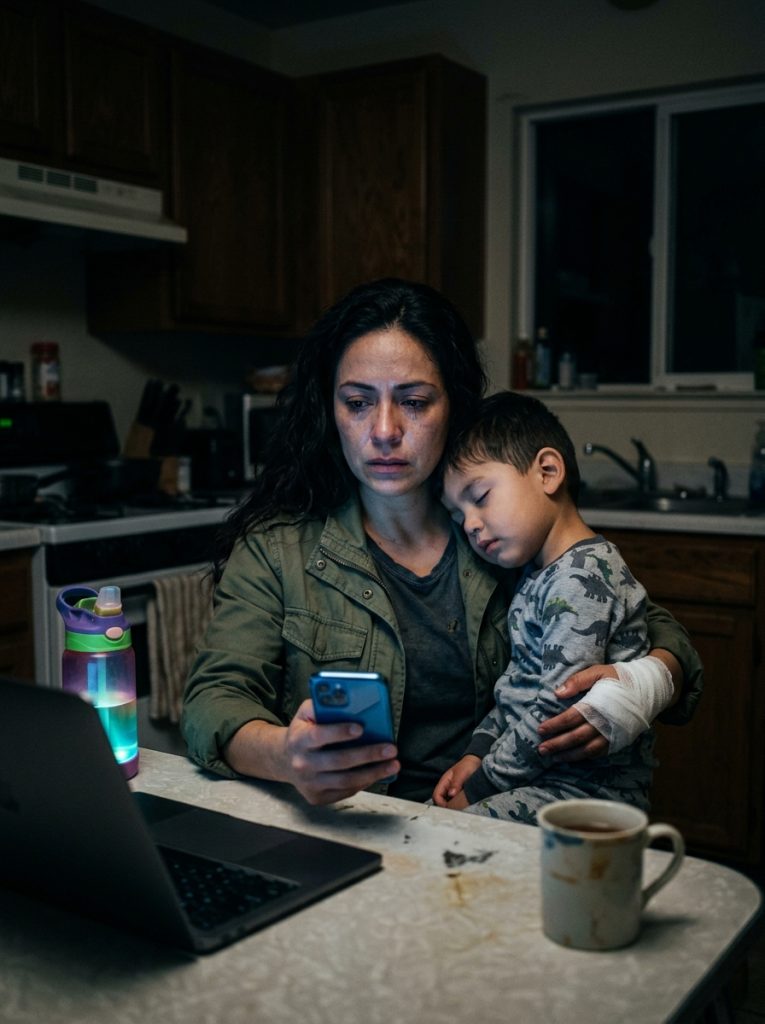
I sat in my dark kitchen and read that message about six times, with Mateo’s bandaged hand warm against my collarbone, and I did not feel triumphant. I felt something more complicated than that, something I’m still untangling. Relief that I wasn’t crazy. Grief that it took a recall — that it took my own kid getting hurt — for “I wasn’t crazy” to be allowed.
And here’s a thing nobody warns you about being publicly vindicated: the same crowd that’s capable of turning on you is capable of turning toward you, and it doesn’t feel the way you’d expect. Strangers who’d called me hysterical two weeks earlier were suddenly in my comments calling me a hero, and I wanted to scream at every one of them that I was the same person saying the same thing — the only variable that changed was a federal notice, not me. I’d been right the entire time. Being right hadn’t been enough. It took my son’s hand. That equation doesn’t balance no matter how many heart emojis show up to pretend it does.
By the time the sun came up, it had become A Whole Thing. Not because of me. I hadn’t posted a word. It was the contrast that did it: the influencer who built a brand on “trust me, I test everything” caught on video mocking the exact safety warning that turned out to be federally correct. The internet does not forgive that particular flavor of wrong. His comment sections, the same ones that had buried me, turned on him with the speed of a tide going out.
His sponsors moved faster than I’d have believed. By noon, two of them had posted those bloodless little statements — “we are pausing our partnership pending review” — which is corporate for “we have read the room and we are leaving it.” By the end of the week the number was up to five. Tate posted an apology video. I watched thirty seconds of it. It was an apology to his brand, not to me and not to the families, the kind where someone says “if anyone was hurt” instead of “I hurt people,” and I closed it and didn’t finish.
He never actually contacted me. To this day. I find that clarifying, honestly. It tells you the mockery was never personal — I was never a person to him, just content, just a “panic mommy” who tested well with his audience. That’s the part that’s hard to explain to people who want this to be a satisfying revenge story. He didn’t lie awake thinking about ruining me. He didn’t think about me at all. I was a prop, the same way the bottle was a prop. The cruelty was casual, and casual cruelty is somehow worse than the deliberate kind, because you can’t even get the dignity of being someone’s enemy.
The 1 a.m. message I mentioned was from a lawyer — but not the kind I expected. Not the company coming after me. It was a lawyer from a firm that handles product-liability cases, and they were not threatening me; they were asking if I’d be willing to speak with them, because my report, my measurements, and my dated video were apparently some of the earliest documented evidence that the manufacturer knew or should have known. My ninety-second video — the one Tate turned into a punchline — had a time stamp. In a courtroom, a time stamp is not a joke. A time stamp is a spine.
The manufacturer, for the record, did exactly the thing manufacturers do. They issued the recall in language so passive you’d think the bottle had decided to overheat all on its own, offered a refund or a “replacement product” (no thank you), and never once used the word “sorry.” I learned later that there had been other reports before mine — a handful of parents who’d noticed the same thing and filed the same kind of report, each of us alone, each of us probably feeling exactly as crazy as I felt. We never knew about one another. That’s the quiet tragedy buried under the viral one. There’s no group chat for people who notice a problem early. We were a dozen scattered Renatas, and it took all of us plus one public humiliation to move a needle that a single good-faith company should have moved the first time somebody wrote in.
I want to tell you what I did with all of it, because this is the part that actually changed my life, and it isn’t the part the algorithm cared about.
I went back to work. Not for an influencer, not for clout — back to product safety, the boring, unglamorous field I’d left when Mateo was born. A consumer-safety nonprofit reached out after the recall and asked if I’d help them with exactly this: the gap between when a regular person notices a product is dangerous and when the system officially agrees. Because that gap is where kids get hurt. That gap is two weeks long in my house, and it has a small bandage on its hand.
The work is slow and it doesn’t trend. We help people file reports correctly so they don’t get dismissed. We teach parents how to document a hazard — photos, measurements, dates — so that if they’re ever a “panic mommy” on someone’s feed, they’ve got a spine of time stamps too. We push for the warnings to come faster. None of it makes a satisfying video. All of it matters more than anything I could’ve posted.
Mateo’s hand healed completely. There’s the faintest mark, which the doctor says will fade, and which I notice every single time he reaches for something, the way you notice the one thing you couldn’t protect them from. He doesn’t remember it. He’s five; he’s moved on to dinosaurs and a deep professional interest in trucks. I’m the one who remembers. That’s the job.
Here’s the closest thing I’ve got to a clean ending, and it isn’t about Tate at all. A few months after the recall, I got a message from a teenager — sixteen, maybe — who said she’d seen the whole thing play out and it had made her want to study engineering, the safety side specifically, because she hadn’t known “the person who figures out if things are dangerous” was a job a regular person could have. She asked me how to start.
I wrote her back a very long message. Longer than I’ve ever written to anyone who mocked me. Because that — one kid deciding the unglamorous, un-viral work of keeping people safe is worth doing — is worth more than every sponsor Tate Brixton ever lost.
“Relax, lady, it’s a water bottle, not a bomb.”
No. It was a hazard, and I measured it, and I was right, and being right cost me two weeks of being the internet’s joke and one night in urgent care with my son. I’d do it again tomorrow. The difference is, now I’ve got the time stamps, the lawyers, the nonprofit, and a sixteen-year-old somewhere learning to read a thermal reading.
Next time the system will be a little faster. That’s not a slow clap. That’s just the work. I’ll take it.