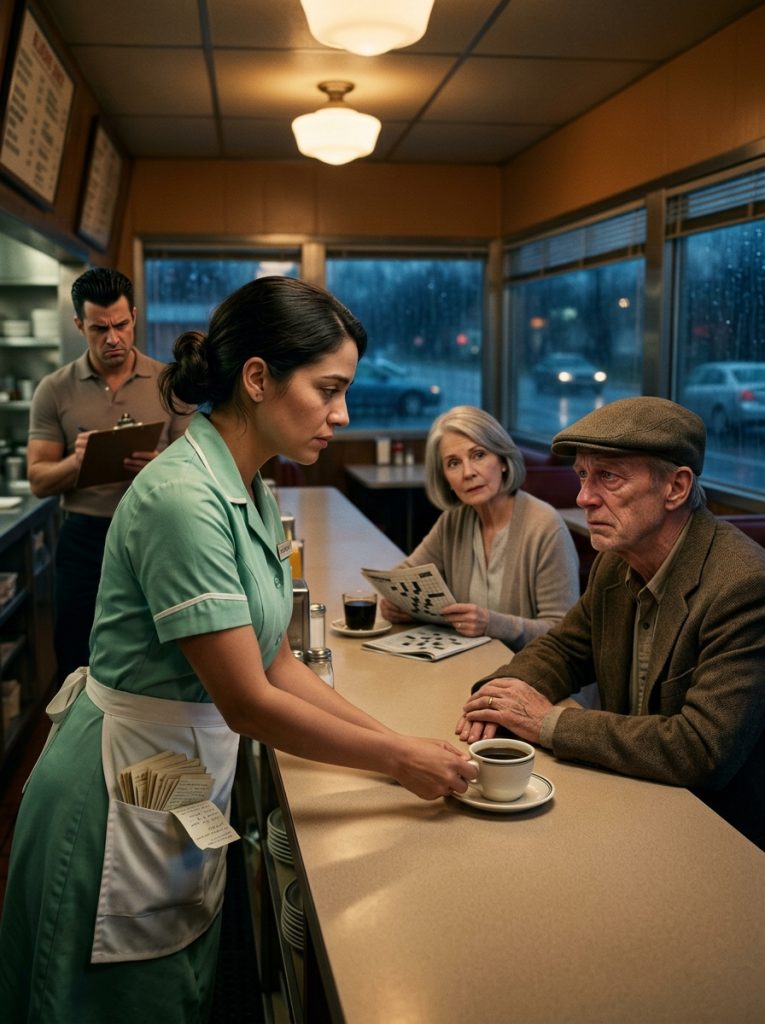
Harlan Pike’s hands were still shaking when the quiet woman from the end of the counter reached our booth.
I’d just sat down across from the man who’d tormented me for a year, and he’d just said the word please for the first time. The whole diner felt like it was holding its breath.
“Rosie,” Harlan said. His voice cracked on my name. “I need to tell you something, and I need you to let me finish, because if I stop I won’t start again.”
I nodded. I didn’t trust my own voice.
“My wife’s name was Ruth,” he said. “We came to this diner every morning for thirty-one years. That booth. That window. She always ordered the eggs runny and I always told her they’d make her sick, and she always ate them anyway just to spite me.” A small, broken laugh. “She passed two years ago. In the spring. And I kept coming because I didn’t know how to start a morning without this booth.”
My eyes were already burning.
“You came along right after,” he said. “Young. Kind. You’d refill her — I mean, you’d refill my coffee and call me ‘hon,’ the way she used to, and I hated it. I hated that you were here and she wasn’t. I hated that the world just kept turning. So I made you the place I put all of it.” He looked down at his shaking hands. “Every cruel thing I said to you, I was really saying to God for taking her. You were just the only one who kept showing up.”
The diner was dead silent. Even the griddle seemed to have stopped hissing.
“That’s not an excuse,” Harlan said. “There is no excuse. A grieving man is still a man, and I was a coward, and I took it out on a girl who never gave me anything but patience. I’m sorry, Rosie. I’m so sorry.”
I reached across the table and put my hand over his. He flinched, then held on like he was drowning.
“I forgive you,” I said. And I meant it. Not because he’d earned it. Because I was tired of carrying it.
That’s when Eleanor Voss spoke.
“Rosie,” she said gently. “Could you ask Brett to come over here? And bring your apron.”
I blinked at her. The lonely lady with the crossword. “Ma’am?”
“Humor an old woman,” she said, and there was steel under the softness.
Brett came over already irritated, clipboard in hand. “Ma’am, is there a problem with your order?”
Eleanor stood. She set a small leather card holder on the counter and opened it.
Brett looked at it.
And every drop of color drained out of his face, the same way it had drained out of Harlan’s a moment before.
“Eleanor Voss,” she said pleasantly. “I own the Bluebird. All nine of them. Including the paycheck that’s been signing yours, Brett.”
The clipboard slipped in his hands.
“I like to eat in my own diners,” she went on. “Quietly. No announcement. You learn things about a restaurant that no manager’s report will ever tell you. You learn it from the floor. From the booths. From watching how the people with the least power get treated by the people with the most.”
She turned to me. “Rosie, may I see your apron?”
My hands were trembling as I untied it. I’d forgotten, in everything, how stuffed that pocket was.
Eleanor took it and gently emptied the pocket onto the counter.
Notes. Dozens of them. Folded napkins, the backs of receipts, a child’s drawing of a little sun. A whole year of strangers’ kindness spilling across the chrome.
“Read one,” Eleanor said to Brett.
He swallowed. He unfolded the nearest napkin. His voice came out thin. “‘Don’t let him dim you, kid.'”
“Another.”
“‘You handle that man with more grace than he deserves. We see you.'”
“One more.”
His hand was shaking now. “‘Best server in Ohio.'”
Eleanor let the silence sit.
“In six months of sitting at that counter,” she said, “I watched you write Rosie up for the crime of being kind to a man who was cruel to her. I watched you tell her the customer is always right while the customer called her slow and stupid in front of children. And I watched her square her shoulders, reach into this pocket full of proof that she is loved, and go do her job anyway.” She tilted her head. “Tell me, Brett. In all those mornings — did you ever once defend her?”
He didn’t answer. He didn’t have to.
“You’re not fired,” Eleanor said. “That would be too easy, and you’d learn nothing. You’re going to spend the next month working every position in this diner. Dish pit. Bussing. The 5 a.m. open. You’re going to find out what it feels like to be on your feet for nine hours being treated like furniture. And then we’ll talk about whether you understand what this job actually is.”
Brett nodded, mute, and went to go re-learn how to be a person.
Then Eleanor turned to me, and her whole face changed. Softened.
“I’ve been looking for someone to manage a new location,” she said. “A real manager. Not someone who counts bathroom breaks. Someone who understands that a diner isn’t a building, it’s the people inside it, and how you treat the ones who can’t do anything for you is the only test that ever mattered.” She smiled. “You passed it every single morning, and you didn’t even know you were taking it.”
I started crying right there at booth six. The good kind, finally.
“The pay is nearly double,” Eleanor said. “You’ll hire your own staff. And the first rule you’ll teach them is the one you already live by.” She gestured at the pile of notes on the counter. “That one.”
Harlan Pike was crying too, by then, dabbing his eyes with a paper napkin and not caring who saw.
“She’s the best thing about this place,” he told Eleanor, fierce and wet-eyed. “You take care of her, you hear me?”
“I intend to,” Eleanor said.
Here is what happened after.
I took the job. Of course I took the job.
But I made one condition, and Eleanor agreed to it before I even finished the sentence.
Every Bluebird now keeps a jar by the register. We call them Ruth’s Notes, though most customers don’t know why. If you see a server having a hard day — being yelled at, being talked down to, being treated like they don’t matter — you can write them a note and drop it in. At the end of every shift, they take their notes home.
Because I know exactly how much a stranger’s folded napkin can weigh against a cruel man’s words. I carried a year of them in my apron. They are the reason I didn’t quit. They are the reason I was still standing when the woman who owned everything finally stood up.
Harlan still comes in every morning. Booth six. The window.
But now he orders the eggs runny.
For Ruth.
And he tips. Every single day, he leaves a tip and a note in the jar, and I’ve never once read what he writes, because some things between a man and the wife he lost are nobody’s business but theirs.
Brett finished his month. He cried in the dish pit on day three and apologized to me on day nineteen, and it was clumsy and real, and I accepted it. He’s an assistant manager now at the airport location, and the servers there say he’s the first one to step in when a customer crosses the line.
People change. Not all of them. But more than you’d think, if somebody gives them the room to.
On my first morning as manager of the new Bluebird, I tied on a fresh apron, and the pocket was empty and flat, and for a second it made me sad.
Then the bell over the door rang at 7 a.m., and an old man I’d never met came in looking lost and tired, and I poured him a coffee and called him hon and slid it across the counter to him for free.
And I thought: this is how the pocket fills back up.
One cup at a time.