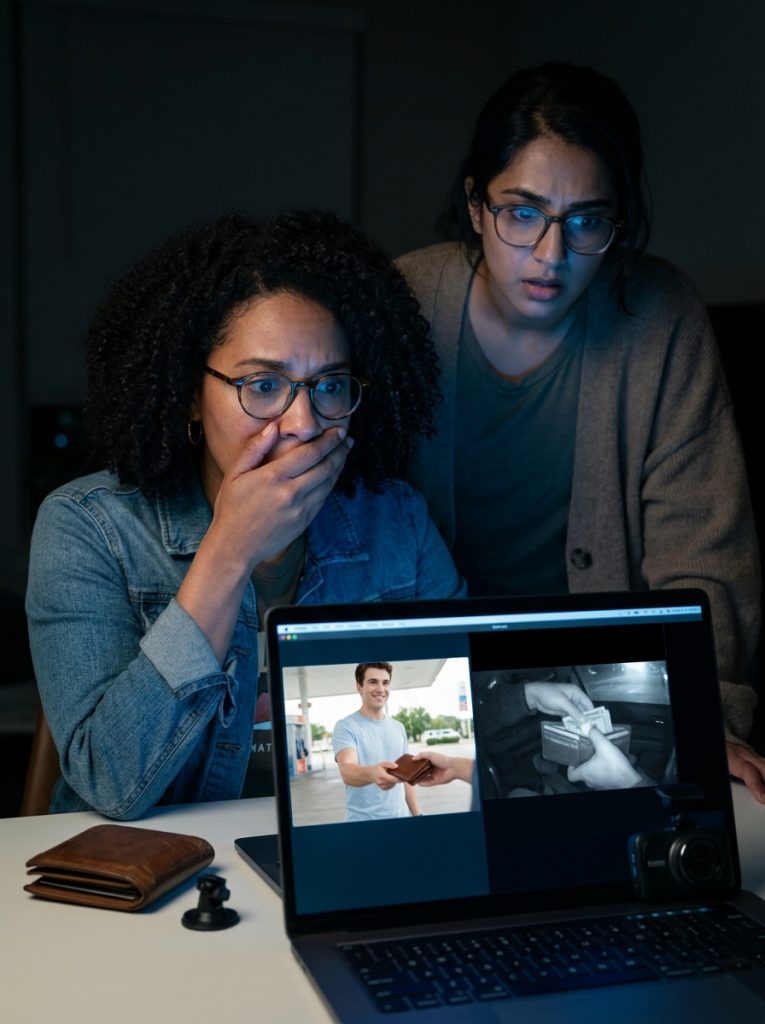
I sat on my apartment floor at midnight with two video windows glowing on my laptop, and for the first time all day, I wasn’t the one who should be afraid.
His lie had three million views. My truth had a timestamp.
Priya wanted me to post it immediately. Blast it everywhere. Tag him, tag the brands, set the whole thing on fire.
I almost did. My thumb was over the button.
Then I made myself stop and think like the designer I am instead of the angry person I’d become by four o’clock.
Because here’s what I knew about Tyler Cross by then, after a day of being his villain. He was good at the story. Better than me. If I came out swinging — ranting, crying, accusing — he’d spin it in an hour. “Jealous woman edits a fake video to smear me.” His audience would eat it up. He had a million followers trained to defend him and a face built for the camera. I had four hundred followers and a cat.
So I didn’t rant.
I let the footage do it.
I made one clean post. No screaming caption. Just the facts, the way you’d present evidence.
On the left: his polished, three-million-view “good deed” video, the one where he holds my wallet up to the light and talks about how some people would just keep it, but that’s not who he is.
On the right: my dashcam. Same parking lot. Same minute. Tyler Cross picking my wallet up off the ground, opening it, glancing around, and sliding my rent money into his own pocket — before he ever turned the camera on himself.
I synced them so they played side by side. His mouth saying “that’s not who I am” while his hand, in the other window, showed exactly who he was.
My caption was four words.
“He took the cash.”
Then I went to bed, because there was nothing left to do, and I figured maybe a few hundred people would see it.
I woke up to my phone vibrating itself off the nightstand.
The split-screen had done in nine hours what his polished lie took all day to do. It passed his view count by breakfast. By noon it had been reshared by one of those big accounts that exists to catch exactly this kind of thing. By evening, “He took the cash” was a comment people were leaving under every video Tyler had ever made.
And once people started looking, his whole shelf of good deeds started falling off the wall.
That’s the part I didn’t expect. I just wanted my three hundred dollars and my name back. But the internet, once it smells a staged saint, gets thorough.
The “homeless man” Tyler had famously bought a meal for on camera? Came forward to say Tyler paid him forty bucks to act, took the meal back after filming, and kept it. The “surprise” he threw for a struggling single mom? Her real story didn’t match his video at all; he’d inflated her hardship and pocketed most of the “fundraiser.” The tearful tip he’d left a waitress in a viral clip? She said he asked for it back in the parking lot the second the camera stopped.
One by one, they posted. Some of them had been carrying it for over a year, sure no one would believe them over a man with a million followers.
My little timestamp gave them all permission.
I started getting messages from them. Not the public posts — private ones. Thank-yous. The woman who’d been the “struggling single mom” in his video wrote me three long paragraphs about how used and silenced she’d felt for a year, how her own kids had asked why the nice man on the phone made their lives sound so much sadder than they actually were. I cried reading it. I hadn’t done any of this for them. I’d done it for my rent money and my own name. But somehow it had unlocked a door for a dozen people I’d never met. That’s the strange math of the internet. The same machine that crowns a fake saint can free all of his witnesses overnight — if you hand it the right four seconds of truth.
The brand — the one about to sign him for a campaign about “everyday heroes” — pulled out by the end of the week. Then the other sponsors. Then his management company put out one of those careful statements about “no longer representing.” His follower count, which he’d treated like a force field, started dropping by the tens of thousands a day.
He tried to do the thing I knew he’d try. The tearful apology video. Sitting in soft light, voice cracking, talking about his “mistakes” and his “growth.”
But somebody leaked the outtakes. The takes between sobs, where he checked the framing and asked his editor if the lighting made him look sincere enough. The internet had already learned how he worked, and the apology died the same day it posted.
Here’s the part I’m proudest of, and it’s not the views.
The police got involved once the video spread, because what he’d done — taking the cash, then filming a fraudulent good-deed video around the theft — was, it turns out, a real crime and not just an internet sin. I filed a report. So did two of the others. Tyler returned my three hundred dollars through a lawyer, with a typed apology so obviously written by someone else that Priya and I read it out loud in funny voices.
I didn’t keep the money.
I’m not saying that to sound noble. I just couldn’t look at it without feeling sick. So I donated it — all three hundred — to a real organization, the actual kind that actually feeds actual people, the kind Tyler had only ever pretended to be. I posted the receipt. No face. No ring light. Just the receipt.
That post has eleven likes. It’s my favorite thing I’ve ever made.
People ask if I feel bad about what happened to him. His career, his sponsors, all of it.
I think about that honestly, because I don’t enjoy ruining people, even people like him.
But I keep coming back to this: I didn’t ruin Tyler Cross. I filmed a parking lot, and he ruined himself in front of my dashcam, and then he spent a whole day calling me a liar to a million people to cover it up. The footage didn’t lie. He did. All I did was put the two side by side and let people decide which one to believe.
They decided.
Tyler’s gone quiet now. The accounts are mostly dead. Last I heard he’d moved cities and was trying to start over under a slightly different name, which — good luck, the internet has a long memory and an excellent search function.
I went back to my regular life. Four hundred followers. A cat. A job I like. I never wanted to be internet-famous, and I’m relieved I’m not.
But I did make one change.
The dashcam stays in the car, obviously. It’s earned its place.
And on the rare day I catch myself wanting to do something kind so other people will see it — post the donation, film the good deed, perform the decency — I stop. I think about a man holding a wallet up to a ring light, narrating his own goodness while his other hand committed a crime.
And I do the kind thing quietly instead.
Because I learned something for three hundred dollars and a viral week I never asked for.
The people who announce how good they are, and the people who actually are, are almost never the same person.
The camera can’t tell the difference.
But a dashcam, pointed at the truth and left running, always can.