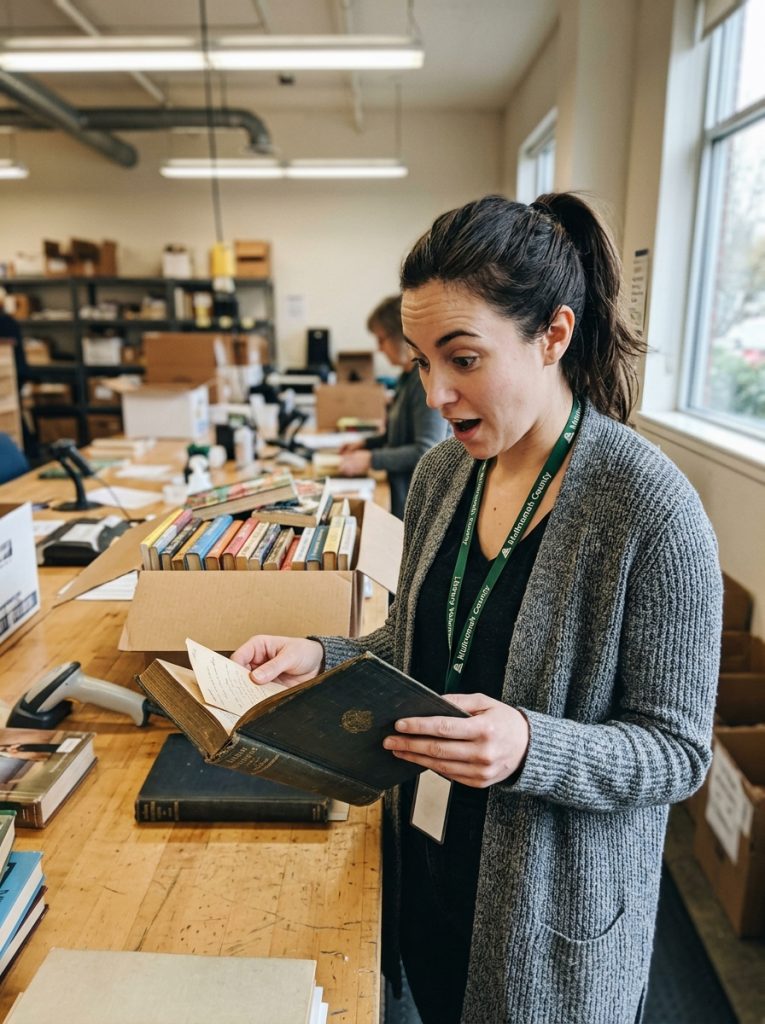
The head librarian’s name was Marianne Choi.
She took the 1987 checkout card from my hand, turned it over twice, and said, “I’ve seen this handwriting before.”
We were standing in her office — a glass-walled room at the back of the main floor, surrounded by shelves she’d built the collection on for fourteen years. Marianne is 56, meticulous, the kind of librarian who remembers patron requests from three years ago. She sat down at her computer and pulled up the library’s donor management system.
“The literacy scholarship fund,” she said. “We’ve received anonymous gifts for twenty-two years. Small amounts mostly — two hundred, five hundred, sometimes a thousand at year-end. Always cash or money order. Always with a note in the same handwriting.”
She opened a scan folder. Notes — dozens of them — all on the same cream-colored stationery cards. All signed the same way: A Friend.
The handwriting matched the card I’d found in the first-edition book. Precise. Unhurried. Capitals for names, lowercase for everything else.
“Vogt,” Marianne said, tapping the 1987 card. “E. Vogt. Let me search the patron database.”
She typed. Waited. Clicked twice.
“Edmund Vogt. Active library card. Last renewal — ” she paused. “Three months ago. Address: 1847 SE Hawthorne Boulevard, Unit 4.”
Two blocks from the library.
Marianne looked at me. I looked at her.
“Twenty-two years,” she said. “And he lives two blocks away.”
We sat with that for a while. I went back to my processing table and finished the Saturday shift but I could not stop thinking about it — a man who had been giving to this library for longer than I had been alive, who lived close enough to walk here in four minutes, who had never once come to a scholarship ceremony or put his name on anything.
Marianne made some calls that week. She contacted the fund administrator and asked for a full accounting of anonymous gifts over two decades. The total was $47,600 in cash donations — enough to have partially funded twelve student tuitions over the years. And now, with the three first-edition books appraised at $180,000, the fund had more than tripled overnight.
The following Saturday, Marianne asked me to come in early. She’d sent a letter — handwritten, on library stationery — to 1847 SE Hawthorne, Unit 4. The letter said simply: We know who A Friend is. And we would like to say thank you, in person, if you’re willing.
He came.
Edmund Vogt walked into the Multnomah County Public Library at 10:17 on a Saturday morning in November. He was 81. Plaid flannel shirt, thick bifocals, a worn brown leather satchel over one shoulder that looked like it had been carried daily for decades. He was small — shorter than I expected — and he moved slowly, with the careful steps of someone whose joints remind him of gravity every morning.
He walked up to the circulation desk and said, “I received a letter.”
Marianne came out of her office. She shook his hand and led him to the reading room — the one with the skylight and the long oak table that the library uses for community events.
I was already there. So were three other people: Jasmine Trần, 24, a nursing student whose first-year tuition had been covered by the literacy scholarship in 2020. Marcus Adeyemi, 28, a high school English teacher who had received the fund’s book grant in 2016. And Delia Ortiz, 22, a community college graduate whose GED prep materials had been funded by the scholarship the year she turned nineteen.
They had been contacted by Marianne earlier in the week. They knew only that they were coming to meet the anonymous donor who had funded their educations.
Edmund stopped in the doorway.
He looked at the three of them — Jasmine in her scrubs from a morning clinical, Marcus in his teacher’s blazer, Delia with her community college pin on her jacket — and he took off his glasses and pressed the heel of his hand to his eyes.
Marianne said, “Edmund. These are three of the twelve students your donations have supported over the past twenty-two years.”
He didn’t speak for a long time.
Then he said, “I was a teacher. Forty-one years. Middle school English. I retired in 2004.”
He put his glasses back on.
“When I retired, I had a pension and a studio apartment and more books than I knew what to do with. I didn’t have children. I didn’t have — ” he paused. “I had students. Hundreds of them. Over four decades. And the thing I learned, teaching, is that the kids who need the most are the ones who ask for the least.”
He looked at Jasmine.
“I never wanted anyone to know because I didn’t want the gratitude. I wanted the books to do the work. I wanted the fund to keep going without my name on it because names make things complicated. People start wanting to meet you. People start expecting you to be something.”
He sat down at the oak table.
“I’m just a man who reads,” he said. “And who knows what a book can do for a kid who doesn’t have one.”
Jasmine was crying. She wasn’t quiet about it — she was the kind of person who cries openly and without apology. She stood up and walked around the table and hugged Edmund from behind, both arms around his shoulders, her face pressed into the plaid of his flannel shirt.
He patted her hand. He said, “Oh. Okay.”
Marcus said, “Sir, I teach The Outsiders every year to my eighth graders because of a book grant I received from this fund when I was twenty. That book changed my life.”
Edmund said, “S.E. Hinton. She was sixteen when she wrote it. Sixteen.” He shook his head. “Books written by young people for young people. That’s what I always funded.”
We stayed in that reading room for two hours. Edmund told stories from his teaching years. He asked each of them about their work, their lives, their reading habits. He was curious in the way of someone who has spent eighty-one years paying attention to other people.
When he left, he stopped at the circulation desk and returned three books from his satchel. Each one had a small handwritten note tucked inside the front cover — a recommendation for the next reader.
He’d been doing that for decades. Notes inside returned books. Unsigned.
The scholarship fund was renamed the Edmund Vogt Literacy Fund in January. Edmund attended the ceremony. He wore the same plaid shirt. He did not make a speech. He sat in the back row and clapped for the new recipients and then he walked home — two blocks, four minutes, back to his studio apartment with the shelves full of books he would eventually give away.
I still volunteer on Saturdays. And every week, when I open the donation box, I check the bottom corners.
Not for first editions. For notes.
Because I know now that the most generous people in the world don’t sign their names.
They just show up. Quietly. For decades.
And they let the work speak.
I saw Edmund one more time after the ceremony.
It was a Saturday in February — a cold morning, rain on the windows of the processing room. I was sorting donations as usual. A grocery bag this time, mostly children’s books from the nineties, dog-eared and loved.
Edmund walked in at his usual time — 10:15, leather satchel, bifocals, three books to return. He set them on the circulation desk. He nodded at me through the glass partition of the processing room.
I nodded back.
He walked to the stacks. Third floor. Fiction, L through M. His usual route.
I went back to sorting.
And inside each of the three books he returned — tucked into the front cover, as always — there was a small handwritten note. Not signed. Not addressed.
Just a recommendation. A sentence about why this book mattered. A bridge from one reader to the next.
He’d been building those bridges for decades. One note at a time. One reader at a time. One quiet Saturday morning at a time.
No name. No recognition. No audience.
Just a man who reads. And who knows what a book can do.
The scholarship fund has distributed $230,000 in its first year under the new structure. Four students this year. Full tuition. They’ll never meet Edmund unless they come to the library on a Saturday morning and happen to see an old man in a plaid shirt returning books.
But his name is on the fund now. And his story — the story of twenty-two years of quiet generosity — is part of this library’s permanent collection.
Not on a shelf.
In the people it built.