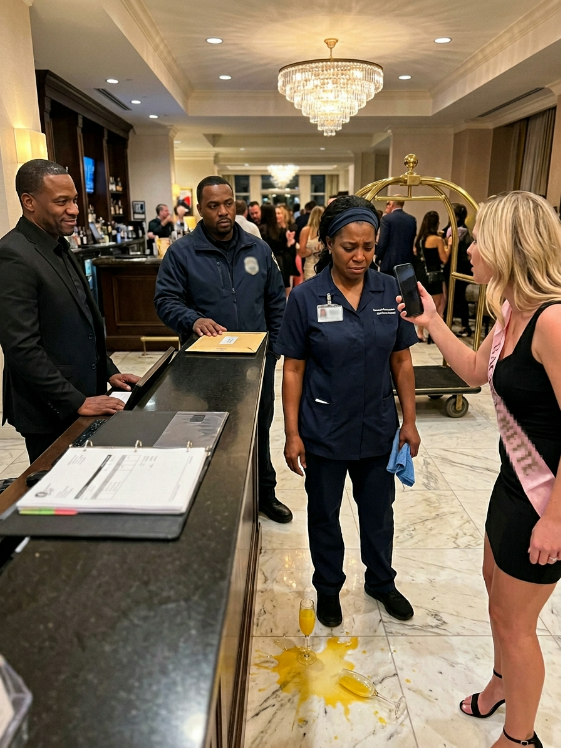
I did not apologize.
That was the first break in the role.
For three weeks, I had lowered my eyes when Calvin wanted lowered eyes. I had said yes, sir when he needed to feel tall. I had cleaned the same lobby corners twice because he liked giving orders in front of guests.
But with Tessa Lane’s phone pointed at my face and the locked envelope under Omar’s hand, I stood up straight.
Calvin noticed before anyone else did.
His smile flattened.
“Renee,” he said, warning tucked inside my first name. “The guest is waiting.”
Tessa laughed.
“Yeah, Renee. Louder this time.”
The lobby bar went still in that ugly, excited way rooms get when people sense humiliation might become entertainment.
I folded the cleaning cloth once.
Then again.
I placed it on the edge of the bar.
“No,” I said.
One word.
Not loud.
It did more than shouting would have.
Tessa’s phone dipped.
Calvin stepped toward me.
“Excuse me?”
I looked past him to Omar.
Omar slid the locked envelope across the front desk. The sound of paper against stone carried farther than it should have.
Calvin’s eyes followed it.
There are moments when a guilty person recognizes an object before the room understands why it matters. Calvin recognized that envelope. Not because he had seen that exact one, but because men like Calvin know the shape of consequences.
I walked to the desk.
Tessa kept filming.
For once, I was grateful.
“Mr. Moss,” I said, using his title because titles matter when they are about to collapse, “I am ending the special audit test at Harbor Gate Hotel as of 9:42 p.m.”
Someone at the bar whispered, “Audit?”
Calvin’s face changed color.
He recovered quickly.
“This is ridiculous. You are housekeeping staff.”
“Tonight I am,” I said.
Omar opened the envelope with a small brass key from his pocket. Inside were two things: my corporate authorization letter and an emergency access freeze order signed by the regional compliance director.
I had read them before the shift started.
Still, seeing them on the desk made my hands tremble.
Not from fear.
From the relief of no longer pretending.
Calvin reached for the vendor binder.
Omar moved first.
He did not grab Calvin. He did not need to. He simply stepped between Calvin and the counter with the calm bulk of a man who had worked hotel security long enough to know that blocking a reach is often better than stopping a fight.
“Do not touch hotel records,” Omar said.
Calvin laughed once, but no one joined him.
I took out my phone and called the regional director on the number we had prepared.
She answered on the second ring.
“Carter.”
“Audit test ended,” I said. “Manager attempted to direct guest harassment of undercover staff. Vendor binder secured. Witnesses present.”
Calvin said, “You cannot do this in my lobby.”
The regional director heard him.
“Tell Mr. Moss his access is frozen. IT is locking his accounts now.”
I repeated it.
That was the moment his confidence finally cracked.
He pulled out his phone, jabbed at the screen, and tried to log in to the management portal. The little spin of failure on his face was almost quiet.
Almost.
Tessa lowered her phone completely.
“Wait,” she said. “Are you actually corporate?”
I looked at her.
For a second, I wanted to be cruel. I wanted to tell her exactly what kind of woman points a phone at a worker and demands a louder apology.
Instead, I said, “You recorded the manager instructing a staff member to accept public harassment. Do not delete it.”
She went pale.
Advertisement
“I was just joking.”
Every person who has worked service has heard that sentence.
It usually arrives right after the harm becomes inconvenient.
I turned back to the binder.
Omar put on gloves from the security drawer. He slid the vendor invoice binder into a clear evidence bag while Calvin protested that those were confidential management files.
“They are hotel records,” I said. “And corporate owns the hotel records.”
The lobby doors opened, and two people from regional finance walked in. They had been waiting in the parking garage for my signal. Calvin saw them and stopped talking.
That silence was better than an apology.
We moved the binder, the envelope, and the front desk access logs into the small conference room behind the business center. Calvin was instructed to surrender his keys and remain available for questioning. He refused until the regional director got on speaker and told him refusal would be treated as abandonment of position.
He handed the keys to Omar.
Not to me.
I noticed.
Omar did too.
“Ms. Carter is lead audit on site,” Omar said. “Hand them to her.”
For the first time since I had arrived at Harbor Gate, Calvin had to place something in my hand.
The keys were warm from his palm.
The investigation did not end that night. People always want the dramatic moment to be the finish, but audits do not work that way. Audits are receipts, dates, duplicate invoice numbers, payroll exports, witness statements, and patient repetition.
By 2 a.m., we had confirmed three duplicate vendor payment streams.
By 5 a.m., we had found the service-fee diversion.
Housekeeping had been charged guest recovery fees after complaints Calvin encouraged guests to make. Then those fees were routed into a discretionary account tied to vendor rebates.
In plain language, he had found a way to make workers pay for the disrespect he allowed.
That was the line that made me leave the conference room and cry in the service hallway.
Not the kickbacks.
Not the binder.
The service fees.
The fact that women making beds on swollen ankles had lost money because Calvin trained the hotel to treat them as blameable.
Omar found me there and handed me a paper cup of water.
“You got him,” he said.
I shook my head.
“Not enough.”
He nodded like he understood.
Two weeks later, Calvin Moss was removed for cause. The official letter used cleaner words than he deserved: vendor irregularities, payroll manipulation, hostile service culture, breach of management duty.
The staff used shorter words.
Gone.
Corporate issued back pay to housekeeping and front desk staff for the stolen service fees. Some checks were small. Some were not. One housekeeper named Lidia opened hers in the break room and sat down hard because it covered two months of her daughter’s therapy copays.
That was the moment the audit felt real.
Not when Calvin lost his keys.
When Lidia stopped apologizing for crying.
Tessa’s video became part of the evidence. She tried to delete it the next morning, but her own group chat had already saved a copy. Her apology email arrived three days later, full of phrases like bad judgment and not who I am.
I did not respond.
The video responded for her.
Harbor Gate changed managers, but more importantly, it changed rules. Guest complaints involving staff conduct had to be reviewed with video and witness context before fees touched payroll. Vendor binders moved to shared digital review. Housekeeping got a direct anonymous line to regional compliance.
On my last day at the hotel, I put the navy housekeeping uniform in a laundry bag and clipped my real badge back onto my blazer.
Omar walked me to the lobby doors.
The marble floor was spotless.
A new housekeeper passed us pushing a cart. She looked at me, then at Omar, unsure whether to step aside.
I stepped aside first.
That mattered to me.
Outside, the Baltimore morning was cold and bright. I stood on the curb with the corporate badge heavy against my chest and the memory of the housekeeping badge still pressed into my skin.
Power is not proven by who gets the apology.
Sometimes it is proven by who never has to beg for one again.