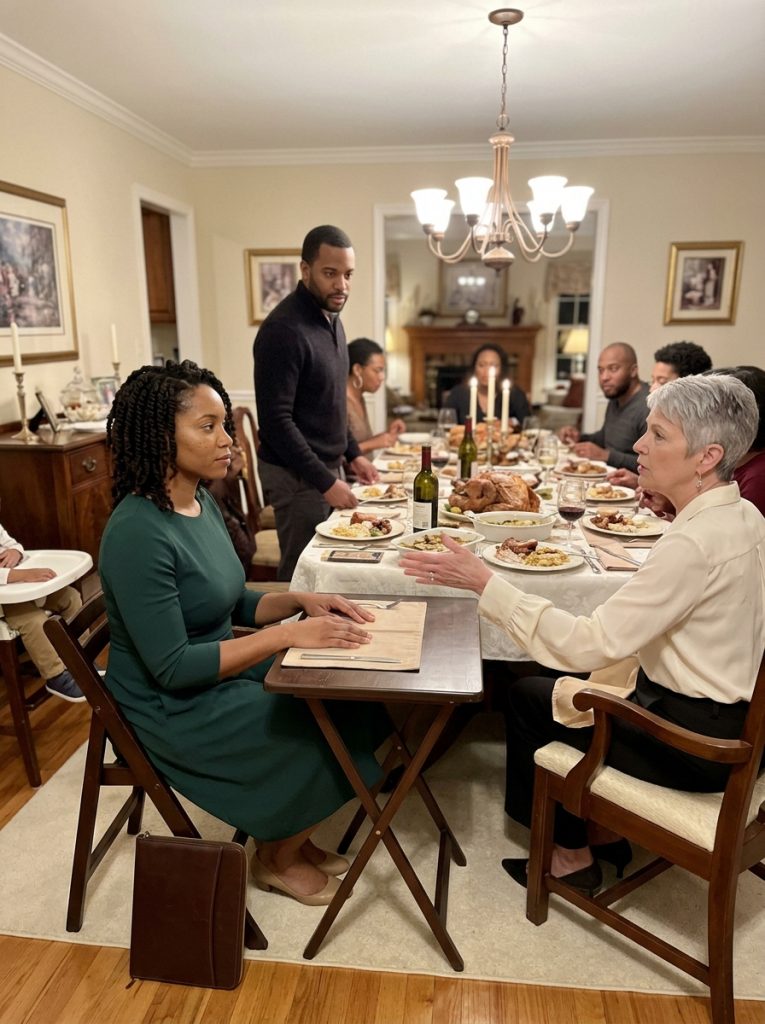
I want to be honest about something before I tell you what I said. I had imagined this moment for years. In my imagination, it was a grenade. I’d reveal the mortgage, watch Carol’s face collapse, and walk out triumphant while the relatives gasped.
But standing there in that quiet dining room, with a six-year-old looking up at me and my husband frozen over his turkey, I realized I didn’t actually want a grenade. I wanted the truth in the room, and I wanted my dignity back. Those aren’t the same as revenge, and I’m glad I knew the difference by the time it counted.
“Two years ago,” I said, keeping my voice even and kind, “this family almost lost this house. The investments Dad left behind didn’t hold. You were sixty days from foreclosure, Carol.”
Carol’s smile flickered. “That’s not — we refinanced—”
“There was no refinancing,” I said gently. “There was me.”
I opened the folio and set the documents on the main table — not thrown, not brandished, just placed, where anyone could look. The note on the house. Two years of payments. My name.
“I bought the note so you wouldn’t lose your home,” I said. “I’ve carried this mortgage for two years. Quietly. I never told anyone because I didn’t do it for credit. I did it because Dev loves this house, and because I thought that’s what family does — you catch each other when you’re falling, even the people who never learned your name.”
You could have heard a pin drop. Dev’s head came up slowly. He looked at the papers, then at me, and I watched five years of his shrinking begin, finally, to reverse.
Carol’s mouth opened and closed. Her sister, Aunt Pat, leaned over and read the top page, and I saw the exact moment the truth landed on her face. The whole table was reading now. The mother who “built this family” and “decided who belonged” had been kept in her bragged-about home for two years by the daughter-in-law she sat at the kids’ table.
“I’m not telling you this to take anything from you,” I continued, before anyone could turn it into a fight. “The house is yours, Carol. It always was, to me. I’m not going to hold it over your head, or evict anyone, or make a single Thanksgiving toast about it ever again. That’s not who I am.”
I closed the folio.
“But I’m done pretending. I’m done with the folding chair. Not because of the chair — I could sit on the floor and be happy with people who love me. I’m done because for five years this family has treated me like a guest on probation while I quietly treated it like my own. And I will not spend a sixth year being told I don’t belong at a table I’ve been holding up the whole time.”
I didn’t wait for Carol to respond. I picked up my plate from the kids’ table, and I started toward the door — not storming, just leaving.
That’s when Dev stood up.
For the first time in our marriage, in front of his mother, my husband found his spine. “Aisha, wait.” He turned to Carol, and his voice shook but it held. “Mom. I’ve let you do this to her for five years because I was scared of you. I’m not anymore. She saved this house. She saved you. And you put her at the kids’ table.” He took a breath. “She’s not sitting there ever again. And if there isn’t room for my wife at this table — the table she paid for — then there isn’t room for me either.”
He picked up his own plate and came to stand beside me.
The room was silent. And then something happened I didn’t engineer and couldn’t have. Aunt Pat stood up, pulled out the chair next to her own at the main table, the best seat in the house, and said, “Aisha. Sit. Here. Where you should have been all along.” Then she looked at her sister and added, not unkindly, “Carol, sit down and eat your dinner. You’ve been served humble pie and it’s the only dish you didn’t cook.”
A few relatives actually laughed. The tension broke like a fever.
Carol didn’t apologize that day. Pride like hers doesn’t turn on a dime. But she sat down. And she was quiet for the rest of the meal, and a couple of times I caught her looking at me with an expression I’d never seen from her before — something like the dawning understanding that she’d spent five years insulting the one person who’d been holding her whole world up.
The drive home that night was the quietest Dev and I had ever been together — not the bad kind of quiet, but the kind where something has shifted and you’re both feeling the new shape of it. Finally he said, “I’m sorry. Five years. I knew it was wrong and I let it happen because standing up to her felt impossible.” I told him the truth: that I’d forgiven the folding chairs a long time ago, but that I’d needed to see whether, when it finally mattered, he’d choose me out loud. He had. Barely in time, but he had.
The family group chat, where I’d been a quiet ghost for five years, lit up that week. Some relatives were uncomfortable — not with how I’d been treated, but with how it had been said out loud, which tells you everything about how families like that work. But Aunt Pat, bless her, posted one message: “Aisha kept a roof over this whole family’s heads for two years and got a card table for her trouble. We should all be ashamed. I am.” Nobody argued with Pat. Nobody ever does.
The apology came later. Weeks later, in her kitchen, just the two of us, awkward and halting and real. “I treated you like a threat,” she admitted, “because you were everything I was afraid of not being. Capable. Independent. Not needing me.” She cried a little. “I’m ashamed of the chair, Aisha. I’m ashamed of all five of them.”
I forgave her. Not all at once, and not because she earned it in a single conversation, but because carrying the grudge was heavier than carrying the mortgage had ever been, and I was tired of heavy things.
We’re not best friends now. I won’t pretend the story ends with us baking together every Sunday. But she learned my name. She uses it. And things are different in a way that matters.
I never asked for the mortgage to be repaid, and I never brought it up again. That mattered to me — I didn’t want anyone, least of all myself, to think I’d revealed it to collect a debt. Eventually Carol and Dev’s siblings arranged, quietly, to take the note back over and pay me out, and I let them, because dignity flows both ways and they needed to do that to stand up straight again. It was never about the money. It was about being seen as family instead of staff.
This past Thanksgiving — the sixth — I walked into that dining room in Naperville, and there was a place card at the main table, in Carol’s careful handwriting.
It said Aisha. Just my name. No “Dev’s wife.”
My niece — one of Dev’s sister’s kids, who’d spent five years watching me get sent to the children’s table — pulled me aside that day. She’s nineteen now. She said, “I always thought it was so wrong, what Grandma did to you. I just didn’t know I was allowed to say anything.” I told her she’s always allowed to say something. That’s the entire point of having a voice.
Sometimes that’s the whole victory. Not the grand house, not the humbled queen, not the grenade I’d imagined for years.
Just your own name, in someone’s handwriting, at the table you always belonged at.