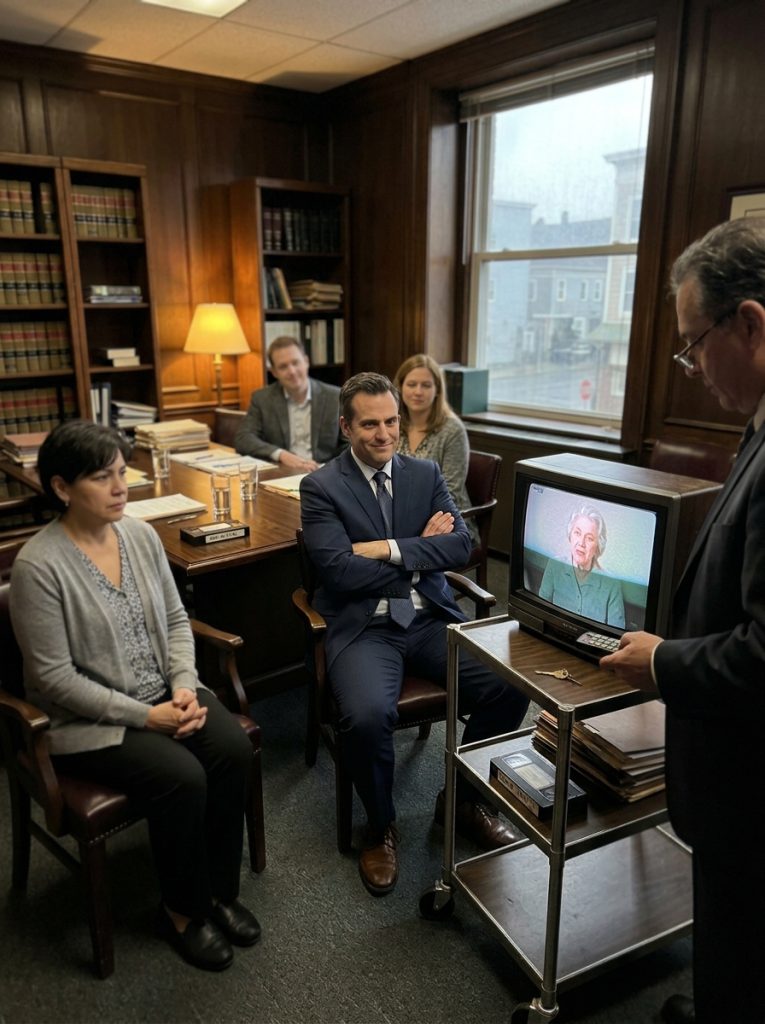
“I want to start with the diner,” Margaret said from the screen, her hands folded on the table just like mine were in my lap. “Because that’s where I spent the happiest hours of my last years, and you should know why.”
The room was silent now. Even Daniel.
“My husband and I built that diner from nothing. When he died, I kept it, and I turned it into the company that paid for all of your lives. Your schools. Your cars. Your weddings. The down payments you never paid back.” A small, tired smile. “I don’t say that to shame you. I say it because I want you to understand the value of what we’re discussing, so that what I do next is perfectly clear.”
She looked, on the tape, slightly off-camera, the way you look at someone you trust to keep filming steady.
“For nine years, I ate dinner alone every night. Except I wasn’t alone, was I, Alma?”
I made a sound I’m not proud of. A kind of gasp. Hearing her say my name from beyond like that.
“There’s a woman in that room named Alma Reyes,” Margaret went on. “She served me coffee for nine years, and somewhere in there she became the daughter I apparently failed to raise. She sat with me. She drove me to my surgeries — the ones none of my children knew about, because none of my children asked. She cut my food when my hands shook. She never once asked me for a thing. Not one dollar. In nine years.”
Daniel’s face had gone the color of paper.
“My children, on the other hand,” Margaret said, and now her voice had the steel I’d only heard her use on bad days, “visited me when they needed money and vanished when they didn’t. I forgave it for a long time. I told myself I’d raised them wrong and it was my fault. But dying clarifies things. And I’ve decided I’m done paying for affection I should have been given for free.”
She took a breath. You could hear how it cost her.
“So. The diner — the building, the business, the company it grew into — I leave in its entirety to Alma Reyes.”
I don’t remember the room’s reaction because I couldn’t hear anything over the roaring in my own ears.
“Alma,” Margaret said, looking right out of the screen at me, as if she’d known exactly where I’d be sitting. “I know you. I know your first instinct is to refuse this, to say it’s too much, that you don’t belong. Stop it. You belonged at my table when no one else would come. You belong here too. Run it the way we always talked about. Keep the booth by the window. And take a salary that lets you stop standing on those feet you’ve worn out being kind to people.”
Then she addressed her children, and her voice softened into something worse than anger — disappointment, and under it, a terrible, patient love.
“To my children, I leave the house, divided equally, and the contents of my savings, divided equally. It’s a great deal of money. More than you deserve and less than you expected, which feels about right.” A pause. “Daniel. My eldest. I imagine you’ve already said something cruel to Alma since walking in. You always did lead with your worst. I’m leaving you exactly the same as your siblings, no more and no less, and I want you to sit with the fact that the woman who poured my coffee earned more of my trust in nine years than you earned in forty-six. Not because I stopped loving you. Because I finally stopped letting you mistake my love for a bank.”
Greg paused the tape there, gently, to let us breathe.
The brass key on the table — I understood now what it was. The key to the diner. To my diner.
Daniel stood up so fast his chair scraped. “This is insane. She was clearly not competent. A waitress? We’ll contest this. Greg, you know we’ll contest this.”
Greg took off his reading glasses, slow and calm. “Margaret anticipated that too, Daniel. She recorded a full competency evaluation with two physicians the same week as this tape. She had me draft the documents with three independent witnesses. She spent her last good month making this airtight specifically because she knew you’d say she was crazy rather than admit she was disappointed.” He set the glasses down. “She wasn’t crazy. She was clear. There is nothing to contest.”
Daniel sat back down. For the first time since I’d known of him, he had nothing smooth to say.
I want to tell you I felt triumphant. I didn’t. That’s the part I keep trying to explain to people who hear this story and want it to be about a waitress getting rich and a rich man getting humbled.
Mostly, I felt grief. Because the woman who saw me — really saw me, when I was just “the help” to her own son — was gone, and no diner could bring her back. I’d have given the whole building for one more dinner in that booth.
But I also understood, sitting there, that this was Margaret’s last wish, and that refusing it would be the one way to truly let her down. She didn’t leave me a business. She left me a way to stop being invisible. She’d spent her dying weeks making sure the world couldn’t take it away from me the way the world takes things from women like me.
So I kept it.
The decision to keep it didn’t come easy. For a week I lay awake feeling like a thief, like the family would be right to hate me, like I’d somehow stolen a mother’s estate just by being kind to her. I called my own daughter and asked her what to do.
“Mom,” she said, “that woman spent her last weeks making sure nobody could take this from you. If you give it back out of guilt, you’re not being humble. You’re telling her she was wrong about you. Is that what you want her last act on this earth to be — being wrong about the one person who actually showed up?”
That settled it. Margaret hadn’t been wrong about much in her life. I wasn’t going to make her wrong about me.
I run the diner now. Margaret’s booth by the window has a little brass plaque on it and a fresh flower every day, and no one but me ever sits there. I gave half the staff raises the first month. I hired two foster kids aging out of the system because Margaret always said the diner should be a place for people the world overlooks.
Daniel and his siblings got their money. I hear he went through his share faster than anyone expected. He came into the diner once, months later, quiet, and sat at the counter. I poured him a coffee and didn’t charge him for it.
“She really loved you,” he said finally, staring into the cup. “More than us.”
“No,” I told him, and I meant it. “She loved you more than anything. She just couldn’t reach you through your hand always being out. That’s not the same as not loving you.”
He left a tip. First time, I’d bet, he ever left one in his life.
Margaret’s other children come in now and then. Time has a way of humbling people, and grief humbles them faster. I always have a booth and a warm cup waiting. She’d have wanted that, too.
I keep the camcorder tape in a safe at the diner. Some nights, after close, when the chairs are up and the lights are low, I play it just to hear her voice say my name.
“You belonged at my table when no one else would come.”
I’ll spend the rest of my life making sure her table is one where the overlooked always have a place. It’s the only tip she ever wanted.