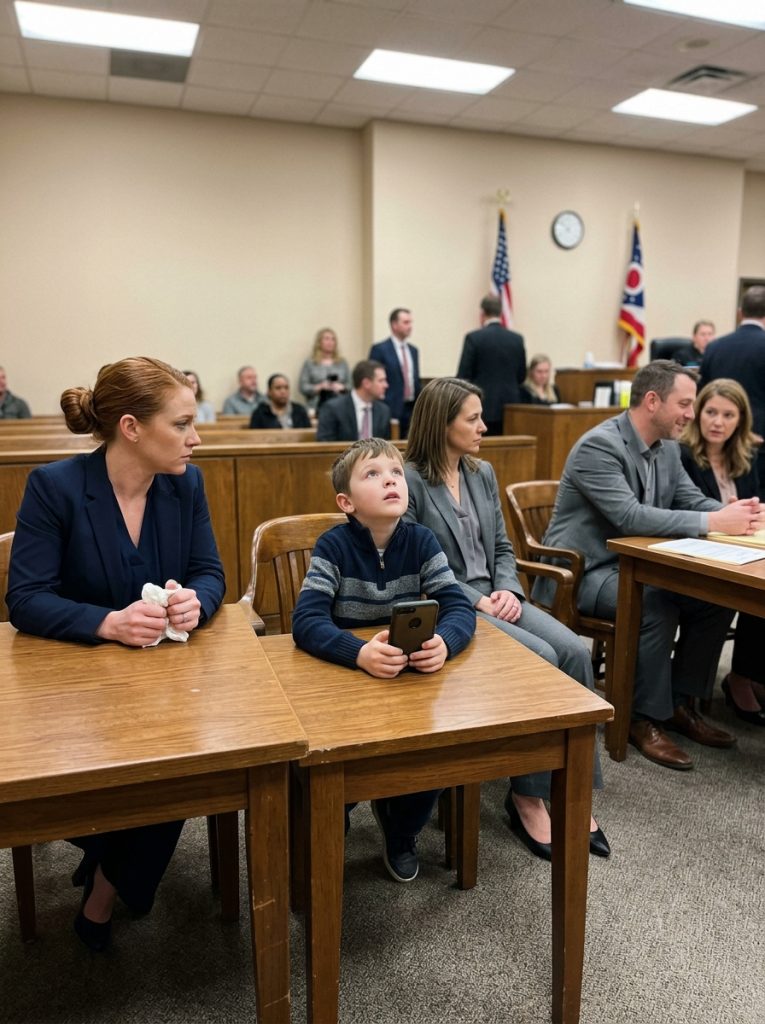
The phone wasn’t dead. It had no cell service, that part was true. But it still recorded. And my son, it turned out, had figured that out months before any of the adults in his life did.
He pressed play and held the phone up toward the bench with both hands, the way you’d hold something fragile.
At first there was just static, the muffled sound of a car. Then Glen’s voice came out of that little speaker, and it was not the patient, sad voice he’d been using all morning.
It was the other voice. The one only Eli and I had ever heard. Low. Flat. The voice that made the air go thin.
“You think your mother can protect you?” the recording said. “If you tell anyone what goes on at my house — anyone — I will make sure she disappears. You’ll never see her again. Is that what you want? Then keep your mouth shut and smile for the nice lady who asks the questions.”
The courtroom did not make a sound.
Then Eli’s small recorded voice, trembling: “I won’t say anything, Dad. I promise. I promise.”
And Glen, again: “Good. Because I can make people disappear, Eli. I’ve done it before.”
Eli took his thumb off the screen. The recording stopped. The silence afterward was the loudest thing I have ever heard.
My son set the phone down on the table very carefully, like it had been heavy to carry, which I suppose it had been. For three months. Three months of holding the one thing that could save us both and being too afraid to play it, because the man on the recording had told him exactly what would happen if he did.
That was the silence the evaluator had written down as “guarded and anxious.” That was the quiet Glen had blamed on me. My little boy hadn’t been poisoned against his father.
He’d been protecting me. With a dead phone and a held breath, for three months, a ten-year-old had been protecting his mother.
I don’t remember standing, but I was standing. The bailiff gently asked me to sit. I sat. I couldn’t stop looking at Eli, who was looking at me now with an expression that broke my heart in half — like he was checking whether he’d done something wrong.
He hadn’t. He’d done the bravest thing I’ve ever seen a person do.
Glen’s lawyer was on his feet, of course. “Your Honor, we have no way to verify when that was recorded, or the context, or whether the child was coached—”
“Counsel.” The judge’s voice had changed completely. The tired kindness was still there, but under it now was steel. “Sit down.”
He sat down.
She looked at Glen for a long, long moment. Glen had stopped leaning toward his lawyer. He had stopped smiling. The charm had drained out of his face, and underneath it, for one second, the rest of us got to see what my son had been seeing for years.
“Mr. Cole,” the judge said. “I have spent thirty years in this courtroom listening to adults explain children’s silence. I have rarely been so wrong about a case at the start of a morning and so certain about it by the end.” She turned to the guardian ad litem. “I want this recording preserved and forwarded to the prosecutor’s office. Today.”
The word prosecutor changed everything. This wasn’t custody anymore. Threatening to make someone “disappear” is not a parenting disagreement.
Glen’s lawyer tried once more. “Your Honor, even if authentic, this could have been a single bad moment, taken out of—”
“Counsel,” the judge said again, and this time she didn’t even raise her voice. “A grown man told a ten-year-old he could make the boy’s mother disappear, that he had ‘done it before,’ and instructed the child to lie to a court evaluator. There is no context in which that becomes a single bad moment. Sit down, and do not stand up again unless I ask you to.”
I looked over at Glen. The mask was fully off now. The charming, patient man who’d been so sad about his unstable ex-wife was gone, and in his place was someone cold and calculating and, for the first time in front of other people, afraid. Because the one thing men like Glen cannot survive is being seen clearly by a room full of witnesses.
What followed happened fast, the way things finally do once the truth is in the room. Glen’s visitation was suspended that morning, pending investigation. The recording, authenticated by its metadata, became evidence in a criminal matter, not just a family one. The careful man who never left a mark had, it turned out, left a mark in the one place he never thought to check — a cheap old phone in the hands of the child he’d terrorized into silence.
Sole custody came to me. The judge said the words and I had to ask her to repeat them because my ears wouldn’t accept them the first time.
I gathered my son in the hallway outside and held him until the bailiff politely pretended he had somewhere else to look.
“I was scared to play it,” Eli whispered into my shoulder. “He said you’d disappear.”
“I know, baby,” I said. “I know you were. And you did it anyway. Do you understand how brave that is? You were braver than every grown-up in that room.”
There was a criminal case after that. I won’t drag you through all of it. Threatening to make someone disappear, coaching a child to deceive the court — those aren’t things that vanish once the custody hearing ends. Glen hired a lawyer who specialized in damage control, and the process was long and ugly, and there were nights I wondered whether dragging Eli through any of it was worth it.
Then I’d watch my son sleep with the light finally off, and I’d remember the three months he’d carried that phone like a stone in his chest, and I’d know that letting Glen’s words stay buried would have taught Eli the exact wrong lesson — that the people who scare you into silence get to win.
They don’t. Not this time. The protective order is permanent. Glen’s contact is supervised and minimal, and only because the court, not I, decided a sliver of a father was better than none. I disagree some days. But it isn’t my call anymore, and honestly, after years of Glen controlling everything, there’s a strange peace in letting the system hold that line instead of me.
We’ve spent the last year putting him back together, gently, with a therapist who is worth every dollar. The phone is gone now — it’s evidence in a file somewhere downtown — but for a while afterward Eli still reached for his pocket out of habit, looking for the heavy thing he used to carry. We replaced the habit with other things. A worry stone. My hand. The knowledge, slowly relearned, that protecting the family is not a ten-year-old’s job.
He talks now. God, does he talk. He tells me about his day in exhausting, beautiful, run-on sentences, and I never, ever interrupt, because for three months I would have given anything to hear his voice.
People ask me sometimes how I won. They assume I had a brilliant lawyer or some piece of leverage.
I tell them the truth. I didn’t win.
My son did. With both hands, in a striped sweater, too small for his age, in front of a judge who finally asked the right person the right question.
All I did was raise a boy brave enough to press play.