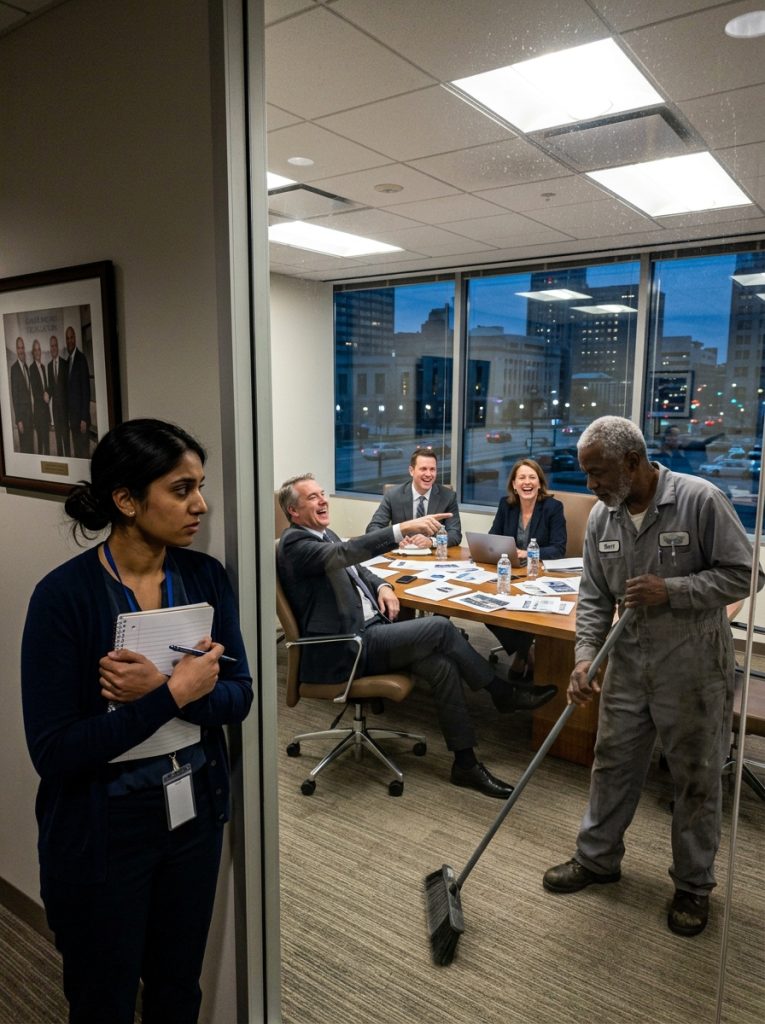
Walter let the silence sit for a moment. He wasn’t nervous. He was the only person in that atrium who wasn’t.
“Most of you know me as the man who empties your bins,” he said. “A few of you say good morning. Fewer say thank you. That’s all right. I didn’t take this shift to be thanked.”
He picked up the badge he’d just set down, turned it over in his fingers, and put it in his pocket.
“Forty-one years ago I started this company in a rented unit off Fifth Avenue with two folding tables and a loan I shouldn’t have qualified for. We made one good product. Then a few more. It grew past anything I dreamed. And about fifteen years ago I did something the board still thinks was a mistake. I stepped back from the corner office and I kept the shares.”
He let that land.
“I kept the shares, and I took a broom, because I learned something running this place. People will tell the boss whatever the boss wants to hear. But nobody performs for the man with the mop. With a broom in my hand, I see exactly who you are.”
I swear nobody in that atrium breathed.
“So for the last few years,” Walter said, “I’ve watched. I’ve watched who holds the elevator and who lets it close. I’ve watched who learns the cleaning crew’s names and who steps over us like furniture. And two nights ago, I stood in a boardroom and listened to three of my senior executives plan to cut forty-one jobs — and laugh at the help while they did it.”
He turned, slowly, and looked at the front row.
The three VPs did not stand up. They could not.
“I pulled the list myself this morning,” Walter went on, and now his voice had an edge under the calm. “I read all forty-one names. I read why each one was on it. And do you know what I found? Not one of those names belonged to a person who wasn’t doing their job. They belonged to people whose salaries looked good to cut on a slide. They belonged to the newest, the youngest, the ones without somebody upstairs to protect them.”
His eyes found me again in the crowd.
“There’s an analyst near the bottom of that list,” he said, “who once cried in a stairwell her first week because she thought she wasn’t good enough for this place. She’s still here at nine at night, two years later, making everyone else look smart. Her name was on the list. Whose names weren’t on it? The three people who made it.”
He set a single sheet of paper on the podium.
“That’s the part I want you all to understand. The men who built that list made very sure their own names would never appear on one. That is the opposite of leadership. That is just fear in a nice suit.”
Then Walter did the thing I will tell my children about.
“The layoffs are cancelled,” he said. “All forty-one. Effective this second. Nobody in this room is losing their job today.”
The atrium exploded. Four hundred people who had spent a week sick with dread made a sound I’d never heard a crowd make — relief, all at once, like a held breath finally let go. People were crying. The woman next to me grabbed my arm. I realized I was crying too.
Walter raised one hand and the room quieted.
“I’m not finished,” he said. “Because cancelling the list doesn’t fix what the list told me about how this company is run.”
He looked, finally and fully, at the three VPs in the front row.
“Gentlemen. Stand up.”
They stood. Slowly.
“Two nights ago you had a great deal to say about the help. I was the help. I heard all of it.” He let them stew in four hundred stares. “You’re not fired. I don’t fire people in front of a crowd — that’s your move, not mine. You’ll meet with me upstairs, privately, with dignity you didn’t extend to anyone else. But you will not be planning anyone’s future at this company anymore. You’ve shown me exactly how you treat people you think can’t fight back. I believe you.”
They sat down without being told to.
Then Walter softened. The edge left his voice, and the man from the stairwell came back.
“For the rest of you,” he said, “here’s what happens now. We’re going to grow the careful way — the way that took two folding tables to a building with our name on the door. We’re going to promote from the people who do the work, not the people who narrate it. Starting this week.”
He looked at me one more time.
“Miss Priya,” he said, in front of four hundred people, “come see me Monday. You’ve been making other people’s slides long enough. I’d like to see what you make when your name is on them.”
He let the room breathe. Then he did one more thing I didn’t expect.
“I want to say something to the people who clean this building, cook in that cafeteria, and sit at the front desk,” he said. “Stand up, if you’re comfortable. The folks nobody put on a slide because nobody thought your jobs were worth a line.”
Around the atrium, in ones and twos, they stood. The night crew. The cafeteria staff in their hairnets. Marisol from the front desk, who’d buzzed me in past two in the morning more times than I could count. Walter looked at them like they were the most important people in the room, because to him they were.
“These are the people who taught me who this company really is,” he said. “Not the suits. Them. They held the door for me when I was just the man with the mop. Remember that the next time you decide who matters.”
Then he turned back to the rest of us. “I’m raising the floor wage, effective this pay period. I should have done it years ago from a corner office. I’m glad I didn’t — because I’d have done it as charity. Now I’m doing it as a man who watched all of you decide whether I was worth being kind to when you thought I couldn’t do a single thing for you.”
The atrium was crying and cheering at once. I have never, before or since, seen four hundred people feel so much at the same time.
I don’t remember how I got back to my desk. I remember my hands shaking and a dozen coworkers I barely knew squeezing my shoulder on the way past.
Monday I went up to the top floor for the first time. Walter’s office wasn’t what I expected. No marble. A worn desk, a coffee maker, and on the wall, a framed photo — the building dedication from forty-one years ago, two folding tables and a young man with dark hair and Walter’s exact calm eyes.
“You kept your name off the door,” I said.
“Name on the door makes people perform,” he said, pouring me a coffee like we were equals, because to him we always had been. “Name on the work is what matters. Now sit down. We’ve got people to take care of.”
That was three years ago. I run a team now. The first thing I taught them wasn’t a spreadsheet.
It was every single name on the cleaning crew.
The promotions came the way Walter promised — from the people who did the work, not the people who narrated it. Tanya in payroll kept her job and got the title to go with it. The two pension guys made it to their pensions. Marisol runs the whole front-desk team now and still buzzes me in with a grin when I stay too late.
Walter still works a night shift sometimes. He says old habits die hard, and that a broom is the most honest tool in the building. When I stay late, I find him in the hallway, and we don’t say much. He just gives me the smallest nod.
I’ve learned to give it back.