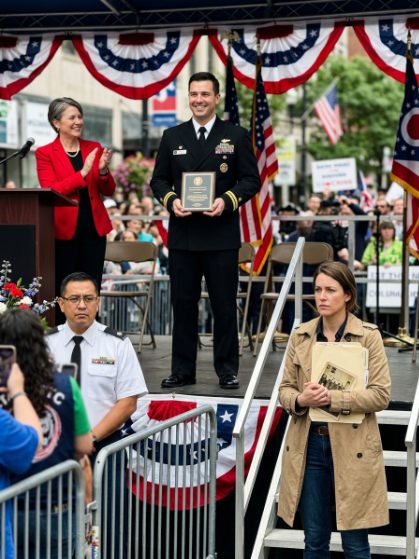
I stepped onto the stage before I could talk myself out of it.
The microphone was still on.
That mattered.
Cole Reddick saw the folder first. His smile did not disappear all at once. It flickered, like a bad connection, then came back too wide.
Mayor Lila Grant leaned toward me with the kind of smile public people use when they are deciding whether you are a voter, a donor, or a problem.
She whispered, “Not now.”
I said, “Now is exactly when.”
The little boy in the front row still had his fingers at his forehead in a half salute. That image almost broke me. Not Cole. Not the mayor. The boy.
Because lies like Cole’s do not only steal from the dead.
They train the living to salute the wrong man.
I reached the microphone before the event volunteer could stop me. The FOIA folder was shaking in my hands. I could feel the folded photo of Daniel inside it, pressed against the records like a heartbeat.
Cole laughed into the microphone.
He said, “Hannah, this is not the place.”
He used my first name because men like Cole think familiarity is a leash.
I looked at the crowd.
Then at the JROTC instructor in the front row.
He nodded once.
Small.
Steady.
I opened the folder.
My first page was not the roster.
It was Daniel’s unit photo.
I held it up, not close enough for the crowd to see details, just enough for them to understand there was a real face behind what I was about to say.
I said my brother served in the unit Cole had just described.
The crowd quieted in a strange uneven way. People in the back kept clapping for half a second because sound takes time to learn it is wrong.
The mayor reached for my elbow.
I stepped away.
Cole said my grief was understandable.
That was his first mistake.
Not because it was cruel.
Because it was rehearsed.
He had prepared for emotion.
He had not prepared for records.
I read the first document into the microphone. The official unit roster for the deployment Cole claimed. Daniel Brooks was listed. The men and women Cole had borrowed from were listed. Cole Reddick was not.
Cole said rosters were incomplete.
I read the second page. Service verification. No deployment with that unit. No assignment to that theater. No record matching the awards displayed on his chest.
The JROTC instructor stood then.
He did not come onstage.
He did not need to.
He said, loud enough for the front rows to hear, that the ribbon order was wrong too.
The mayor’s face changed.
Not from belief.
From calculation.
She looked at Cole like a risk she had failed to vet.
Cole leaned toward the microphone and said I was attacking a veteran in public.
The word veteran moved through the crowd like a shield.
For a second, I felt it working.
People wanted him to be what they had been told he was. They had brought their children. They had waved flags. They had clapped. Nobody likes realizing they have been used in daylight.
So I went to the money.
I opened the charity filings.
Cole had raised funds for returning service members through a nonprofit with a name that sounded like every other patriotic nonprofit. The filings showed vendor payments to a logistics company. The logistics company was registered to Cole’s cousin. The invoices were for outreach consulting, parade coordination, donor strategy.
The amounts matched the donations from the livestream where he told Daniel’s story.
My hands stopped shaking.
Anger can do that sometimes.
It can make you very still.
Cole said I was misreading financial documents.
I said I had already sent them to the state charity bureau, the local station, and the veterans’ groups listed as beneficiaries.
That was when the news camera turned fully toward him.
Not me.
Him.
Advertisement
Cole looked at the lens and forgot the microphone was still picking up his breathing.
The mayor stepped back.
A staffer whispered in her ear.
Someone in the crowd said, “Is that true?”
Then someone else.
Then many people.
Cole tried one more time.
He said the story was symbolic.
Symbolic.
That word landed so badly the front row seemed to recoil.
The JROTC instructor walked to the stage stairs and asked Cole, very calmly, to stop wearing what he had not earned.
Cole did not remove anything.
Of course he did not.
Men like that rarely surrender the costume in public.
But he did step away from the microphone.
And the mayor, who had been ready to hand him a plaque five minutes earlier, announced that the ceremony was paused pending review.
Paused.
Politician language for I am trapped between cameras and consequences.
I left the stage before anyone could turn me into the event. I had not come there to be brave. I had come there to put the record where applause had been.
The story broke before I reached my car.
By evening, Cole’s company had issued a statement saying he had embellished portions of his service narrative. By the next morning, actual veterans were on the local news explaining that embellishment was not the word.
Fraud was closer.
The charity bureau opened an inquiry. The attorney general’s office followed. Donors requested refunds. The mayor said she had been misled, which was true and also convenient.
Cole disappeared for three days.
Then he posted an apology video from an office with no flags behind him.
That was how I knew a lawyer had been involved.
He said he had wanted to honor veterans.
He said stories sometimes merge in memory.
He said trauma takes many forms.
I turned it off when he said Daniel’s first name.
Not because I was afraid.
Because he did not get to use it anymore.
The investigation took months. It found Cole had never deployed with Daniel’s unit, never earned the ribbons he wore, and had used the false story to raise money, secure speaking fees, and build business connections. The logistics company returned funds. Cole’s company lost two city contracts. The nonprofit was dissolved under supervision, and the remaining money went directly to the veteran housing group it had claimed to support.
The best part was smaller.
A week after the parade, Daniel’s old unit held a private gathering at a VFW hall outside Columbus. No cameras. No mayor. No bunting. Just folding chairs, coffee, and men and women who knew exactly how much silence can weigh.
They invited my mother and me.
I brought the folder because I did not know how not to.
An older sergeant named Ellis took it from my hands and set it on the table like it was something sacred and annoying at the same time.
He said, “You can put that down now.”
I did.
For the first time in months, my hands were empty.
They told stories about Daniel that had nothing to do with the one Cole stole. Bad coffee. A terrible card game. The way Daniel labeled everything he owned because he trusted nobody with socks. My mother laughed so hard she cried.
I cried without laughing.
Both counted.
The town held another ceremony in the fall. Smaller. Quieter. The mayor came, but she did not speak. The JROTC instructor read the names of the actual unit members connected to the charity. Daniel’s name was one of them.
No one called him a symbol.
No one borrowed his ending.
When they unveiled the corrected donor plaque for the housing fund, my mother touched Daniel’s name with two fingers.
I thought of the little boy at the parade saluting Cole.
This time, a group of students stood in the back, listening to the instructor explain why records matter.
Not because paper is more important than people.
Because paper is how people stop thieves from rewriting them.
Afterward, I took Daniel’s folded unit photo out of my bag and put it in a frame on my desk at the newsroom.
Not in the folder.
Not hidden behind evidence.
Just there.
A face, in the right order.