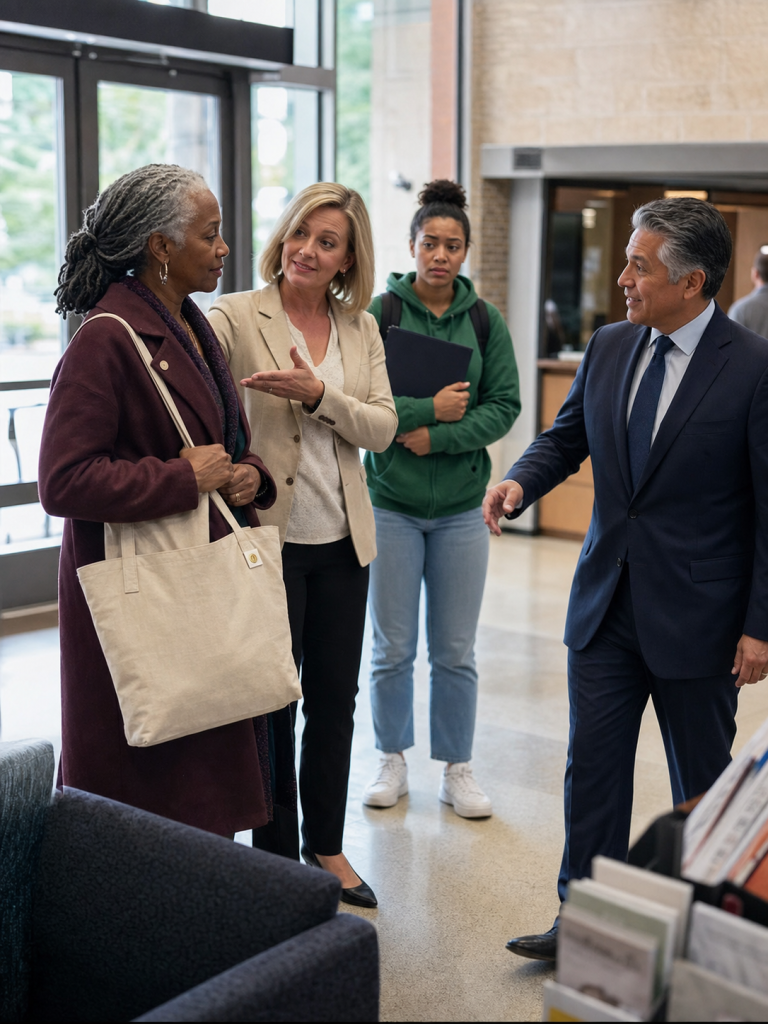
Dean Moreno did not say it sharply. That was what made it land harder.
He kept one hand over mine and turned to the students gathered in the lobby.
“This is Denise Walker,” he said. “The Walker Foundation is the reason several students on this very tour can afford to be standing here today.”
The mother in the cream blazer went still. Her daughter looked at the floor and then, slowly, back up at me.
I wanted to reach out and rescue that girl from her mother’s embarrassment. She had not done anything. But I also knew, from a long life of it, what it costs to let these moments slide by uncorrected. Someone always pays for the silence, and it is usually not the loud one. So I stood quietly and let the dean speak.
He told them I had started the scholarship fund nine years earlier. He did not tell them why. Not right away. That part belonged to me, and I would give it when I was ready.
A young woman in a green hoodie near the back clutched her folder tighter. I recognized that look immediately. Hope mixed all through with fear, like she had been invited into a room she fully expected someone to ask her to leave.
Dean Moreno turned toward her. “Kayla. Mrs. Walker is one of the people I most hoped you’d get to meet today.”
Kayla’s eyes went wide.
The mother in the cream blazer found her voice, smaller now. “I am so sorry. I didn’t realize.”
I looked at her for a long moment. “That,” I said, “was the problem.”
Her mouth opened, then closed. For once, she had nothing loud to say.
I could have stopped right there. A clean little victory. A public correction, witnessed and complete. But the students were watching me now, and I had not driven across town to be somebody’s cautionary tale. I had come because that morning, that exact morning, would have been my son’s thirty-fifth birthday.
“My boy Jamal went here,” I said.
The whole lobby softened around his name.
Jamal had been the first in our family to enroll in college. He worked at a tire shop in the mornings, hands always stained, and took his classes at night with his eyes half-closed from tiredness. He wanted to become a respiratory therapist, because his little cousin had bad asthma and he could not stand to watch her fight for air. He was bright and funny and chronically, hopelessly late to everything, and convinced there was no problem in this world that could not be solved with hot sauce or a well-built spreadsheet.
He died in a car accident halfway through his second year.
For months afterward, I could not so much as drive past the campus. I would take the long way around, adding twenty minutes to every trip, just to avoid the sight of those brick buildings and what they had promised.
Then one day a plain envelope came in the mail. A small refund from his student account. It was not much money at all. But I sat at my kitchen table holding that little check, and I thought about all the students out there just like him. Carrying jobs and family and grief and bus schedules on their young backs, hoping nobody would decide they didn’t belong.
“I used that refund to start the very first scholarship,” I said. “Just one. Then I baked and sold pies out of my church kitchen. Then people who had loved Jamal began to give. Then people who never met him gave too. Now the fund helps students who are not always seen the first time somebody looks at them.”
I let my eyes rest, just briefly, on the mother in the cream blazer when I said it.
No one snickered now. The boy by the vending machines was studying his own shoes.
Dean Moreno asked if I would walk along with the tour. I said I would. The mother stayed near the back the whole way, quiet for the first time all morning. But her daughter, after a while, drifted up beside me and asked, shy and careful, about the nursing prerequisites. She was polite. She was embarrassed. And she was kinder than her mother had been to me. Children should not have to inherit every careless word their parents throw around. So I answered every single question she had, and I meant it.
Kayla walked on my other side, close, like she was afraid I might disappear. At the library, she leaned in and whispered, “I got one of the Walker awards. That’s how I’m here.”
I squeezed her hand. “Then you had better make us proud by asking for help before you drown, not after.”
She laughed, surprised. “Yes, ma’am.”
At the end of the tour, the dean invited me to say a few words to the group. I did not give a speech about dreams or destiny. I told them where the tutoring center was, and its hours. I told them to learn the bus schedule by heart, both directions. I told them that professors are far less frightening if you email them before the assignment is due instead of after. Practical hope. The useful kind. Jamal would have liked that.
The mother in the cream blazer approached me quietly afterward, near the doors. Her eyes were wet.
“I was wrong,” she said. “And rude. To you.”
“Yes,” I said. “You were.”
She nodded, accepting it. “Thank you for letting me learn it without humiliating my daughter in front of everyone.”
That was an apology I could accept, so I did.
Before I left, Dean Moreno walked me over to the scholarship wall near the entrance. Jamal’s photo was there, in a simple frame among the others. Not a saint. Not a tragedy. Just my son, grinning like he knew a joke the camera was not let in on.
Kayla had followed us. She stood in front of his picture for a long moment, reading his name. Then she reached out and touched the strap of my tote, near the little gold pin.
“I’ll remember,” she said. “All of it.”
Outside, the late morning sun was hitting the tall college windows and turning them gold. Students crossed the courtyard with their backpacks and their coffee cups and their whole futures balanced in their arms, not one of them knowing yet how much they were carrying.
For the first time all day, I did not feel lost at all. I felt like I was standing exactly where Jamal had sent me.