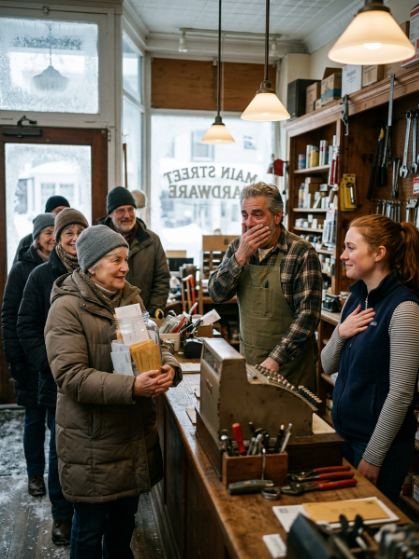
They came up Main Street in the cold in a line that stretched past the bakery and around the corner, breath fogging, boots crunching the frost.
Mrs. Petrocelli was near the front, carrying a tall glass jar stuffed so full of envelopes the lid wouldn’t sit flat. Behind her came the Lions Club, the high schoolers, the man who runs the gas station, the mother of three who buys garden seed every spring, the retired teachers, the firefighters off their shift.
Sal came out from the back wiping his hands on his green apron and stopped dead behind the counter when the bell over the door started ringing and ringing and wouldn’t stop.
“What is this,” he said. Not really a question. His voice had already gone thin.
Because Sal had said no to every fundraiser. He’d refused the jar, the car wash, the bake sale. He’d made it impossible for the town to help Sal Moretti.
So the town didn’t help Sal Moretti.
They helped Antonio.
Mrs. Petrocelli set the jar on the counter and put her hand over Sal’s. “We didn’t raise this for you, you stubborn man,” she said. “We raised it for your father. It’s the Antonio Moretti Fund. You can’t say no to it. It isn’t yours to refuse.”
That was the thing none of us, not even me, had figured out until she said it out loud. Sal couldn’t accept charity for himself. But he could not, would not, turn away something done in his father’s name. Antonio, who gave half this town its first set of house keys and never charged a dime for advice.
The whole plan, I learned, had started with my grandfather, of all people, who bought his first hammer from Antonio in 1962. He’d gotten the idea and brought it to the church basement, and from there it moved the way things move in a small town, quietly, completely, until almost every household on the list had put in an envelope.
There was no single big donor. That was the beauty of it. Twenties and tens and a child’s handful of quarters taped to a card. A note from the widow Antonio had let run a tab through a hard winter in 1979. A check from a man Antonio had hired when no one else would, who owned his own company three towns over now.
Sal opened the jar with shaking hands. He read the first note. Then the second. Then he stopped reading them out loud because he couldn’t.
The total, when I counted it that afternoon, covered every back month of the lease and the next full year besides.
But the money wasn’t even the real thing that happened that morning.
The real thing was that the town didn’t just leave the jar and go.
They stayed and they shopped.
They’d planned that too. Everyone had brought a list, a project they’d been putting off. They bought paint and lumber and bolts and birdseed and snow shovels. The high schoolers bought batteries. The firefighters bought half the plumbing aisle. I rang up more sales in four hours than I had in the previous two months, and every person looked me in the eye and said my name, because that’s what you get here that you don’t get across the highway.
A man from the chain store actually came in around noon, on his day off, in his own coat, and bought a drill from us. He didn’t make a thing of it. He just wanted to.
Sal stood behind his counter and tried three times to give a speech and gave up every time. Finally he just took off his glasses, pressed his hand over his mouth, and let the town see him cry, which for Sal Moretti is a louder thing than any speech.
When the line finally thinned that afternoon, he came and found me at the register.
“You knew about the books,” he said. “You never told anybody how bad.”
“No, sir,” I said. “Wasn’t mine to tell.”
He nodded slow. Then he said, “Antonio would’ve liked you, kid.” Which, from Sal, is the highest sentence in the language.
That was two weeks ago. The store is still here. The lease is paid. We’re not rich, we’ll never be the chain, but the math says next winter now, and the winter after that, and that’s more future than we had a month ago.
Sal did one thing with the fund I should tell you about, because it’s the most Moretti thing I ever saw.
He set aside a piece of it, and he started a tab. An official one, in a ledger, in his father’s name. The Antonio Moretti account. When somebody comes in this winter who can’t quite cover the part they need to fix the furnace before the cold, Sal rings it to that account and tells them to pay it back when they can, or pass it on if they can’t.
The town saved the store in his father’s name.
So Sal’s spending his father’s name saving the town right back.
I still open the door at eight every morning. Some mornings I look up Main Street out of habit, half hoping to see them all coming again.
They’re not coming. They already came.
But the jar’s still on the counter. Empty now, washed clean, holding pens.
Sal won’t let me move it.