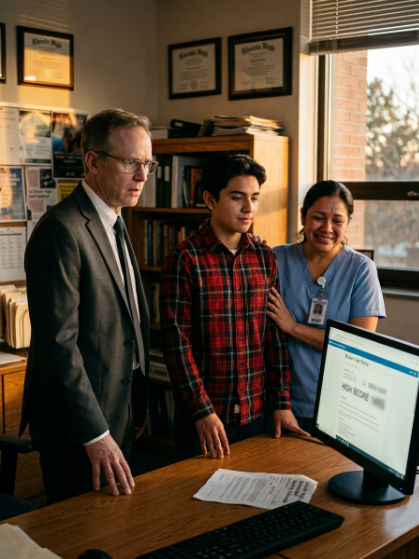
The score was a five.
If you don’t know what that means: on an AP exam, five is the top. The highest there is. College-credit, skip-the-intro-class, are-you-sure-this-is-right top.
I’d taken the hardest version of that test with no accommodations, with a hand that quit on me halfway through, and I’d gotten the highest score it’s possible to get.
My mom made a sound I’d never heard her make. My counselor, Ms. Ruiz, actually clapped once, like a startled seal, then covered her mouth.
And Mr. Halvorsen — the man who’d called accommodations a crutch, who’d “lost” my paperwork, who’d told a seventeen-year-old that maybe AP wasn’t for him — just stared at the number on the screen.
I could have said a lot of things. I’d rehearsed some of them, honestly, lying awake those five weeks. Some weren’t polite.
But what came out was this:
“I’d like to speak at the next school board meeting.”
Ms. Ruiz lowered her hand. “Eli, you don’t have to do anything. You won. You can just… enjoy it.”
“I didn’t win,” I said. The words were finding themselves as I spoke. “I survived. There’s a difference. And the next kid might not.”
Because here’s what nobody in that office understood, except maybe my mom, who’s spent twenty years lifting people who can’t lift themselves.
I’m good at math. Really good. The accommodation isn’t what makes me good — my brain does that. The accommodation just lets the world see it. Take it away and I can still claw through, because I’m stubborn and I have a mother who works doubles and refuses to let me quit.
But an accommodation isn’t supposed to be a test of how stubborn you are.
The next kid with my disability might not be stubborn. They might just be quietly brilliant and quietly crushed. They might believe Mr. Halvorsen when he calls them a crutch-user. They might decide AP isn’t for them and never find out what they could have done.
My five doesn’t help that kid. My five, all by itself, just makes me the exception that proves everyone was right to doubt the rest.
I didn’t want to be the exception.
I wanted to be the last one who had to prove it the hard way.
So three weeks later I stood at a microphone in a district board room, in a flannel shirt, with my hands shaking — and this time I didn’t hide them. I let everyone see the tremor. I held up the page.
I told them I’d been denied a legal accommodation. I told them exactly what I’d been told. I told them I’d scored a five anyway, and then I said the part I’d practiced until my voice would hold:
“I’m not here because it worked out for me. I’m here because it almost didn’t, and the only reason it did is luck and a stubborn streak I didn’t earn. You can’t build a policy that only works for the stubborn kids. The law already says you don’t have to. So why did you make me?”
The room went very quiet.
Then a woman in the front row stood up. I didn’t know her. She turned out to be the district superintendent, Dr. Caldwell.
She didn’t make a speech. She asked one question, to the row of administrators behind her.
“How many other accommodation requests went ‘missing’ this year?”
Nobody answered. Which was, itself, an answer.
The review took two months. They found a pattern. Mine wasn’t the only “lost” file — there were eleven. Eleven kids told some version of toughen up. Eleven kids who never got a microphone.
Mr. Halvorsen was reassigned out of testing. The district rewrote the whole process — accommodations confirmed in writing, with a tracking number, a parent copy, and a deadline the school is legally on the hook for. They named it after the policy, not after me. That’s how I wanted it.
But here’s the thing I actually carry.
A few weeks after the meeting, a freshman I didn’t know found me by my locker. Skinny kid. Held his right hand the same nervous way I hold mine. He didn’t say much. Fourteen-year-olds aren’t built for speeches either.
He just said, “My mom heard you talk. I have a test next week. They already gave me my time. No fighting.”
Then he nodded and walked off, the way you do when you’re too young to know how to say thank you for something that big.
I’m going to college next fall. Engineering. With the credit from that five.
But I think about that freshman more than I think about the score.
Because a five is a number. It’s mine, and I’m proud of it.
The kid at the locker — that’s the actual grade.
That’s the only one that counts.