Sergeant Marcus Hale walked the length of that courtroom in his dress uniform and stopped in front of the bench like he was reporting for duty.
“Your Honor,” he said, “I served with Captain Marsh. Two deployments. I’d like to testify, if the court will have me.”
My mother’s lawyer objected — not on the witness list, no notice, improper. Judge Pratt looked at the chaos my mother had brought into her courtroom and overruled him so fast it left a mark.
Marcus was sworn in. And he told them.
He told them about the convoy outside Kandahar. About the IED. About the medic who pulled two men out of a burning vehicle with shrapnel in her own shoulder and kept working the tourniquet on a kid’s leg while she bled into her own boots.
“That medic is sitting at that table,” he said. “I’ve got the scar she’s got. Mine’s on my leg. Hers is on her shoulder, because she put her body between the blast and my soldier. I am alive because of Captain Lena Marsh. The idea that she invented her service is the single most offensive thing I have heard in this or any room.”
Then my lawyer did what we’d planned from the start.
He’d never needed the scar. The scar was for them — for the gallery, for my mother’s certainty. The scar was theater.
The folder was the kill shot.
He entered my DD-214. My deployment orders. My commendations, read into the record one by one. The Purple Heart citation, with the date and the place and the names.
Cody had stopped rustling his costume camo jacket. He was sitting very still now.
And then my lawyer entered one more thing.
A recording.
Three weeks before trial, at a family dinner she didn’t know I’d skipped, my mother had been caught on my aunt’s phone — my aunt, the one relative who couldn’t stomach what was happening — bragging about the lawsuit.
“She can’t prove half of it fast enough to matter,” my mother’s own voice said, filling the courtroom. “By the time it sorts out, the farm’s sold and the money’s split. Cody needs it more than some soldier with a government pension.”
So she knew. She always knew I’d served. The whole case was a lie she told on purpose, betting I’d be too dignified to fight dirty.
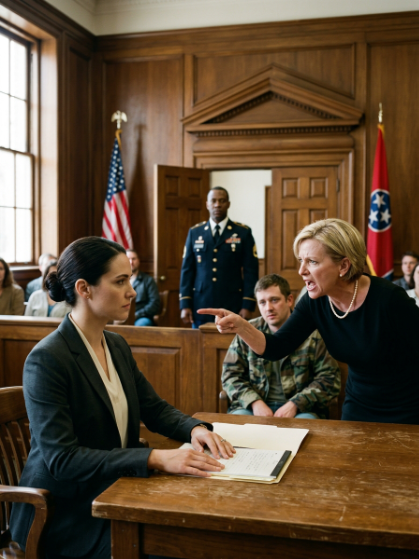
That’s when my mother broke.
She came up out of her chair screaming — that the recording was illegal, that I’d always been ungrateful, that the farm was supposed to be Cody’s, that her own father never loved her best and now her daughter was stealing what little she had left.
Judge Pratt warned her once. My mother screamed through it.
“Madam,” the judge said, “sit down or I will hold you in contempt.”
My mother called the judge a word I won’t repeat.
She spent that night in the county jail for contempt of court. I didn’t ask them to do it. I didn’t have to. She did it to herself, in public, exactly the way the Army taught me people do when you simply decline to interrupt them.
The will stood. Granddad’s hundred and twelve acres are mine.
There was more in the folder than I ever brought up in the caption. Cody hadn’t just “tried” the Army like the family liked to say. He’d washed out of basic — separated for theft. My lawyer had the record. We didn’t need to use it to win, so I told him to leave it sealed. Cody knew I had it. That was enough. He hasn’t smirked at me since.
And there was a letter.
Granddad wrote it the year before he died and left it with his attorney, to be opened only if anyone challenged the will. The judge read part of it aloud.
He wrote that he’d watched his daughter spend her life resenting everyone who worked harder than she was willing to. He wrote that he left me the farm not as a prize but as a trust — because I was the only one who ever showed up to work it without asking what was in it for me. He wrote that he was proud of my service every single day, and that he was sorry he never said it enough while he was alive.
I cried in that courtroom. Not when they read my citations. Then.
Here’s where it landed.
I didn’t take the farm to sell it, which is what my mother could never understand. I moved back. I’m running it. Cattle and hay and a hundred and twelve acres of the only place that ever felt like mine.
My mother and I don’t speak. The contempt charge, the resignation of her own lie into the public record — there’s no bridge back from a thing you did on purpose. I’ve made my peace with that. The Army also teaches you that some casualties you can’t prevent. You just stop the bleeding where you can and you keep moving.
My aunt — the one who recorded it — comes to the farm for Sunday dinner now. We don’t talk about the trial. We talk about the cattle.
I hung Granddad’s letter in the front room, framed, next to a photo of him at the wheel of the old tractor.
Some mornings I stand out in the high field where he taught me to drive that thing when I was nine, and I think about how my own mother stood up in front of a judge and a flag and swore I was nothing.
Then I get back to work.
The land doesn’t care who believed me.
It just knows whose hands are on it now.