The green eyes in the painting seemed to stare right through me. For a fraction of a second, the oil paint shifted. The vibrant emerald faded into a dull, tired brown. My eyes.
“Security!” Julian barked, his voice cracking. He spilled his champagne on the mahogany floor. The glass shattered. The sharp sound made the donors flinch. “Get him out of here! He’s having a medical episode!”
Two massive guards in dark blue uniforms stepped forward. They grabbed my arms. Their grip was tight, bruising my frail bones. I didn’t struggle. I just kept my eyes locked on the canvas.
“I’m not having an episode, Julian,” I said. My voice was barely a rasp, but it carried across the silent gallery. “I’m having a revelation. And so is everyone else in this room.”
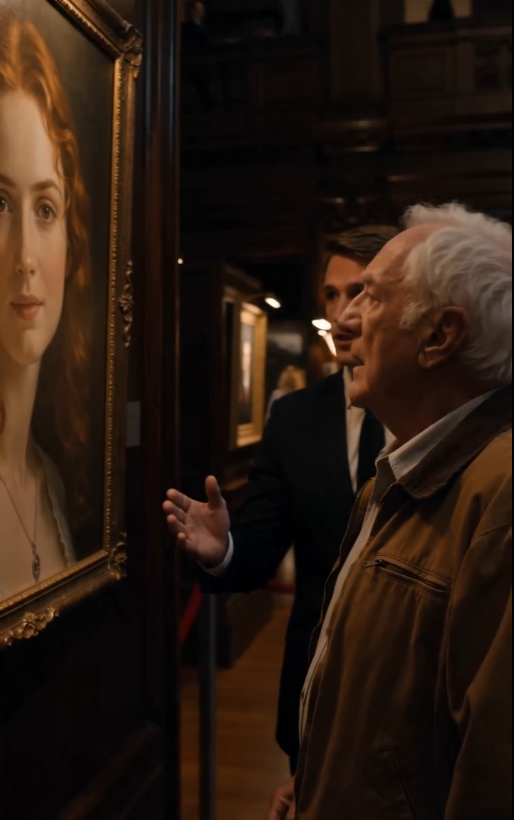
Julian’s jaw tightened. The color drained from his cheeks, leaving him looking sickly under the track lighting. He forced a tight, patronizing smile, looking around at the crowd. “Ignore him. He’s a senile janitor who wandered into the wrong wing. He’s been fired. We’ll have him escorted to the street.”
“You can’t fire me, Julian,” I said. I pulled my arms free from the distracted guards. I stepped closer to the painting. “Because I don’t work for you. I work for the estate of Elias Vance.”
Julian laughed. A sharp, ugly sound that bounced off the vaulted ceiling. “Elias Vance is my father! He died in 1990. You’re a nobody, Arthur. You’re a ghost.”
“Elias Vance was a pseudonym,” I said. My voice was steady. I reached into the deep pocket of my faded brown jacket. My fingers brushed the cold, hard glass of a small vial. “A pseudonym your father used to sell my stolen paintings. He didn’t have the talent to paint a stick figure, let alone a masterpiece.”
The room went dead silent. The hum of the air conditioning seemed to roar in my ears. The donors were no longer looking at Julian. They were looking at me.
“Lies,” Julian spat. He lunged forward, his hands reaching for my pocket. “You’re trespassing! You’re defaming a dead man!”
I pulled out the vial. It was filled with a clear, pungent liquid. Acetone. Pure, uncut acetone. I had carried it in my pocket every single day for sixty years. Waiting for this exact moment.
“The eyes were added in 1968,” I repeated. I unscrewed the cap. The sharp smell of the chemicals cut through the expensive perfume in the air. “Because the original painting wasn’t a portrait of a woman. It was a self-portrait. My self-portrait. Your father stole it, painted over my face, and turned it into Clara to sell to the highest bidder.”
Julian froze. His hand hovered in the air. “That’s impossible. The X-rays show a female understructure.”
“The X-rays show what your father wanted them to show,” I said. I stepped up to the canvas. I didn’t hesitate. I poured a single drop of the acetone onto my thumb. I pressed it against the painted green eye.
The crowd gasped. Julian screamed, “Stop him! He’s destroying a ten-million-dollar asset!”
The guards grabbed my shoulders, but it was too late. I rubbed my thumb in a small, tight circle. The thick, yellowed varnish dissolved. The green paint flaked away, revealing the dark, rich brown oil beneath.
I stepped back. The guards let me go.
The damage was small, no bigger than a dime. But it was enough. The green iris was gone. In its place was a brown eye. My eye. Staring back at the room.
The silence in the gallery wasn’t just quiet. It was a physical weight. It crushed the air out of the space between us.
Julian stared at the small patch of brown paint. His mouth opened, but no sound came out. He looked at the donors. They were already pulling out their phones, taking pictures. The flash of the cameras popped like strobe lights.
“The original copyright registration is in the basement archives,” I said, my voice echoing in the quiet room. “Along with the police report my wife filed in 1968. The one your father bribed the precinct to bury.”
I looked at the head of the museum’s board of directors, a stern woman named Margaret, who was standing in the front row. “Margaret, the Vance collection is stolen property. Every painting in this wing belongs to me. And I want them returned.”
Margaret didn’t hesitate. She stepped forward, her heels clicking against the mahogany floor. She looked at Julian with pure, unadulterated disgust.
“Julian,” she said, her voice cold and flat. “You’re suspended. Effective immediately. Hand over your keys and your badge.”
Julian’s face went completely white. He looked at Margaret, then at the painting, then at me. The arrogance was completely gone. He looked like a trapped animal.
“You can’t do this,” he whispered. “My family built this museum. I am the director.”
“You’re a thief,” Margaret corrected. She nodded to the security guards. “Escort him out. And call the NYPD. We’re filing a formal report for art fraud.”
The guards moved in fast. They pulled Julian’s arms behind his back. The metallic click of the handcuffs was sharp and final. They marched him out of the gallery, past the staring donors, and into the elevator. He didn’t look back. He just stared at the floor, his shoulders slumped, entirely defeated.
I walked up to the painting. I reached out and gently traced the air above the small patch of brown paint. The acetone smell was fading, replaced by the familiar scent of old oil and dust.
The silver locket rested against her painted collarbone, catching the dim gallery light.