I caught Carla’s wrist on her way past my booth with the coffee pot.
Gently. Like you’d flag down someone you didn’t want to startle.
“That was a kind thing you just did,” I said.
She shrugged like I’d accused her of nothing much. “They’re hungry. I’ve got pancakes. Math’s not hard.”
“Do you do that a lot?”
She looked at me then, really looked, the way a woman who’s worked nights for thirty years reads a stranger in three seconds flat. “There’s a jar by the register,” she said. “Regulars drop change in it. We call it the counter fund. Nobody who’s a kid eats alone and hungry in my section. Been that way since before the owner got sick.” A pause. “You writing a review or something, hon?”
I almost laughed. Because that was, in fact, almost exactly what I was doing.
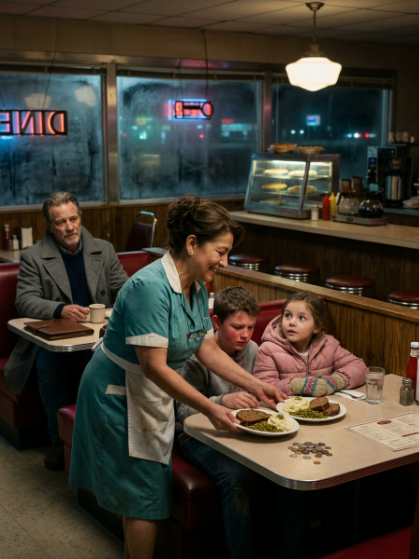
I hadn’t told her the truth, so I’ll tell you. My company owns a stake in the group that holds the note on this diner and four others off this stretch of interstate. The location was underperforming. I’d driven out, anonymous, to sit in a booth, confirm what the spreadsheet already said, and recommend we close it.
I had the closure memo half-written in the leather folio on my table. I’d been three sips into deciding this place was a tired room with bad coffee and no future.
Then a boy emptied his pockets onto a table, and a woman gave away food she couldn’t spare, and tucked her own tip money into his hoodie when she thought the world wasn’t looking.
The world was looking. The world had a folio and a closure memo.
Here is the part I didn’t tell Carla, either. I grew up on that exact sentence — I’m not even hungry. I said it to my own little brother across a lot of empty tables, in a lot of cold apartments, while I did the same coin math that boy was doing. Nobody ever slid the coins back to me. I built a whole armored life so I would never feel that small again, and somewhere in the building of it I’d turned into the man with the memo.
I asked her to sit for a minute. She told me the owner, a man named Sal, had been in and out of the hospital for a year, that the diner was three months behind, that the staff had quietly taken fewer hours so Sal wouldn’t have to cut anyone. She told me Jesse, the boy in the hoodie, had been coming in since his mom started working doubles, that she always “ran a special” the nights he had his little sister.
She wasn’t asking me for anything. People who give like that almost never do.
I left the diner at eleven that night. Before I went, I slid an envelope under my coffee cup — what I’d planned to expense for a week of meals and a hotel, in cash. Enough, I hoped, to cover whatever was about to come due. I heard later she chased the door into the parking lot, thinking I’d dropped it by mistake. I was already gone.
That tip changed her month. What I did on Monday changed her year.
I tore up the closure memo. Then I went to the group and made a different recommendation — that we buy Sal’s note outright at a number that let him keep his dignity and his name on the door, and that we keep every soul on staff.
I made one condition non-negotiable in the paperwork. A line item the accountants kept trying to delete: the counter fund gets matched, two to one, by the company, forever. No kid eats alone and hungry in Carla’s section. It’s a clause now. It’s in the contract, in plain language, right under the part about grease traps and parking-lot lighting.
Carla runs the place. She fought the title “manager” for a week because she said she’d never managed anything but a coffee station. She manages it better than people with degrees in it. I made sure the wage matched the work, finally.
Sal still comes in mornings, slower now, and sits at the counter and tells everyone he hired her.
And Jesse? Jesse got a job bussing tables there at sixteen, the legal way, with a schedule that works around school. His little sister does her homework in the corner booth — the warm one, by the pie case — and orders pancakes like she owns the place. Because in a way the company would never put on a balance sheet, she sort of does.
I walked into that diner ready to give it one star and end it.
A waitress on hour twelve, kneeling at a booth with two plates she couldn’t afford to give away, reminded a tired rich man what a place is actually worth.
It was never the coffee.