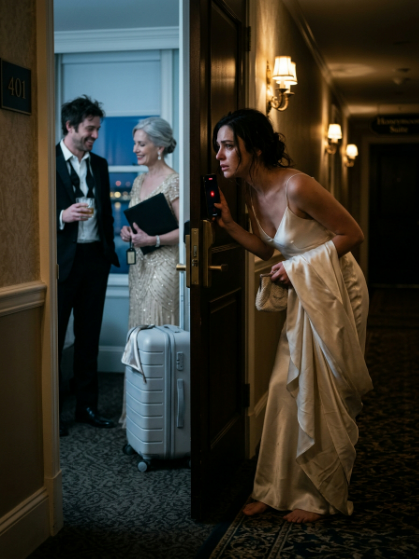
I leaned closer to the door, and the part they hadn’t said out loud yet finally landed.
“Once it’s annulled,” Vivian was saying, “the trust still pays out. Your grandfather’s lawyer confirmed it. The condition is that you married. It doesn’t say you have to keep her.”
“And if she fights it?” Brooks asked.
“With what money? She translates menus. We give her a week at the Bayside, a sad little settlement, and she signs. Girls like that are grateful for an exit.”
So that was the whole architecture of my wedding.
Brooks’s grandfather, old Walter Ashworth, had left his fortune behind a single clause: Brooks would inherit on the day he married. The family read that the way greedy people read everything — as a loophole. Marry someone disposable. Collect. Discard.
They picked me because they thought I was disposable.
Here is what they didn’t know.
My father was not a rich man, but for thirty years he was a paralegal in an estate firm, and he raised me on one sentence: read the whole document, Anya, especially the parts written for people who won’t.
So a month before the wedding, when Brooks’s hands got cold every time I mentioned the future, I did exactly that. I paid a real lawyer two weeks of my savings to pull old Walter’s trust and read it with me, line by line.
The clause did not say married. It said enters into and maintains a good-faith marriage, with the trustee as sole judge of good faith.
And the trustee was not the family lawyer.
It was Grandmother Ashworth. Walter’s widow. Eighty-one years old, sharp as a tack, and the only person in that entire family who had ever looked me in the eye and asked me a question about myself.
I stood in that hallway with the red recording dot glowing and let them finish. Every word. The motel. The settlement. The annulment already drafted. Vivian laughing about how grateful girls like me would be.
Then I did not crawl. I did not weep in a parking lot.
I picked up my pale gray suitcase — the one with my real passport and my father’s emergency cash sewn into the lining, packed like someone who might need to leave — and I rolled it quietly to the elevator. I checked into a different room two floors down under my own name and I slept better than a bride should.
In the morning, I did not call a divorce lawyer.
I called Grandmother Ashworth, and I asked if I could bring her coffee.
She received me in her suite in a silk robe, suspicious, until I set my phone on the table between us and pressed play.
I watched her face as she listened to her grandson and her daughter-in-law plan to use a wedding she had paid for as a vending machine.
She listened to the whole thing. She did not interrupt. When it ended she sat very still for a long moment, the way Caleb’s people do when something heavy settles into place.
“My husband wrote that clause,” she said finally, “because he was terrified Brooks would marry exactly the way Brooks just did. For money, and meanly. He made me the judge of good faith because he trusted me to know the difference.”
She slid the phone back to me.
“There is no good faith here,” she said. “I am the trustee. I have made my determination.”
The trust did not pay out.
Brooks married for a fortune and received, on the morning after his wedding, the news that the fortune was now funding a charitable foundation in Walter’s name, with his grandmother as chair and a stranger she’d taken a liking to invited onto the board.
I filed for annulment myself, on my terms, citing fraud — and the recording made it brief.
Vivian tried, once, to spin me as the schemer. But you cannot sell “the gold-digger” to a room when the bride is the one who walked away from the gold.
I kept the suitcase. I never unpicked the lining. Some mornings I still run my thumb along the seam where the passport used to sit, just to remember the shape of being ready.
My father has been gone three years now. I think about him every time someone underestimates me on sight.
He didn’t leave me money.
He left me the habit of reading the whole document — and a packed bag, in case the people smiling at me hadn’t.