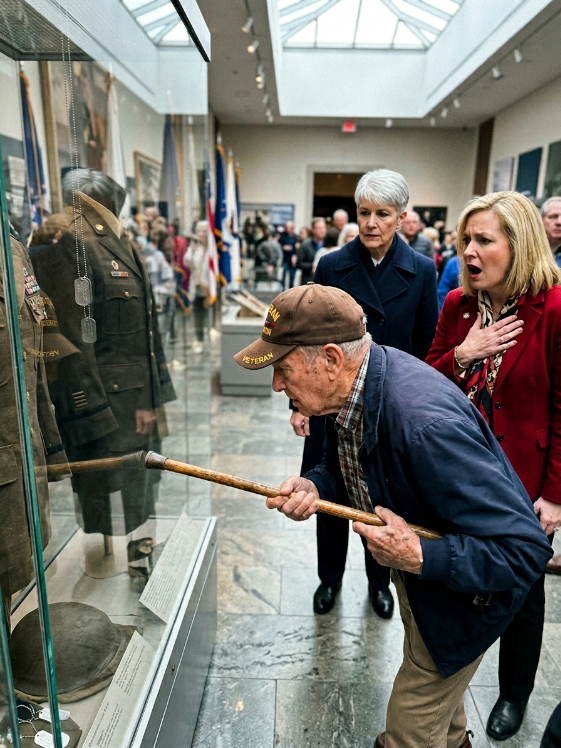
Colonel Ruth Haines stared at Eli Mercer’s hand, then at the dog tags inside the cracked display case, then at the blank space on the exhibit wall.
The National Valor Museum gallery had been built for silence. Cool skylight fell across polished stone floors. Donors moved in soft shoes. Carolyn Price, chair of the museum’s donor council, had been smiling beside the rescue-mission display only moments earlier, speaking about legacy with one hand lifted toward her family’s name on the temporary banner.
Then Eli pressed the tip of his cane into the glass.
The crack ran in a thin white line across the case. Every polite voice in the room broke into a gasp. Eli was seventy-six, brown veteran cap low over his forehead, weathered hands steady on the cane. He did not swing. He did not shout. He leaned forward with controlled urgency as if the glass had been the only thing between him and breath.
Security started toward him.
Carolyn recoiled in her red blazer. ‘Do not touch him yet,’ she snapped, though her face said she wanted him gone before anyone raised a phone. ‘Sir, step away from that case.’
Eli’s eyes stayed on the tags. ‘Those are mine.’
A donor near the back laughed once, nervous and ugly. ‘Everybody says that in military museums.’
Ruth Haines did not laugh.
She had been invited as a retired colonel and advisory guest, the sort of veteran a museum liked because she knew when to stand for pictures and when to stay useful. At sixty-eight, silver hair cropped close, navy coat buttoned, she had spent the tour reading what was not on the plaques. The rescue case told of a classified extraction in North Africa, three civilians saved, one senator’s son credited with carrying the transmitter that called in air cover. The story was clean. Too clean.
Now she saw the service number stamped on the tag nearest the crack.
Not all of it. Enough.
‘Hold security,’ Ruth said.
Carolyn turned. ‘Colonel, with respect, this man just vandalized a national exhibit.’
‘With respect,’ Ruth said, ‘that exhibit may be lying.’
The security guards stopped because rank still had gravity when spoken without volume.
Eli’s cane trembled once. He caught it with both hands and steadied himself. ‘I didn’t come to break anything. I came to get my name back.’
Carolyn’s mouth tightened. ‘Your name is not in this exhibit.’
‘I know.’
That was the first moment the donors understood the scene was not random.
The case held a desert radio, a torn field map, three unit patches, and the dog tags turned so the engraved side faced the back panel. Eli had noticed that from across the room. He had stood through Carolyn’s speech about the late Senator Price’s family service, through the museum director praising donors who preserved truth, through the photograph of a young man named Andrew Price receiving a medal Eli knew he had not earned.
The young man in that photograph was Carolyn’s father.
Eli had been twenty-nine when the mission went bad. He was a communications sergeant attached under a borrowed name, the kind of man sent where records could be adjusted later. Andrew Price was the senator’s son, brave enough in public, terrified under fire. When the radio failed and civilians were trapped behind a burned convoy, Eli crawled through wreckage with the transmitter strapped to his chest. He called the coordinates. He dragged Andrew Price out after the younger man froze. Then he was ordered to surrender his tags before the medical helicopter lifted because the mission could not officially include him.
They told him the paperwork would be corrected.
Paperwork learned to disappear.
Ruth walked to the case and crouched despite the stiffness in her knees. She peered through the crack. ‘Mercer, E. J.’
Eli closed his eyes.
Carolyn said, ‘You cannot possibly read that from here.’
Ruth stood. ‘I don’t need the full number. I served under the officer who signed the after-action correction no one filed. I saw this name in a sealed appendix in 1994.’
The museum director, a narrow man named Keller, went pale enough to match the stone. ‘Colonel, perhaps we should discuss this privately.’
‘No,’ Ruth said. ‘Private is how we got here.’
Carolyn stepped between Ruth and the case, recovering the performance of control. ‘My father gave his life to public service. This museum accepted verified artifacts. If an elderly visitor has a claim, he can submit a form.’
Eli laughed softly. It had no humor in it. ‘I submitted forms until my wife stopped asking why the mailbox made me sick.’
He reached into his coat and removed a folded photograph, the edges soft from being opened too often. Ruth took it because his fingers had started to shake. The image showed three dusty men beside a helicopter ramp. Andrew Price sat on the floor, face blank with shock. Eli stood behind him, one hand pressed to a blood-dark bandage on his own side, dog tags visible against his shirt.
Carolyn glanced at the photo, then away. Too fast.
Ruth caught it. ‘You’ve seen this.’
‘I have seen many wartime photographs.’
‘You’ve seen this one.’
The silence that followed did more damage than any confession.
Keller whispered, ‘Carolyn.’
She snapped, ‘My family funded this wing.’
‘Your family funded an omission,’ Ruth said.
The donor tour dissolved into murmurs. Someone asked whether the museum had provenance files. Someone else, braver or angrier, asked why the dog tags had been displayed backward. Keller looked at the case as if it had betrayed him by existing.
Eli remained where he was, shoulders bowed, not victorious. He looked tired in the way men look when the truth finally arrives after the people who needed it most are gone.
‘My wife died thinking I made peace with it,’ he said. ‘I didn’t. I just ran out of offices to sit in.’
Ruth placed the photograph on top of the case, away from the cracked glass. ‘Then we start with this office.’
The museum closed the gallery within the hour. Not because Carolyn ordered it, but because Ruth refused to leave and three donors refused to stop filming the director’s promises. By evening, the museum board had pulled the Price family naming banner from the Valor Wing pending review. By the next week, archival staff found the sealed appendix Ruth remembered: Eli Mercer listed as communications lead, rescuer of two civilians and Andrew Price, removed from the public citation at the request of Senator Price’s office.
Carolyn’s consequence arrived with paperwork, which was fitting. The donor council suspended her. The naming rights agreement was voided for misrepresentation of artifact provenance. Her statement about respecting the review used many careful words and none of the necessary ones. Ruth read it once, then threw it in the trash.
Eli came back after the corrected exhibit opened. He wore the same brown veteran cap and used the same cane, repaired with a brass collar where it had struck the glass. The case had been replaced. The dog tags now lay face-up beside the photograph and a new plaque with his full name.
Ruth stood beside him while visitors read.
‘You got your tags back,’ she said.
Eli shook his head. ‘No. They can stay here now.’
He touched two fingers to the glass, not hard enough to leave a print.
This time, his name faced the room.