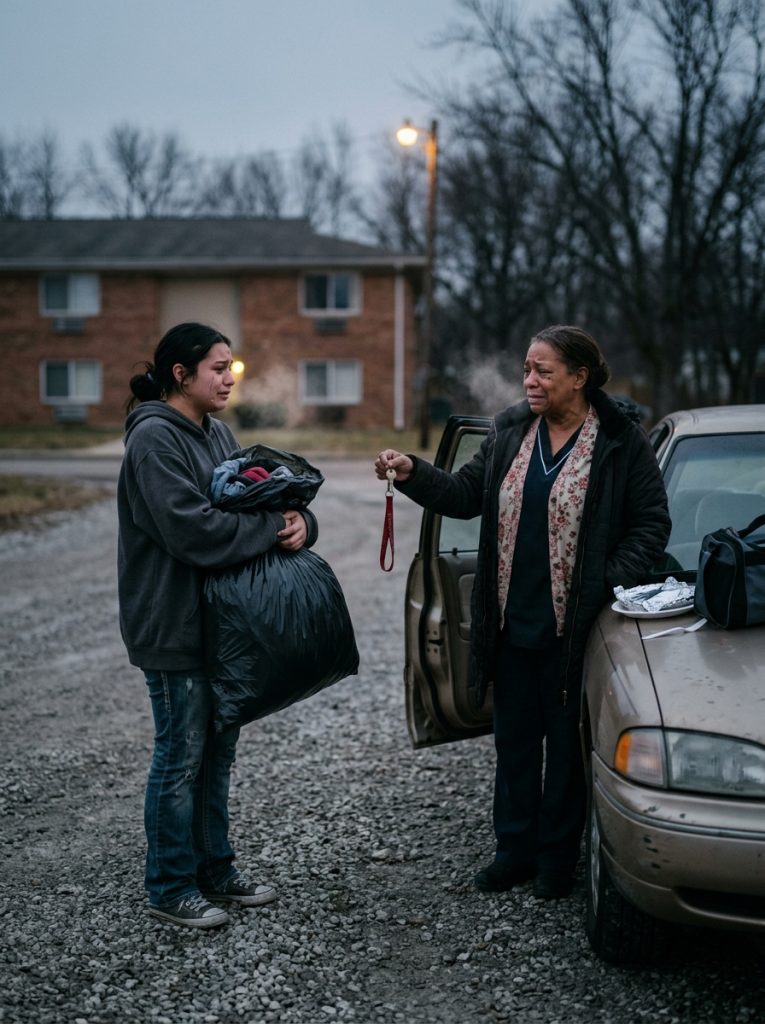
Gloria opened the passenger door for me like I was somebody.
I put my trash bag on the floor by my feet because I didn’t know where else to put it. She handed me the foil-covered plate off the hood. It was still warm. Meatloaf and mashed potatoes and green beans, the Monday plate, my plate.
“Eat,” she said, pulling out of the lot. “You always think better when you’ve eaten.”
We drove across Toledo as the gray sky went pale. She didn’t talk much. She let the radio play low and let me cry without making a thing of it, which is the kindest way anyone has ever let me cry.
We stopped in front of a small brick house on a street with bare maples and a chain-link fence somebody actually took care of.
“This is me,” she said. “Been mine thirty years.”
Inside it smelled like cinnamon and old books. She walked me down a short hallway and stopped at a door that was already open.
“This one’s yours,” she said. “If you want it.”
It was a real room. A bed with a quilt. A desk under the window. A little shelf, mostly empty, waiting. Somebody had set a paperback on the pillow — the same one I’d read eleven times, except this copy was new, the spine not even cracked.
I stood in the doorway holding everything I owned in a garbage bag and I could not make my feet move.
“Why?” I finally said. “You barely know me. I’m not yours. Nobody gets a kid they don’t have to take.”
Gloria sat down on the edge of the bed. She was quiet for a long time.
“I had a daughter,” she said. “Marie. She went into the system when I was too young and too broke and too proud to ask for help getting her back. By the time I got my life together, she’d aged out. Eighteen and a trash bag, just like you this morning. No room waiting anywhere.”
She smoothed the quilt with one hand.
“I found her too late. She was nineteen. She was on her own out there and the world is hard on kids that nobody’s looking for.” She didn’t say the rest. She didn’t have to. “I have spent twenty years feeding other people’s children a hot plate on Mondays because I couldn’t feed my own.”
She looked up at me.
“This was Marie’s room. I never could turn it into anything else. And about two years ago, I watched a skinny, furious girl come through my lunch line pretending she wasn’t hungry, and I thought — that one. That’s the one I get to be on time for.”
I don’t remember dropping the bag. I just remember she caught me.
We stood in the middle of Marie’s room — my room — and we held on, two people who had lost almost everything, finding the one thing left worth holding.
It wasn’t simple after that. I want to be honest. You don’t undo eighteen years of bracing for the next goodbye in a single afternoon. The first month, I slept on top of the covers with my shoes by the door, ready to be moved again. Gloria never once mentioned it. She just left the hall light on every single night, and every morning there was breakfast, and slowly my shoes ended up in the closet where shoes go.
She came to my GED graduation in the spring, front row, in the same floral cardigan, crying louder than anybody. She helped me fill out the community college forms. When the financial-aid lady asked for a parent’s signature, Gloria picked up the pen before I could explain that I didn’t have one of those.
“I’m her people,” Gloria said, and signed.
I’m nineteen now. I work mornings at a diner and take classes at night, and I’m studying to be a social worker, because somebody has to be standing in those parking lots at dawn, and I know now what it means to be the one who shows up.
On Marie’s shelf — my shelf — there’s a framed photo of a girl I never met, dark-eyed and laughing, who would have been my sister if the world had been kinder and faster. I talk to her sometimes. I tell her I’m taking good care of her mom.
People hear my story and they call it sad. The trash bag. The eighteen years. All those Mondays.
But that’s not the part I keep.
The part I keep is a warm plate on a cold hood, and an old tan car with the door already open, and a woman who decided, two years before I knew her name, that this time she was going to be on time.
For eighteen years, nobody came.
And then somebody did.