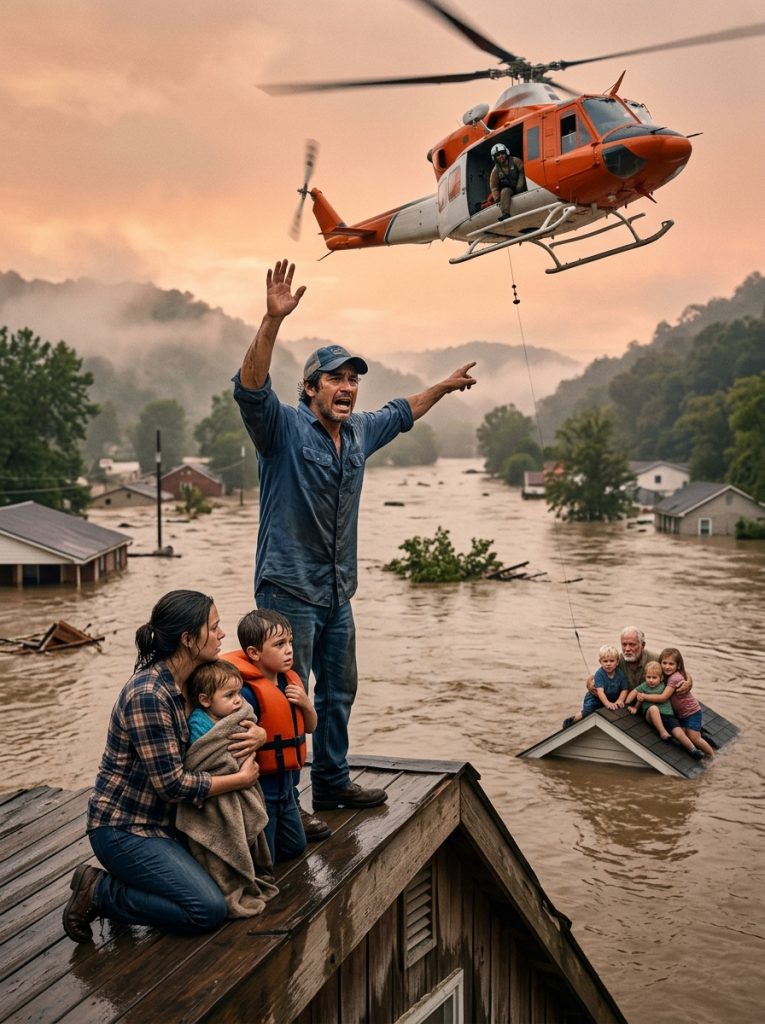
For three seconds the helicopter just hovered there, the line swinging, and I thought the crew didn’t understand.
I kept waving them off. Both arms crossing over my head — the signal for no, not here, go. Then both arms stabbing downstream at the Abbott roof.
The crew chief leaned out the open door. I watched him follow my arm with his eyes, down the brown water, to the smaller roof and the four small shapes clinging to a chimney.
He looked back at me. At Maria kneeling with the baby. At my boy in his orange vest.
I pointed again. Harder. THEM. NOT US.
And the chief raised one hand, flat, and held it toward me. I understood it the way you understand a stranger across a flood. It meant: I see you. Hold on. We’re coming back.
The chopper peeled off and dropped toward the Abbotts.
Maria grabbed my arm. “Daniel. Daniel, what did you do.”
“Their roof’s going under,” I said. “Ours has another hour in it. Maybe more.”
“You don’t know that.”
“No,” I said. “I don’t.”
It was the longest hour of my life.
We watched the helicopter work the Abbott roof. We watched the hoist drop and rise, drop and rise. Mr. Abbott sent the kids up first — that’s the kind of man he is, seventy-four and putting three grandbabies on the line before himself. The smallest one was so light the wind off the rotors nearly took her, and Maria made a sound I’ll never forget when the basket finally cleared the water.
Four trips. Then the old man. Then the roof he’d been standing on slid sideways and went under, and there was nothing left where the Abbott house had been but water and the top of a tree.
If that chopper had taken us first, it would have come back to that tree.
Our roof held.
A flat-bottomed rescue boat came up our street about forty minutes later — a county deputy and two volunteers from the next hollow who’d been running rescues all night in a borrowed jon boat. They took my daughter first, then my son, then Maria, then me, and the whole time I kept apologizing for the wait, and the deputy kept saying, “Son, you got nothing to apologize for. We heard what you did on the radio.”
That’s how I found out the crew chief had called it in.
He’d radioed that a man on a roof waved off his own rescue to redirect them to a house with four kids about to go under. By the time we reached the shelter at the high school gym, the story was already there ahead of us.
I didn’t want it to be. I want to be clear about that. I didn’t do it for a story. I did it because I could count, and the Abbott roof was lower than mine, and there were more of them, and the baby on that chimney could not have held another hour. Anybody who could see what I could see would have pointed downstream too.
But not everybody would have. That’s what people kept telling me, and I’ve made my peace with it being true.
Mr. Abbott found me in the shelter that night. He came across the gym floor in borrowed dry clothes, and he took my face in both his old hands like I was one of his own grandkids, and he couldn’t talk. He just held on. His granddaughter — the littlest one, the one the wind almost took — fell asleep in Maria’s lap like she’d always belonged there.
Weeks later, when the water was gone and the cleanup started, the county held a small ceremony. The rescue captain who ran operations that night shook my hand in front of the firehouse and called it the bravest call he’d seen a civilian make in thirty years on the job. They gave me a folded certificate I didn’t know what to do with.
I’m a maintenance man. I fix HVAC units. I am nobody’s idea of a hero, and I’d undo the whole flood in a heartbeat if I could.
But here’s what came out of it.
The hollow that used to keep to itself doesn’t anymore. After the water, we rebuilt each other’s houses before we rebuilt our own. Mr. Abbott helped me re-shingle the roof I’d stood on — the roof that held — and we don’t talk much while we work, but we don’t have to.
And those four grandkids? They call me Uncle Daniel now. The littlest one drew me a picture of a helicopter and a roof and a stick man with both arms up. She wrote one word on it, spelled the way a six-year-old spells.
“THANK YOO.”
It’s on my refrigerator. I look at it every morning before work.
People say I gave up my family’s spot on that helicopter. I don’t see it that way.
I just trusted that a roof that had held all night would hold a little longer.
And it did. We all came down off our roofs in the end.
My name is Daniel Reyes, and I’d point downstream again.