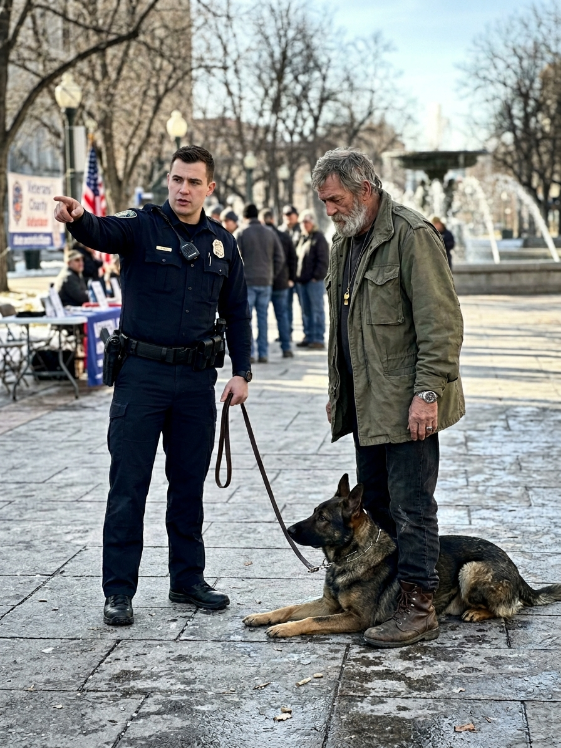
A senior handler pushed through the charity crowd, saw the brass dog whistle on Owen Briggs’s chest, and said one name under his breath.
‘Breaker.’
Three older veterans near the folding tables turned before Officer Tyler Nash did. The name moved through them like a radio signal from another decade. Owen stood in the cold Denver sun with his shoulders lowered, gray beard lifting slightly in the wind, army surplus coat hanging loose over his frame. K9 Ranger remained flat at his worn boots, leash tight in Tyler’s hand, eyes fixed upward.
Tyler had been pointing toward the park exit only seconds earlier. Now his arm hung halfway down, uncertain what command still belonged to him.
The senior handler, Captain Denise Alvarez, stopped a few feet from Owen. She was in uniform, hair pinned tight, breath showing in the winter air. Her gaze went from the whistle to the dog, then to Owen’s face.
‘Sir,’ she said, quietly enough that the crowd had to lean in to hear, ‘is that your call whistle?’
Owen’s hand closed around the brass. ‘Used to be.’
Tyler cleared his throat. He was twenty-seven, polished and tense, too new to know how quickly authority could become embarrassment in public. ‘Captain, he was inside the restricted event area without clearance. The dog disobeyed a direct command.’
‘No,’ Alvarez said. ‘The dog obeyed an older one.’
Ranger’s tail moved once against the pavement.
The veterans’ charity event had started as a clean photograph: folding tables with coffee urns, donation bins, a podium near the fountain, banners snapping too brightly in the wind. Owen had come for the same reason he came every year, though nobody had ever written his name on the invitation. He stood at the edge, listened to speeches about service, and left before anyone asked where he slept.
This year, a volunteer saw his coat and assumed he wanted the food line. Tyler saw him near the K9 demonstration area and assumed he was a problem. Owen made both assumptions easy by not correcting them.
When Tyler told him to move, Owen nodded. When Tyler pointed harder, Owen stepped back. Then Ranger broke heel, crossed the strip of pavement, and lay down at Owen’s boots as if coming home.
Alvarez knelt beside the dog. ‘Ranger.’
The German shepherd flicked his eyes toward her but did not rise.
‘He has never ignored me at a public event,’ she said.
Owen’s mouth almost smiled. ‘Good dog knows when not to.’
Tyler flushed. Around them, the crowd had tightened into a ring. Phones were out, but the mood had changed from entertainment to witness. A man in a veteran cap whispered to another, ‘Breaker Briggs?’ and the second man shook his head like he did not trust himself to answer.
Alvarez looked at Owen again. ‘My first instructor kept a photo of you in the academy office. No name on it. Just a man with a whistle standing in front of three dogs and a burned-out cruiser. They said you trained the unit before there was a unit.’
Owen’s eyes dropped to Ranger. ‘They said a lot of things after.’
The brass whistle was dull from years of handling. Tyler had missed it because he was looking for threat signs: hands, pockets, posture, proximity to donors. He had not been trained to see history hanging on a cord.
Alvarez stood and faced him. ‘Officer Nash, step back.’
He did, stiffly.
Owen touched the whistle but did not blow. ‘Don’t make a ceremony out of me, Captain.’
‘You are standing in the middle of one someone else planned without knowing who built the floor.’
That was when Councilman Peter Vale, who had been waiting near the podium with a speech about public-private partnerships, walked over with a practiced concern that arrived late and loud.
‘Is there an issue here?’
Alvarez did not look away from Owen. ‘Yes. We are removing a man your office listed as deceased in the K9 memorial materials.’
The councilman’s face changed in one clean blink. ‘That must be an administrative error.’
Owen gave a dry laugh. ‘Those are popular.’
Alvarez asked the charity coordinator for the memorial binder. The coordinator brought it with shaking hands. Inside were laminated pages about the 1999 Civic Center bombing response, the day an explosive device damaged the old police substation and scattered the first volunteer dog team across three blocks of smoke, glass, and sirens. The binder credited department leadership, donors, and a later training committee.
It did not credit Owen Briggs.
Owen had been a volunteer handler then, a former Army tracker who slept badly and trained dogs better than anyone in Colorado. He was the one who used the brass whistle to pull two panicked dogs back through smoke. He was the one who found a trapped dispatcher under a collapsed stairwell. He was also the one who argued afterward that the department was using volunteer handlers without benefits, insurance, or housing support.
The argument cost him everything clean on paper.
A captain retired. A report vanished. Owen’s injury claim stalled until his apartment did too. By the time the K9 unit became official, his name had become inconvenient.
Alvarez turned the binder toward Councilman Vale. ‘Who approved this version?’
He adjusted his scarf. ‘Captain, this is not the setting for personnel history.’
Owen looked at the charity tables, the coffee urns, Ranger still at his boots. ‘Funny. It was the setting to move me along.’
The sentence did what shouting could not. Tyler’s face went red all the way to his collar.
Alvarez unclipped Ranger’s leash from Tyler’s hand and offered it to Owen. Not as a transfer of ownership. As an apology the whole crowd could understand.
Owen did not take it. He crouched slowly, knees stiff, and scratched Ranger behind one ear. ‘He’s yours now. I just know the language.’
Ranger pressed his head into Owen’s palm.
Tyler stepped forward. His voice was smaller than before. ‘Mr. Briggs, I apologize. I was wrong.’
Owen looked up at him. ‘Be earlier next time.’
It was not forgiveness. It was instruction.
Alvarez took the podium without waiting for the councilman’s schedule. She told the crowd what the binder left out. Not with grand flourishes, but with dates, names, and the dull brass whistle held in Owen’s palm. The older veterans filled in what they knew. One remembered Owen training dogs under highway lights. Another remembered him sleeping in his truck behind the old station because housing paperwork had been delayed again.
Councilman Vale stopped smiling for cameras. By dusk, his office had issued a correction. By the next morning, reporters had the missing injury claim, the stalled housing benefit file, and the old photo from the academy office.
The city moved quickly once embarrassment became public. Owen’s veteran housing benefits were reinstated within a week. The K9 unit added his name to the memorial wall and invited him to the ceremony. He almost refused. Alvarez told him Ranger would sulk. That got him there.
At the ceremony, Tyler stood in the second row without sunglasses, hands folded in front of him. Afterward he asked Owen if he could learn the old whistle calls. Owen studied him long enough to make the young officer sweat.
‘Only if you learn when not to use them,’ he said.
Spring came late to Civic Center Park. Owen still wore the army surplus coat, but it hung in the closet of a small apartment now, not over a shelter chair. The brass whistle stayed on its cord by the door.
On his first quiet morning there, Ranger visited with Alvarez and lay down at Owen’s boots again.
Owen opened the window, let the city noise in, and left the whistle on the table.