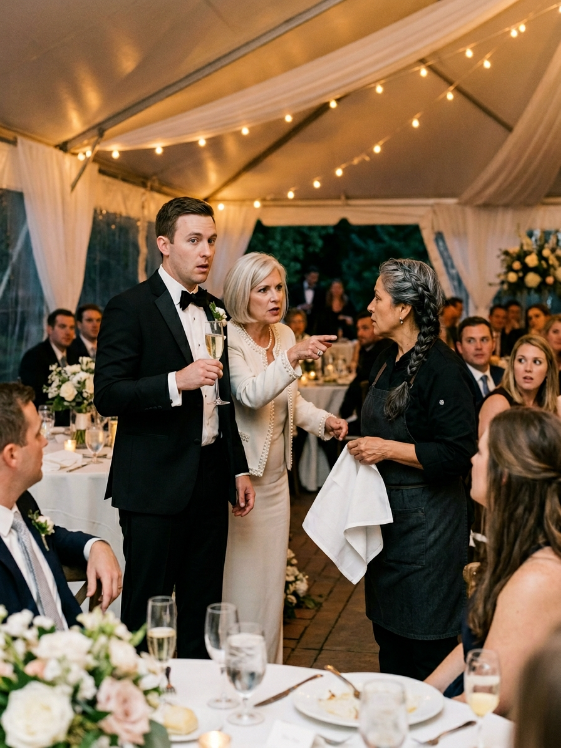
Theresa Vale reached for the tray cloth, and Nathan stepped away from the microphone before his mother could touch it.
The movement was small, but inside the Rosemont Estate wedding tent it landed harder than a dropped glass. Warm string lights trembled over white linens and half-cleared champagne flutes. Guests who had been leaning toward Nathan’s toast leaned back instead, their faces turning from the groom in his black tux to the waitress standing at the edge of the head table.
Elena Ortiz kept one hand around the bunched cloth. She was fifty-five, in a black catering uniform with her dark braid coming loose from the rush of service, and she looked more tired than afraid. The small stitched tag at the edge of the cloth faced the table, not the crowd. Theresa’s pearl suit caught the light as she extended her hand again.
‘Give me that,’ Theresa said.
Nathan heard the last line of the lullaby in his own head before Elena finished humming it. It was not a song people knew. The recording in his dresser was eleven seconds long, a hiss of old tape and a young woman’s voice singing to a baby whose name nobody said.
His bride, Mara, set her reception roses on the table and touched his sleeve. ‘Nathan?’
He could not answer her yet.
Theresa’s smile tightened for the guests. ‘This server has interrupted a private family moment. Someone get the catering manager.’
Elena lowered her eyes. She did not say she was sorry. People who feared rich families always apologized quickly, even when they had done nothing. Elena only folded the cloth once, carefully protecting the stitched tag with her thumb.
He said, ‘Sing it again.’
The tent changed shape around the words.
Theresa snapped her head toward him. ‘Do not make a scene on your wedding day.’
‘You made one,’ Nathan said. ‘Elena, please.’
Elena looked at him then. Her eyes were dark and wet, not pleading, not claiming. She sang the line softly, barely above the clink of a bus tub near the service station. Three notes rose, two fell, and the last one lingered exactly the way it did on the tape.
Nathan had been six when he found the cassette in a blue envelope at the back of Theresa’s locked secretary desk. He had played it once before she took it away. Later she told him his birth mother had left him at a county office with no name, no note, and no wish to be found. The song, she said, was probably from a hospital volunteer.
But she never threw the tape away.
Now Elena’s thumb slid from the cloth tag, and Nathan saw three stitched letters: SJV. St. Jude’s Village, the private adoption home outside Louisville that appeared in the sealed paperwork he had only glimpsed as an adult. Theresa saw him recognize it and moved too fast.
She grabbed the cloth.
Elena held on. Not hard. Just enough.
The tag tore at one corner. A small card slipped from the folded hem and landed on the white tablecloth beside Nathan’s champagne flute. It was old, laminated by age and kitchen heat, with a pressed crease down the middle. No one at the table could read it from where they stood, but Nathan knew the handwriting before he touched it because he had seen the same curve on the cassette envelope.
Theresa whispered, ‘Nathan, come with me.’
He picked up the card.
The front held only a date and his birth weight. The back held one sentence in blue ink: For my son, Nathaniel, if they ever let him ask.
Mara covered her mouth. The catering captain stepped back. Elena’s face crumpled once, then steadied.
‘They told me you received my letters when you turned eighteen,’ Elena said. ‘They told me you asked not to answer.’
Nathan looked at Theresa.
His mother by law. The woman who had taught him which fork to use, which charities mattered, which parts of himself were expensive enough to display. She looked smaller beneath the string lights now, but not sorry. Cornered.
‘You were a child,’ Theresa said. ‘We protected you.’
‘From what?’
‘From confusion. From a woman who signed papers she regretted only after she saw what the Vale name could give you.’
Elena flinched, but she did not defend herself first. She looked at Nathan, not Theresa. ‘I was nineteen. St. Jude’s said the placement was temporary while I found work. When I came back with pay stubs, they said the papers were final and your new family did not want contact. I wrote every month for three years.’
Theresa’s jaw hardened. ‘This is not the place.’
Nathan laughed once, without humor. Around them, phones had lowered. Even the cousins who wanted to intervene seemed unable to move.
‘It became the place when you pointed at her like she was dirt,’ he said.
Mara took the old card from Nathan and read the back. She had known about the tape. She had sat beside him in their apartment while he played a digitized copy late at night and pretended the crackle did not hurt. Now she placed the card beside the microphone and turned it so Theresa could see the handwriting.
‘How many letters?’ Mara asked.
Theresa did not answer.
The answer came from the family attorney, Mr. Bales, who had been seated two tables away and had gone the color of candle wax. He stood slowly, napkin in hand like a surrender flag. ‘There is a correspondence file in the Vale trust archive.’
Theresa turned on him. ‘Sit down.’
Bales did not. ‘It was retained because Mrs. Vale requested confirmation of non-contact for inheritance compliance. There were letters.’
The truth was not a lightning strike. It was worse. It was a locked cabinet opening inside every year of Nathan’s life.
Elena pressed the torn cloth tag flat with her palm. ‘I only wanted to hear your voice once,’ she said. ‘The catering company booked this event two months ago. I almost asked to be reassigned. Then I saw your name on the schedule.’
Theresa’s punishment began in the silence that followed. Not with shouting, but with everyone understanding at the same time what she had done. Mara’s father asked her to leave the head table. Bales gathered his briefcase and walked away from her side of the family. Nathan’s uncle, trustee of the Vale charitable fund, said in a voice that carried, ‘The archive will be opened Monday morning.’
Theresa tried one last version of dignity. ‘Nathan, I am still your mother.’
He looked at Elena’s torn tray cloth, then at the woman who had kept it from him for thirty-one years.
‘You were,’ he said. ‘Tonight you are a witness.’
The reception did not recover, but the marriage did. Nathan and Mara cut the cake without speeches. Elena sat at a side table after the catering captain quietly took her apron and told her she was off the clock with pay. She ate one slice of lemon cake with both hands wrapped around the plate.
Three weeks later, Nathan met her at a diner outside Louisville with the opened trust archive between them. There were forty-two letters. Birthday cards with no stamps because they had never been mailed. Two photographs of Elena at twenty-five holding a grocery store paycheck and a lease, proof she had once tried to become stable enough to ask for her son back.
Theresa resigned from the Vale foundation after the board learned she had used adoption privacy clauses to block contact while publicly funding family reunification programs. Her name came down from the spring gala invitation. No one raised their voice when it happened. That made it worse.
Nathan did not call Elena Mom that first month. He called her Elena, then Ellie once by accident, then Elena again while they learned each other’s coffee orders and silences. She never rushed him.
On the first Sunday of winter, she brought the repaired tray cloth to his house. The SJV tag had been stitched back flat, not hidden in the hem. Nathan placed it beside the old cassette on his kitchen table and played the eleven-second recording while snow tapped the glass.
Elena sang the missing verse softly, and this time nobody reached to take it away.