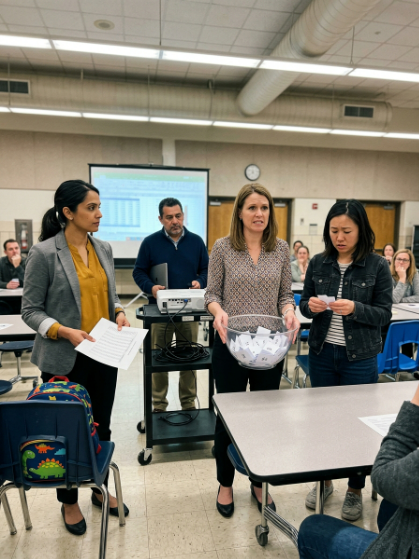
Principal Ortiz did not speak for three seconds after Heather told me to sit down.
Three seconds is longer than people think.
It is enough time for a room to decide whether it is going to protect comfort or truth.
My hand was still on the edge of the projector table.
Heather had the lottery bowl pulled close to her stomach. The folded slips inside it looked harmless, almost childish, little white squares carrying adult consequences.
I looked at Principal Ortiz and said, I need the waitlist file on the screen.
Heather laughed once.
It was not a real laugh.
It was the kind people use when they want the room to remember their status before listening to facts.
This is not a statistics seminar, Dana.
No, I said. It is childcare.
That landed harder than I expected.
A father in the second row muttered, Let her show it.
Then a mother near the cafeteria doors said the same thing louder.
Let her show it.
Meg Han stared down at the stack of unused slips in front of her.
Her hands had gone flat on the table.
I knew that posture.
It was the posture of someone who had followed instructions and then realized instructions can still make you responsible.
Principal Ortiz reached for the laptop connected to the projector.
Heather put her hand over the keyboard.
Luis, she said, this is inappropriate.
He looked tired. More than tired. Embarrassed.
Maybe because he had trusted a process he had never looked at closely. Maybe because peace had seemed easier than auditing a plastic bowl.
He moved her hand gently but firmly.
Meg, he said, please open the spreadsheet.
Meg did not move at first.
Heather whispered her name in a warning voice.
That made the decision for her.
Meg opened the file.
The spreadsheet filled the cafeteria screen.
Names blurred by distance for most parents, but the columns were visible.
Family name.
Grade.
Application timestamp.
Sibling priority.
Eligibility.
Then, at the far right, a column label half hidden because the window was not wide enough.
Sort.
I heard someone behind me say, What is that?
Heather said it was an internal note.
I said internal notes do not belong in random lotteries unless they are excluded before printing.
My voice sounded steadier than my body felt.
I could feel my pulse in my throat.
I could also feel Arjun’s backpack strap still looped around my ankle from where I had left it under my chair. That tiny weight kept me from drifting into abstraction.
This was not about being right.
This was about a child who needed a safe place at 3:15.
I asked Meg how the slips were printed.
She looked at Heather.
Do not look at her, I said more sharply than I meant to. Look at the file.
Meg swallowed.
The room waited.
I sorted by the column Heather told me to sort by, she said.
Heather’s face flushed.
That is not what I told you.
Meg turned toward her then, all the fear draining into something colder.
You told me to use the final order because it kept the process clean.
A sound moved through the cafeteria.
Not a gasp exactly.
More like everyone inhaling at the same time.
Advertisement
Heather tried to regain the room.
The slips were still drawn from the bowl, she said. Everyone saw that.
That was the sentence she should not have said.
Because it let me explain the difference between a visible draw and a random draw.
I asked Principal Ortiz for a marker.
He handed me one from the whiteboard tray.
On the board, I wrote the first fifteen lottery numbers Heather had read aloud.
I had written them in my notebook as she called them.
Then I asked Meg to sort the spreadsheet by the hidden Sort column and read the first fifteen row numbers from the printed-slip list.
She did.
One by one, they matched.
The cafeteria got quieter with every number.
By the seventh, Heather stopped smiling.
By the tenth, a man near the back stood up.
By the fifteenth, Principal Ortiz had both hands braced on the table.
I did not need a complicated model.
That was the worst part for Heather.
The proof was simple enough for tired parents in folding chairs to feel in their stomachs.
I held up my probability printout anyway.
The chance of that sequence appearing naturally from a fair draw was not low in the way rain is unlikely on a sunny morning.
It was low in the way a locked door is unlikely to open because the wind guessed the key.
Heather said I was making accusations.
I said I was reproducing output.
There is a difference.
Then I asked Meg to do the part I could not do from my chair in the audience.
Show the print settings.
Meg’s hand shook as she clicked.
The file had been printed after the Sort column was applied.
The slip numbers matched the row order.
The stack had been cut and folded in that order.
I asked whether the slips had been shuffled after folding.
Meg closed her eyes.
No.
Heather said she had told her not to shuffle because it would make checking easier if anyone challenged the list.
She realized what she had admitted only after she said it.
The bowl had not made the draw fair.
It had made a prearranged list look ceremonial.
A mother in the front row started crying quietly. Her daughter was in kindergarten, she said, and she had turned down overtime because she did not know what else to do.
Another parent asked why the same families kept getting spots.
Another asked whether board members had been tagged in the hidden column.
Principal Ortiz said, Heather, is that true?
Heather looked at him like he had betrayed her by asking out loud.
Those families volunteer, she said.
There it was.
Not a denial.
A justification.
They volunteer.
They show up.
They support the school.
She said it as if the rest of us were strangers trying to steal a benefit from a club instead of parents trying to work and keep our kids safe.
I thought of Arjun packing a granola bar for me.
I thought of him asking if aftercare had games or if it was just waiting.
I thought of all the new families who did not know the right people yet and therefore did not count as committed.
My anger became very calm.
I asked Principal Ortiz to freeze the results.
He did.
Not gracefully.
Not with a speech.
He stood in front of the PTA table and said the aftercare placements would not be finalized that night.
Heather objected.
Parents objected back.
For the first time since the meeting began, the room did not move around her voice.
It moved through it.
Principal Ortiz called the district operations director from the hallway while we waited under the cafeteria lights. Nobody left. Even parents whose children had received spots stayed, because by then the issue had grown teeth.
A fair spot meant nothing if the process could be bent next year.
Meg sat alone at the table.
I walked over to her.
She looked like she expected me to attack her.
I did not.
I asked why she had not said anything earlier.
She wiped her eyes with the heel of her hand.
Because Heather always says there is context, she whispered. And because I did not want to be the difficult parent.
I almost smiled.
Difficult parent.
That phrase had done more damage in schools than most people would ever admit.
It kept smart people quiet.
It made exhausted parents doubt their own eyes.
It turned fairness into a personality problem.
I told Meg she had said something when it mattered.
She shook her head.
You did.
Maybe.
But she had opened the file.
Truth usually needs more than one hand on the door.
The district director arrived forty minutes later with a tablet, a winter coat over workout clothes, and the expression of a woman who had been pulled from dinner into exactly the kind of problem she hated most.
She asked for the spreadsheet.
Heather tried to summarize.
The director held up one hand.
I need the file, not the framing.
I liked her immediately.
Within twenty minutes, she confirmed what I had shown.
The results were invalid.
The hidden Sort column contained board-priority flags and manual rankings unrelated to published eligibility rules.
Longtime PTA families had been moved above newer families with equal or greater need.
The printed slips reflected that order.
The bowl had added theater, not randomness.
Heather sat very still.
Principal Ortiz looked like he had aged a year.
The director announced a rerun for the next morning, conducted by two district staff members using a public randomizer, with the seed number chosen in the room by three parents who were not PTA officers.
She also said the waitlist policy would be rewritten and posted before the next enrollment cycle.
Heather said that was excessive.
The director looked at the crying kindergarten mother, then at Arjun’s backpack under my chair, then back at Heather.
No, she said. It is overdue.
That was the closest thing to applause the room needed.
The next morning, I came back with coffee I had not slept enough to enjoy.
Arjun held my hand outside the office and asked if I had gotten in trouble.
I looked through the glass at the adults gathering around the conference table.
A little, I said.
He considered that.
For math?
For math, I said.
He nodded like that made sense.
The rerun was boring.
That was how I knew it was better.
No performance.
No cheerful speech about patience.
No plastic bowl held like a holy object.
Just eligibility checked, names loaded, a seed chosen in public, results generated, and every parent able to see the same steps.
Some families who had celebrated the night before lost spots.
Some new families got them.
That part was painful, and I will not pretend it was not.
Fairness does not remove disappointment.
It removes the lie that disappointment was destiny.
Arjun’s name appeared in the middle of the list.
Not first.
Not special.
There.
I stared at it until the letters blurred.
Principal Ortiz asked if I was okay.
I said yes, then no, then yes again.
Heather resigned from the aftercare committee before the end of the week. Officially, she stepped back to focus on other commitments. Unofficially, the district removed PTA control from placement decisions and required an audit log for every lottery.
Meg joined the new oversight group.
So did the kindergarten mother.
So did one father whose child had lost a spot in the fair rerun, because he said he wanted to be angry at the outcome without being lied to by the process.
That stayed with me.
I printed the new rules and put them in a folder at home.
Not because I wanted a trophy.
Because systems forget unless someone makes memory part of the paperwork.
Weeks later, Arjun brought home a drawing from aftercare.
It showed a cafeteria table, three kids, and a row of backpacks on hooks.
Mine was labeled MOM in enormous letters even though I was not in the picture.
When I asked why, he said, Because you made the list fair.
I almost corrected him.
I wanted to say the district did it, or the parents did it, or Meg helped, or math only showed what people then had to choose to fix.
All of that was true.
But my son was seven, and sometimes children are allowed to keep the clean version first.
So I taped the drawing to the refrigerator.
The next lottery used the new rules.
New families came in holding forms and worry, just like I had.
This time, nobody told them to be patient as a substitute for being included.
Arjun’s backpack hung on the aftercare hook by 3:15.