We Set His Place at Thanksgiving for Two Years He Wasn’t There FULL STORY
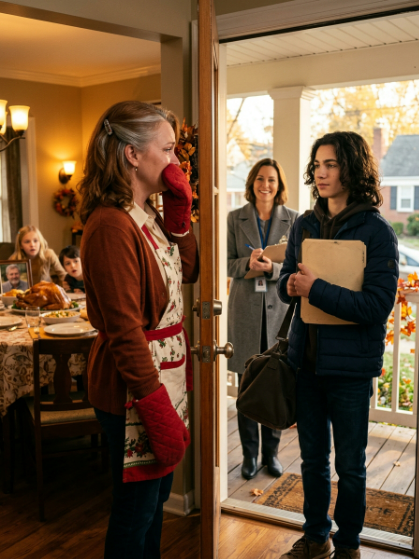
I pulled him inside before the cold could, and the whole table stood up at once.
Sam and Bex knocked their chairs back. The caseworker, Dana, stepped in behind Theo and shut the door on the November air, smiling so hard it looked like it hurt.
Theo held the manila folder out to me with both hands, like it might spill.
“Open it,” he said. “I want to watch you read it.”
Inside was a single page with a court seal at the top and a line near the bottom with my name on it, and his, joined by a word the state does not hand out lightly: finalized.
But that wasn’t the only thing in the folder.
Underneath the decree was an envelope, soft and creased, addressed in my husband’s handwriting.
FOR THE DAY HE COMES HOME, it said. — FRANK.
My knees nearly went.
Dana put a hand on my arm. “He left it with me last spring,” she said quietly. “He came to my office without telling you. He said if the day ever came and he wasn’t there to see it, I was to put it in Theo’s hands. I’ve been carrying it in my desk for seven months.”
That was Frank. Filing one more thing. Hedging against his own heart.
I want to be honest about how this actually happened, because foster stories on the internet skip the boring parts, and the boring parts are where the love lives.
It happened because a tired man in reading glasses refused to let a paperwork lapse become a verdict. Frank filed the appeal himself when the lawyer said it was a long shot. He drove two hours each way to every supervised visit so Theo would never go a month without seeing a face that chose him. He wrote letters to a judge who wasn’t required to read them.
He died in August with the next court date circled on the calendar.
What I didn’t know — what Dana told me on my porch with the turkey going cold — was that the judge had read those letters. All of them. And when word reached the court that the man who wrote them had passed, she did something judges rarely do. She expedited. She moved the hearing up, cleared the last objection, and signed the decree on a Wednesday morning in November.
“Your husband’s file was the thickest I’ve ever seen on a foster case,” she’d written in the margin Dana showed me later. “A child that wanted is a child that goes home.”
Theo read Frank’s letter alone in the room we’d kept ready for two years. He hasn’t told me everything it said, and I haven’t asked, the same way Marta never tells me what my own losses whisper. But he came out with his eyes wet and his jaw set, and he asked me one question.
“Is it okay if I keep the name Donnelly? I know he’s not — I know he’s gone. But he’s the one who—” He stopped. “I want to have his name.”
I said yes before he finished the sentence.
That night, after the pie, I went looking for Theo and found him in his room, sitting on the floor beside the duffel bag he’d carried through nine placements and back to us.
For two years it had sat half-packed in our closet, waiting. He’d told me once, at fourteen, that he never fully unpacked anywhere, because unpacking was how you got your heart broken when they sent you back.
I stood in the doorway and watched a sixteen-year-old boy take everything out of that bag, one item at a time, and put it in a drawer.
When it was empty he held it up, looked at it for a long moment, and then folded it flat and slid it under the bed where he couldn’t see it.
“I don’t need it where I can reach it anymore,” he said.
I had to leave the room so he wouldn’t see me lose it.
We ate Thanksgiving an hour late and cold, and it was the best meal of my life.
We set two extra places that day, like always. Theo’s, finally filled, the boy folding himself into the chair like he’d been afraid the offer had an expiration date.
And Frank’s, at the head of the table, still empty.
I used to think the empty chair was the saddest thing in my house. The thing I couldn’t fix. The proof of who wasn’t there.
I don’t see it that way anymore.
Theo sits to the right of it now. On the night before each holiday he sets Frank’s place himself — the good plate, the water glass filled — and nobody tells him to.
“For the guy who got me home,” he says.
One chair filled by a man who fought to the last filing. One chair kept by the boy he never got to meet at the door.
Some families you’re born into. Some you spend two years and one last letter fighting your way into. Ours is the second kind, and I would not trade a single cold Thanksgiving of it.