We Said Goodbye on That Platform in 1979 FULL STORY
He held the letter out across the cold space between the bench and where I stood, and for a moment neither of us could close it.
Then I sat down beside him, the way I had in 1979, and took it.
The paper was soft as cloth. The date in the corner was from the spring after he left. I didn’t open it yet. I wasn’t ready to be eighteen again that quickly.
“Why did you stop writing?” I asked. It was the question I had carried for forty-five years, and it came out smaller than I expected.
“I didn’t,” Walter said.
And then, slowly, with the long pauses of a man who has rehearsed a thing in private for years and never once said it aloud, he told me.
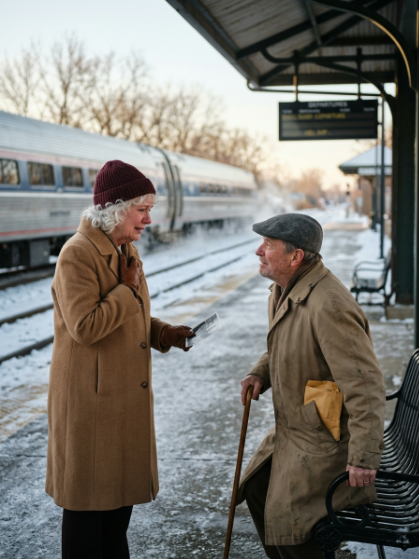
He had written every week, exactly as he promised. For months. When I never answered, he wrote more, then less, then one final time — this letter — and then he made himself stop, because a man can only mail his heart into silence for so long.
“Your letters came back to me unopened,” I said. “I thought you had thrown mine away.”
We looked at each other, two old people on an iron bench, and arrived at the same name in the same breath.
My mother.
She had not approved of Walter. He was leaving, he had no money yet, and she had plans for me that did not include waiting on a poor boy three states away. I was nineteen and living under her roof. It would have been the easiest thing in the world for her to lift his letters from the box before I ever saw them, to send mine back marked return to sender, and to tell each of us, with a sad little shake of her head, that the other had moved on.
She told me he’d married a girl out there. She told me, so gently, to let it go.
So I did. I let go of him for forty-five years on the strength of a lie I never thought to question — because why would a mother lie about a thing like that?
“I found this last one again two months ago,” Walter said. “When my Carol passed, I was going through her boxes, and there it was, with all the others I’d kept. I never knew where to send it, because I never knew where you’d gone.” He looked at the empty track. “Then I read in the paper they were closing the old depot. And I thought—” his voice caught. “I thought maybe you’d have the same notion I did. That a person might want to sit on that bench one last time.”
I opened the letter then.
I won’t tell you everything it said. Some things, even now, are only ours.
But it ended with a line I have read a hundred times since, in his steady nineteen-year-old hand: I’ll wait as long as it takes, even if it takes our whole lives.
We are seventy-one and seventy-three. We do not have our whole lives left. We had a good Tom, and a good Carol, and we will not dishonor them by pretending those years were a detour. They weren’t. They were real, and we loved them, and we said so to each other right there on the bench — because grief and gladness can sit on the same lap, if you let them.
We sat a long while after that. He showed me a photograph of Carol — a kind, round-faced woman holding a fat orange cat — and I showed him the one of Tom on our porch in his terrible fishing hat, and we introduced our dead to each other with the same tenderness you’d use for the living. That, more than the letter, was the moment I knew. A man who lets you go on loving the husband who came after him is a man worth whatever time you have left.
The train we were both not catching pulled out of the station without us.
Neither of us moved.
“There’s a diner two blocks over,” Walter finally said. “It isn’t much.”
“I don’t need much,” I told him. “I had a whole life of much. I’d settle for coffee, and the time we’ve got left.”
We have coffee every Thursday now, at that not-much diner, in a booth the waitress started saving before we ever thought to ask. Some Thursdays we talk for hours. Some we just sit. We are not making up for forty-five years — you can’t, and we have stopped trying. We are only refusing to waste the Thursdays we still have.
He stood the way he does now — slow, with the cane, reaching out of old habit for a hand to steady himself.
This time, after forty-five years, I gave him mine.
And we walked off that platform together, late for everything, and exactly on time.