Undeveloped Film From the Night of the Fire FULL STORY
Ray developed all six rolls that night.
We didn’t speak much. There wasn’t anything to say that the images weren’t already saying for us.
Frame after frame rose out of the trays, and the story my father never got to tell assembled itself in the red glow, one print at a time.
The warehouse on Cherry Street, full of smoke. The loading dock. My father, camera around his neck, must have been driving home from a late job when he saw it.
The photos showed what he did next.
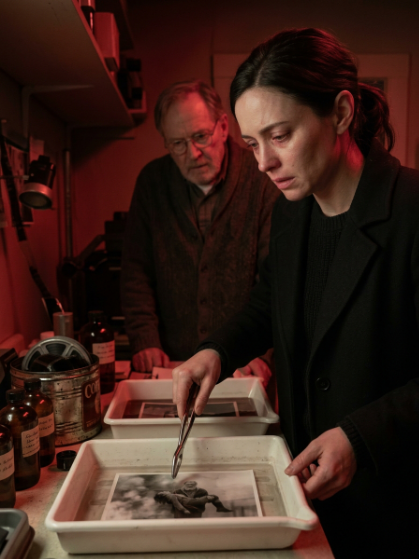
He went in.
There was a sequence—four frames—where he’d clearly set the camera down on something stable and let it shoot on its own while he worked. In them you could see him hauling a man in a security uniform across the floor toward the door. The guard. The one the town said my father killed.
In the next frame, my father was bent over him on the gravel outside, hands on the man’s chest.
He hadn’t started the fire. He’d pulled the only other person out of it.
The guard died anyway. Smoke does that, even after you’re clear of the flames. But he didn’t die alone in there, forgotten. He died on the gravel with a man kneeling over him, trying.
I sat down on Ray’s darkroom stool and cried in a way I hadn’t let myself cry at the funeral.
“Why didn’t he show anyone?” I finally asked.
Ray took off his glasses. “He tried, Nora. Right at the start. He told the investigators he’d been inside. But he had no proof yet—just undeveloped film and soot on his hands. And by the time anyone might have listened, the town had already decided. You know how Galena talks. Once the story sets, it sets.”
I did know.
I remembered the whispers at my high school. The word ARSONIST keyed into my father’s truck. The way people crossed the street. He stopped going to church. He stopped going anywhere. He just retreated into that workshop with his cameras and his silence, and he let them be wrong about him for twelve years.
I think he couldn’t bear to develop the film. To relive it. Or maybe he’d decided that a town that wouldn’t believe his word wouldn’t believe his pictures either, so why open the wound.
He was probably right. While he was alive, they’d have found a way to doubt it.
But he was gone now. And I wasn’t going to let him stay a villain.
The next morning I took the prints, and something else—a thin folder I’d found in the same workshop, the original fire marshal’s report from twelve years ago. My father had requested a copy and kept it.
I’d skimmed it before. This time I read every line.
On page nine, buried in technical language, the marshal had noted that the fire’s origin was “consistent with electrical failure in the north wall” and that “a civilian witness reported entering the structure to assist the security officer.” No name. No follow-up. The lead had simply died in a drawer.
My father was that unnamed witness. The report had half-cleared him a decade ago, and nobody had connected it to the man they’d already convicted in their hearts.
I brought everything to the county fire investigator, a younger woman who hadn’t even lived in Galena back then. She laid the prints beside the old report and went quiet for a long time.
“Ms. Bishop,” she said. “Your father didn’t cause this fire. He died being blamed for a death he tried to prevent.”
The county issued a formal correction. It was a small thing—a paragraph, really, in a record almost no one reads. But the local paper picked it up. SECURITY GUARD’S RESCUER FINALLY IDENTIFIED, the headline said. Twelve years late.
The town reacted the way towns do. Some people sent cards. A few came to the house, awkward, holding casseroles and apologies that had nowhere to land. The pastor asked if he could read the correction aloud on Sunday.
I let him. I sat in the back pew where my father used to sit before they pushed him out of it.
It didn’t fix anything. That’s the part nobody tells you. My father didn’t get to read his own headline. He didn’t get to watch the people who crossed the street walk back across it. He spent the last twelve years of his life carrying a weight that six rolls of film could have lifted in an afternoon, if anyone had been willing to look.
The guard’s daughter found me before I left town. She was about my age. She took both my hands.
“My dad didn’t die alone,” she said. “All these years I pictured him alone in there. Your father was with him.” She was crying. “Thank you for that. Thank you for finding it.”
That was the only thing that felt like enough.
I had a new marker made for my father’s grave. Under his name and his dates, I had them carve four words.
HE WENT BACK IN.
I drove home with the empty coffee tin on the passenger seat, and for the first time in twelve years, I wasn’t ashamed of the name I carried.
I was just sorry he never got to hear me say it out loud.