Trailed From the Graveyard Shift FULL STORY
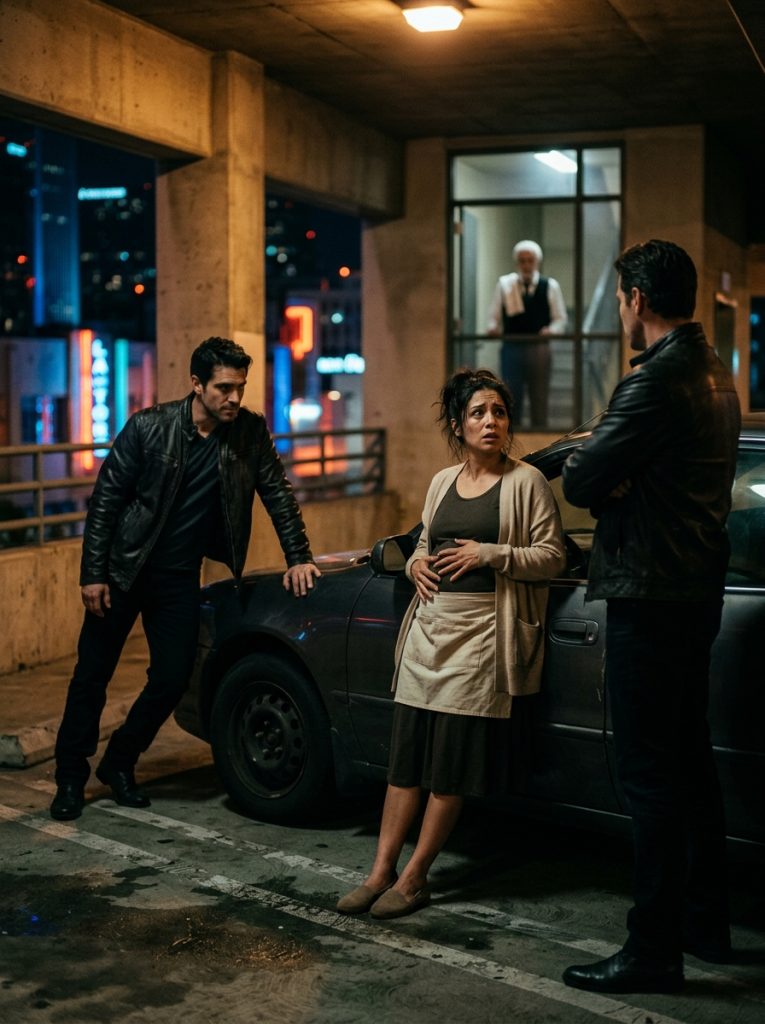
I didn’t see Giovanni that night. I was too busy trying not to panic.
The gum-chewer was still smiling. His partner had moved to block the stairwell door — casually, like he was leaning against it to check his phone, but his eyes never left my stomach.
“Eighty thousand,” he repeated. “Or we revisit this conversation in three months.”
I didn’t sleep that night. I lay in my apartment with one hand on my belly, feeling the baby kick, and I ran through every option I had. I could run. I could beg. I could call the police — but the men who’d been following me were not afraid of the police. Carlos had made sure of that. He’d borrowed from the kind of people the law couldn’t touch.
At 6 AM, someone knocked on my door.
I froze.
“Mrs. Vega.” A man’s voice — not the gum-chewer. Older. Calmer. “My name is Giovanni Russo. I work the bar with you. I just want to talk.”
I opened the door a crack. Giovanni stood on my doorstep in the same bartender’s vest, the same dish towel over his shoulder, the same calm expression he wore every night when he polished glasses behind the rooftop bar.
He held up a manila envelope.
“May I come in?”
I let him in because I was too tired to be afraid anymore.
He sat at my kitchen table and opened the envelope. Inside was a document — a debt contract with Carlos Vega’s name on it, stamped in red: PAID IN FULL.
“This debt no longer exists,” Giovanni said. “The men who threatened you last night have been informed. They will not contact you again. They will not approach you. They will not enter this neighborhood.”
I stared at the stamp.
“How?” I whispered.
“Because I told them to stop.”
His voice didn’t change. His expression didn’t change. But something in the way he said it — the quiet certainty of it — made me understand that Giovanni Russo was not just a bartender.
“Who are you?” I asked.
He set the dish towel on the table. For the first time, I noticed the faded tattoo peeking above his collar — something inked there decades ago and mostly worn away. A symbol I didn’t recognize.
“I used to run things,” he said. “Twenty-five years ago, I was the man people like Carlos Vega went to for loans. I built an organization that controlled the entire downtown corridor. Then my daughter was born, and I realized I didn’t want her to grow up in the world I’d made.”
He looked at my stomach.
“I retired. I moved to a small apartment in Silver Lake. I took a job bartending because I missed talking to people. Nobody knows who I was — not the bar manager, not the other staff. I’ve been invisible for eight years.”
“But you’re not invisible to them,” I said. “The men who hold the debts.”
“No. They still remember my name. And when I call, they still answer.”
He pushed the envelope toward me.
“The debt is paid. The interest is erased. Carlos Vega’s name is removed from every ledger in this city. You are free.”
I started crying. I couldn’t help it. Six months of fear, six months of working double shifts while my body ached and my baby grew, six months of looking over my shoulder every time I walked to my car — and this quiet old man with a dish towel had erased it all in a single night.
“Why?” I managed.
“Because I watched you work for eight months,” he said. “Every shift. Every night. You never complained. You never asked for help. You just kept showing up — for yourself, for your child. That kind of strength deserves protection.”
He stood.
“You won’t see me at the bar anymore. I’ve been meaning to retire for real. But there will be a car outside your building every night — just close enough to be useful. The man inside won’t bother you. He’ll just be there.”
I never saw Giovanni again after that morning. He left the bar the same day, no notice, no goodbye. The manager was confused. The other servers gossiped for a week. I said nothing.
But the car was there — every night, parked across the street. A dark sedan with tinted windows. The man inside never got out. He never waved. But every time I walked past, he tipped his hat.
Three months later, my son was born. Eight pounds, three ounces. Perfect. I named him Mateo Giovanni Vega.
The day I brought him home from the hospital, the sedan was parked outside my building. When I carried Mateo up the front steps, the window rolled down — just an inch. I saw the man inside. He wasn’t Giovanni. He was younger, sharper, the kind of man who’d probably worked for Giovanni a long time ago.
He tipped his hat.
I nodded back.
And I carried my son inside — into a world that felt, for the first time in years, safe.