They Told My Nonverbal Son to “Just Watch” the Robotics Team FULL STORY
The judge in the navy suit crouched to Aanav’s eye level and asked, “Did you build this for someone specific?”
Most fifteen-year-olds would have answered out loud.
Aanav answered the way Aanav answers. He picked up his own device, the one on the table, and pressed three buttons.
A small clear voice came out of the little speaker.
“For me. So people hear me.”
I had to put my hand over my mouth. I was filming from the back and I nearly dropped the phone.
The judge — her name was Eleanor Voss, and I’d find out within the hour that she wasn’t only a fair judge, she was a patent attorney who’d spent twenty years in assistive technology — went very still. She turned the device over in her hands with the care of someone who knew exactly what they were looking at.
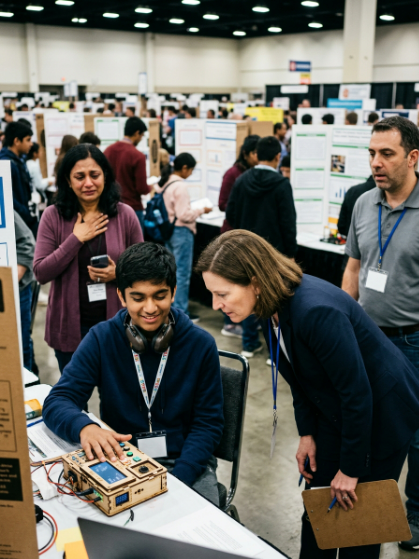
“This is a full augmentative communication device,” she said, half to Aanav and half to the crowd that had gathered. “Core vocabulary, custom phrases, a text-to-speech engine. The commercial version of this costs four to seven thousand dollars and the insurance fights you on every one.” She looked at the index card taped to his trifold, the cost breakdown he’d done in pencil. “You built this for under sixty dollars in parts.”
“Sixty-two,” said the little speaker, after Aanav pressed his buttons. The crowd laughed — the good kind, the kind that was with him.
That’s when I saw Mr. Bregman.
The robotics coach. The man who’d told my son he could “just watch.” He was standing at the edge of the crowd, and the look on his face was the look of a person rearranging everything he thought he knew.
I didn’t say anything to him. I’d promised myself I wouldn’t. This was Aanav’s moment, not my chance to settle a score.
The judging took another hour. I stood at the back and watched my boy explain his work to a stream of strangers, pressing his buttons, patient with every question, lighting up when someone got it.
He won the state fair’s grand prize in his division.
But that wasn’t the part that changed his life.
The part that changed his life was Eleanor Voss handing me her card afterward and saying, “Mrs. Desai, with your permission, I’d like to help your son protect this. Pro bono. A provisional patent, to start. Not because it’ll make him rich — because if a company tries to claim this idea, I want his name on it first. Kids like Aanav deserve to own what they invent.”
She knelt back down to Aanav. “Is that something you’d want? Your name on it?”
He pressed his buttons.
“Yes. And free for kids who need it.”
Eleanor Voss smiled like someone who had just been reminded why she went into her line of work.
“We can write it exactly that way,” she said.
Here is what happened after, in the order it mattered.
Aanav’s device — he named it “OutLoud” — is now in a pilot program at three school districts, licensed at cost, free to any family that can’t pay. The provisional patent is in his name. He’s fifteen. The first time he saw the legal document with “Inventor: Aanav Desai” printed on it, he traced the words with his finger for a long time, and then he pressed his buttons and the little voice said, “That’s me,” and I lost it completely in a lawyer’s conference room.
The robotics club asked him back. Properly this time. Mr. Bregman came to our house to do it in person.
I let Aanav decide. I stayed quiet, the way I’d stayed quiet through all of it, because the whole point was that my son’s choices were his.
Aanav listened to the apology. Then he pressed his buttons.
“I will come back,” the voice said. “If everyone gets to build. Not just watch.”
Mr. Bregman’s eyes filled up. “Everyone builds,” he said. “I promise. Starting with you.”
To his credit, he kept it. The next semester, Aanav co-led the build team. The same kid who’d been parked at the edge of the room ran the soldering station and taught two younger autistic kids how to use his speech device so they could participate too.
People ask me how I stayed silent all that time. How I watched my son get sidelined and didn’t burn the place down.
The honest answer is that some days I didn’t stay calm at all. I cried in the car. I drafted furious emails I never sent.
But I learned something watching Aanav build at our kitchen table, night after night, for a club that didn’t want him.
He wasn’t building to prove them wrong. He was building because he had something to say, and the world hadn’t made him a way to say it, so he made his own.
My job wasn’t to fight that fight for him. It was to keep the lights on, take the photos, and be standing in the back of the room — phone up, heart full — on the day the world finally leaned in to listen.
“For me,” his little voice had said. “So people hear me.”
They hear him now.
All of him.