They Said the Old Man in ICU Bed 7 Had No One FULL STORY
The woman in the photograph was my mother.
Younger than I ever knew her. Standing outside a brick storefront with flour on her apron and that same crooked smile she gave me every morning of my childhood.
I sat down hard in the visitor’s chair.
Arthur’s breathing had gone shallow and slow. The monitor counted it for both of us.
“Arthur,” I whispered. “How do you know my mom?”
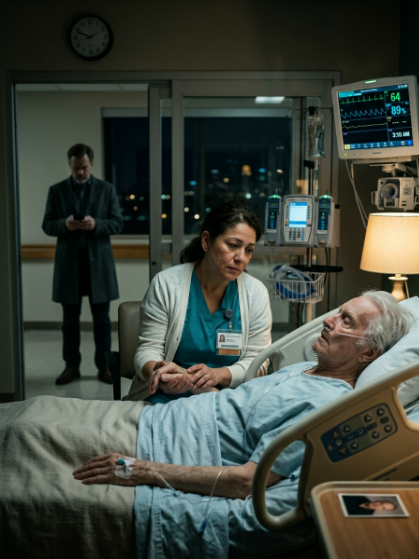
But he was past words now. His hand had gone soft in mine.
I held it anyway. I held it until 4:11 a.m., when the line went flat and the room filled with the sound I will never get used to.
No family came. I called the number on file. Daniel’s voicemail picked up. I left the message you’re trained to leave, calm and kind, and then I stood in the hallway and cried for a man I’d known for nine nights.
The heirs came the next morning.
Suddenly there were four of them. Daniel, two cousins, a lawyer in a grey suit. They moved through Arthur’s room like appraisers, asking about a watch, a ring, a safety deposit box.
Nobody asked what his last words were.
I almost didn’t tell them. But I’m not built that way.
“He said to tell her he never forgot the bread,” I offered.
Daniel didn’t even look up. “He was confused at the end.”
He wasn’t, though. I knew that now.
Three weeks later, a letter came to my apartment. Cream envelope. A law firm I’d never heard of.
I assumed it was a mistake until I read my own name. Rosa Delgado, RN.
It asked me to attend the reading of the estate of Arthur Lindqvist.
The same conference room. The same heirs, dressed for money. And me, in the back, still in scrubs because I’d come straight off shift.
The lawyer read the will in a flat voice until he reached a section that made Daniel sit up.
“The bulk of my estate,” he read, “I leave not to my children, who learned my account numbers but never my room number.”
The cousins went still.
“To St. Brigid Memorial Hospital, I leave four million dollars, to build and staff a family room on the ICU floor, so that no patient there ever spends a night alone again.”
Daniel was on his feet. “This is insane. He wasn’t competent—”
“He was evaluated by two physicians,” the lawyer said calmly. “He was entirely competent. There’s more.”
He turned to me.
“To Rosa Delgado, the night nurse who sat with me, I leave two hundred thousand dollars and the explanation her mother never had the chance to give her.”
My ears were ringing.
The lawyer slid an envelope across the table. My name, in a shaking elderly hand.
I opened it in the parking garage because I couldn’t wait.
Rosa, it began. You won’t remember me, but I remember you.
Forty years ago I lost everything. My business, my house, my pride. For one winter I slept behind a bakery on Lake Street and ate what the owner left out for me. Wrapped in wax paper. Still warm.
Her name was Marisol. Your mother. She never made me feel like a beggar. She’d say, “Eat, hombre, you’ll insult me if you don’t.” She did that every morning for four months until I got back on my feet.
I tried to repay her once, years later, when I had money again. She refused. She said, “Then do it for someone else someday.” I built three companies on the strength of those mornings and never told a soul why.
When I opened my eyes in that hospital and saw your face, I thought I was dreaming. You have her smile. You did for me exactly what she did. You fed a stranger his last dignity.
So this is me, finally, doing it for someone else. Staff that family room. Fill it. And tell your mother, wherever she is, that the man with the bread finally paid her back.
I sat in my car and sobbed.
My mother died when I was twenty-six. She never told me about the man behind the bakery. She probably didn’t think it mattered.
It mattered.
A year later, they cut the ribbon on the Marisol Delgado Family Room on the fourth floor of St. Brigid Memorial. Sofas. Warm lamps. A kitchen that always has coffee. A cot for the daughter who can’t bear to drive home.
Daniel contested the will. He lost. Twice.
I still work nights.
And on the quiet shifts, when a patient has no one, I pull the chair to the railing and I take their hand.
Because my mother taught a starving man that nobody should be invisible.
And he spent his last breath teaching it back to me.