They Handed Me a $250 “Pity Scholarship” with a Smirk FULL STORY
The auditorium went quiet, and I let it stay quiet for a second longer than was comfortable. I’d learned that from him, too. Mr. Alvarez always said the most important thing a teacher does is wait.
“Eighteen years ago,” I said, “I graduated from this school. A lot of you weren’t born yet. Some of your teachers were students here themselves.”
A little laughter. Good. I needed them loose.
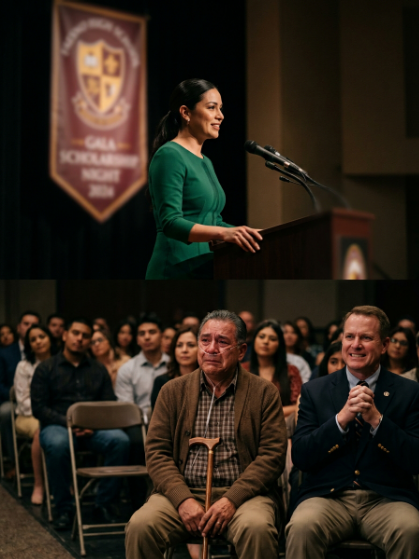
“That spring, I was given an award from this stage. The Booster Club Hardship Award. Two hundred and fifty dollars.” I found Glenn Forsythe in the third row. “It was presented by a man who is, I’m delighted to say, here tonight.”
Heads turned. Glenn sat up, pleased, already arranging his face into the modest smile of a man about to be thanked.
“He held the envelope away from his body,” I went on, “like poverty might be catching. He called us ‘these kids.’ And he was right about one thing. Every little bit did help. That two hundred and fifty dollars bought my first semester of textbooks.”
Glenn’s smile flickered, unsure now which way this was going.
“But it wasn’t the money that got me out of Fresno,” I said. “It was a sentence. Four words, whispered across an aisle by a shop teacher who wasn’t even getting paid to care about me.”
I looked down at the front row.
“Mr. Alvarez. Stand up if you can, sir.”
He waved a hand — no, no — but his daughter helped him to his feet, and he stood there in his brown cardigan, leaning on his cane, the oxygen line catching the stage light, looking like he wanted to disappear and shine at the same time.
“This man bought me a graphing calculator with his own paycheck,” I said. “He let me eat lunch in his classroom for three years so I didn’t have to eat alone. When I told him I wanted to study engineering, nobody else in my life thought that was a sentence a girl like me was allowed to finish. He just said, ‘You’re going to fly.'”
My voice did the thing I’d promised myself it wouldn’t. I let it.
“So I did.”
I straightened the index card I didn’t need.
“Tonight I’m establishing the Daniel Alvarez Scholarship. Not one award. Fifty. Full tuition, books, and housing, renewable for four years, for fifty students from this district every single year — the kids who have the grades and the grit and not the bank account. Funded in perpetuity. Starting this fall.”
The room didn’t clap right away. It gasped first. Then it stood.
I had to raise my voice over it.
“And every recipient will be told the same thing I was told. Not by me. By him. We recorded it last week. Every student who gets this scholarship, for as long as this school stands, is going to hear Mr. Alvarez say, ‘You’re going to fly.'”
That was when the old man finally broke. He put his hand over his mouth and his shoulders shook, and his daughter wrapped her arm around him, and the whole auditorium was on its feet roaring, and I stood at that podium and cried in my emerald dress in front of nine hundred people and did not care even a little.
Glenn Forsythe clapped too. What else could he do. But he clapped like a man who had just understood, eighteen years too late, the difference between charity handed down with a sneer and belief handed across an aisle for free.
Afterward, the line to reach Mr. Alvarez stretched out the auditorium doors. Former students. Current ones. Parents. A girl in a thrift-store dress who reminded me so much of myself that I had to look away.
I knelt by his chair when the crowd finally thinned.
“You shouldn’t have,” he said. “All that money. On an old man’s name.”
“It’s not on your name,” I said. “It’s on the thing you did with it.”
He held my hand in both of his, the way he used to hold a stripped bolt he was about to teach you to fix.
“You flew,” he whispered.
“You taught me how.”
He passed in March, like the doctor said he might. But he went knowing his name would call fifty kids out of the back row every year, for longer than any of us will be here to see.
The first class of Alvarez Scholars starts this fall.
I read every one of their essays myself.
And at the bottom of each acceptance letter, there’s a short video link, and a man in a brown cardigan looking right into the camera, telling a kid he’s never met the truest four words I know.