They Gave My Boss the Award for a Building I Designed FULL STORY
I rolled toward that stage with my heart in my throat and three hundred people turning in their chairs to watch me come.
The ballroom had not been built for a wheelchair to reach the stage. There were stairs, of course. There are always stairs. For one horrible second I was sure I’d have to sit at the bottom of them while the whole room looked down at me.
But Eleanor had thought of that. Of course she had. There was a ramp along the side I hadn’t noticed when they tucked me in the back, and a spotlight operator who held the light on me the entire way up — so that the climb didn’t feel like an apology. It felt like an entrance.
Eleanor took my hand at the top.
Then she turned to the room and told them the truth.
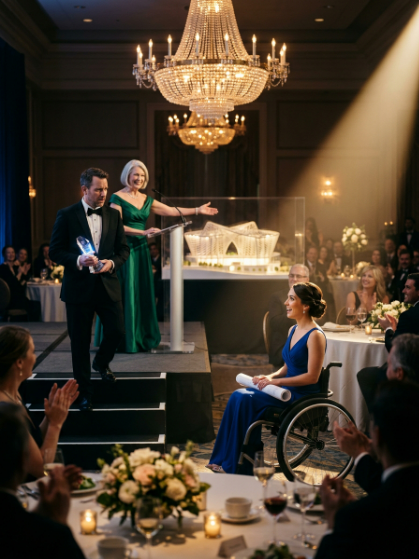
“Eighteen months ago,” she said, “I asked to review the structural calculations for the Cascade Pavilion. The cantilever you’ve all seen in the photographs — the one two engineering journals called impossible. I wanted to know whose mind made it stand up.”
She paused, and the room leaned in.
“Every calculation packet in our archive had the lead engineer’s name stripped out of the title block. Someone had taken the trouble to scrub it. But they missed the footers. Engineers always sign the footers. And across three hundred pages of the most elegant structural work I have seen in forty years in this business, the name down in the footer was the same name, every time.”
She looked at me. Then she looked, for a long moment, at Trevor, frozen on the steps with a trophy he no longer knew how to hold.
“It was not the name printed on the cover.”
You could feel the entire ballroom rearrange itself. Three hundred people doing the same arithmetic at the same instant, and every one of them arriving at Trevor.
He tried. I’ll give him that much. “Eleanor, the design was a team effort — collaborative — Brooke was a valued part of—”
“You presented it to the client as your own work,” Eleanor said. “You moved her off the site meetings and told the partners she ‘wasn’t mobile enough.’ I have the emails, Trevor. I’ve had them for a year. I was waiting to see whether you would do the decent thing on your own.”
She held the award out to me.
“You never did,” she told him. “So I will.”
I won’t pretend my hands were steady when I took it. They were not.
I said something into the microphone about my team, because it was true, and because the whole difference between Trevor and me is that I know exactly whose names belong in the footers.
And then I said the thing I’d been swallowing for fifteen years.
“To the engineers coming up behind me who keep getting seated by the kitchen doors — design the impossible thing anyway. Sign your work somewhere they can’t erase it. Somebody is always, eventually, reading the footers.”
The room came up out of its chairs.
Trevor was gone within the month. Not fired in a scene — Eleanor is far too precise for that. He simply walked out through a door and was never invited back through it, the same quiet way he’d once walked me out of those meetings.
The firm made me a principal that spring. My name goes on the cover now, where it should have been from the start. The first thing I did with the new title was tear out the “accessible seating” at every company event. We don’t seat anyone by the kitchen anymore. Eleanor approved it before I’d even finished the sentence.
A first-year engineer found me at my desk a few weeks later. Deaf, brilliant, already being talked over in meetings the same way I had been at her age. She’d seen a clip of the gala that somebody posted online. She didn’t want advice, she said. She just wanted to see, in person, that it was possible to be the one who stayed.
I cleared the chair across from my desk for her. I’ve kept it clear ever since.
The Cascade Pavilion still reaches out over the water, exactly the way the journals swore it couldn’t.
There’s a small brass plate near the entrance now, with the structural engineer’s name on it.
Mine.
For nineteen years, people decided what I couldn’t do long before anyone thought to ask what I could.
It turned out the only thing I truly couldn’t do was make them ask.
So one night, under a borrowed spotlight, I stopped waiting for the question — and I showed them all of it at once.