They Called Me a Shoplifting Risk and Tailed My Cane FULL STORY
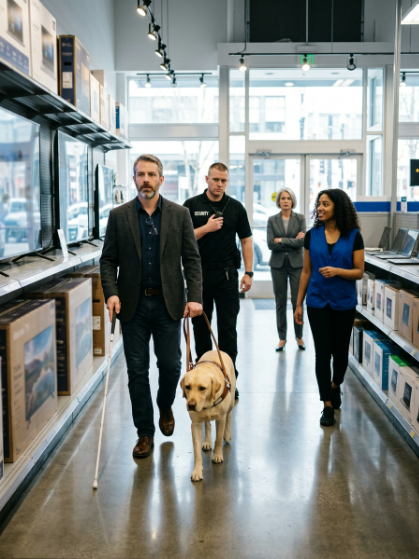
“How has my morning gone,” I repeated. I let the question sit in the quiet store for a moment. “Eleanor, can everyone hear me all right?”
“They can,” she said. Her heels had stopped a few feet away. I could hear the manager’s breathing change.
“Good. Because I’d like to give my first observation while it’s fresh.” I shifted my grip on the cane. “I’ve been in the store eleven minutes. In that time, I was followed by security from the moment I entered. I was told my guide dog wasn’t allowed, which is a violation of the Americans with Disabilities Act. The guard radioed a colleague to ask about ‘walking me out.’ And a manager suggested I’d be ‘more comfortable’ shopping elsewhere.”
You could have heard a pin drop on that glossy floor.
“That’s four ADA problems before I reached the television aisle,” I said. “Which is, I’ll admit, efficient. You’ve given me half my report and I haven’t even taken out my recorder.”
Eleanor Shaw’s voice was very controlled. “Who told you the dog wasn’t allowed?”
“I did.” Dale, the guard. To his credit, he didn’t lie. To nothing else’s credit, he added, “I was following protocol. He fit a profile.”
“What profile is that?” I asked. Genuinely curious.
He didn’t answer.
“I’ll tell you what I am,” I said, not unkindly, because I’ve been angry in stores before and it never taught anybody anything. “I’m a man who lost his sight at nineteen and spent the next twenty years learning every single way a building, a website, and a sales floor can tell a person like me that he doesn’t belong. I’m very good at noticing it now. Your company is paying me a significant fee to notice it, write it down, and tell you how to fix it. You just gave me a live demonstration for free.”
The manager started in. “Sir, if I’d known who you were—”
And that was the sentence that ended him, really. He just didn’t know it yet.
“That’s the problem, isn’t it,” I said. “You’d have treated me like a person if you’d known I was important. The whole point of my job is that you shouldn’t need to know. The next blind customer who walks in won’t have a vice president parking outside. He’ll just have his cane, his dog, and his money, same as me. What happens to him?”
Silence.
“There was one exception,” I added. “A young woman. Royal blue vest. Priya. She offered to help, told me to take my time, treated me like a customer and not a threat. While everyone else was managing a liability, she was doing the actual job.”
I heard a small sound from somewhere to my left. Priya, I think, realizing she’d been seen.
Eleanor Shaw is not a woman who wastes time. I’ll give her that.
The guard was walked off the floor that afternoon, pending review of his “profiles.” The manager — who, it came out, had a pattern of these little suggestions to customers who didn’t look like his idea of a customer — was gone by the end of the week. Not because he embarrassed a consultant. Because once they pulled the door-camera logs and the complaint history, the consultant had only witnessed what a dozen quieter people had already lived.
Priya got promoted. I made sure her name was in the report in ink, not as a footnote, as the example. Within six months she was running the accessibility-training program I designed for the whole region — the one every new hire now takes before they ever set foot on a floor. She emails me sometimes. The last one said a blind teenager came in to buy his first laptop, and her newest trainee knelt down, introduced himself to the dog by name, and asked the kid what he wanted to do with it.
“He wanted to make music,” she wrote. “We sold him the laptop and the software and nobody followed him once.”
That’s the report I actually came to write. Not the four violations in eleven minutes.
The fix.
I still shop there, at that exact location. Dale’s old post is empty most days. When I come in now, somebody usually says, “Morning, Mr. Bell. Morning, Duke.” They say the dog’s name. People always remember the dog’s name first. I’ve made my peace with that.
Here’s what I’ve learned in twenty years of being underestimated by buildings and the people inside them.
Nobody ever asked what I couldn’t do because they were curious. They asked because it was easier than finding out what I could.
The day they stop guessing, and start asking — that’s the day the door finally opens.
For me, it opened with a vice president’s heels on a Tuesday morning.
For the next guy, I’d like it to just be open already.
That’s the whole job.