They Called Me a Gold-Digger at the Will Reading FULL STORY
Mr. Okonkwo opened the visitor logbook and set it on the table beside the photographs.
“Six years of entries,” he said. “I’ll spare everyone the full reading. But I’d note for the record that Ms. Delgado’s name appears more than nineteen hundred times. Mr. and Mrs. Abernathy’s names appear, together, eleven.”
Lydia stopped talking after that.
I should explain how I ended up the only name on those pages.
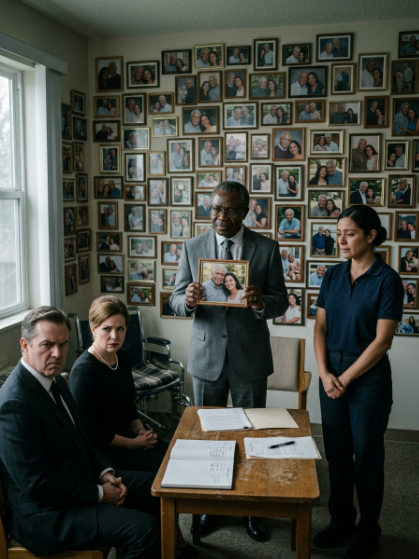
When my father first started at Cedar Pines, Walter was already there—a widower, a retired high-school music teacher, sharp as a tack and lonely as an empty church. His kids had moved him in and moved on. I was nineteen, doing community college, sitting in the lounge most nights while my dad cleaned.
Walter taught me chess to pass the time. Then he started saving the crossword for me. Then somewhere in there, without either of us deciding it, he became family.
I kept coming after my dad retired. After I got my own job at the facility, in housekeeping. I came on my lunch breaks. I came on holidays, because holidays were the worst for him—he’d watch the door, and his kids would call for four minutes from somewhere loud and then not come.
I never once thought about his money. I didn’t know he had any. He lived in a single room and wore the same three cardigans.
So when the will named me, I was as shocked as anyone.
Grant recovered first. “We’ll contest it on undue influence,” he said to the lawyer, ignoring me entirely. “She’s a housekeeper. She inserted herself into a vulnerable man’s life. Any judge will see it.”
Mr. Okonkwo nodded slowly, like he’d expected exactly this.
“You’re welcome to contest,” he said. “I should tell you that Mr. Abernathy anticipated you would. He left something to be read aloud in that event. He was quite specific.”
He took out a single sheet, handwritten. Walter’s shaky cursive. I knew it from a hundred birthday cards.
He read it.
“To my children, Grant and Lydia. If you are fighting over this letter, then you came back the moment you smelled money, exactly as I knew you would.
I am not leaving my house to Maria because she tricked me. I am leaving it to her because for six years she was the only person who treated me like I was still alive.
She brought me Coltrane records. She learned to play chess badly so I’d feel like a champion. She sat with me through two pneumonias and one Christmas none of you remembered. When I was afraid at night, she stayed past her shift and held my hand, off the clock, asking for nothing.
You gave me your name and your blood. She gave me her time. Time is the only thing that was ever real.
To Grant and Lydia, I leave one dollar each, and the truth: you did not lose your inheritance. You spent it, a skipped visit at a time, over many years.
To Maria, I leave the house, and my records, and my thanks. Be happy in it, kiddo. You earned every brick.”
The room was silent.
Lydia was crying, but I don’t think it was grief. Grant stood up, said something to his lawyer about “fighting this,” and walked out. He did try, for a while. His own attorney eventually told him the photo wall and the logbook and the letter made it hopeless, and he gave up.
I didn’t celebrate. I want you to understand that.
I went back to Walter’s room after everyone left. I sat in the chair I’d sat in for six years. I looked at the wall of photographs—all those ordinary Tuesdays, his arm around me, both of us laughing at something I can’t even remember now.
And I would have given the house back. The whole thing. For one more of those Tuesdays.
That’s the part Grant and Lydia never understood. They thought I won something. I didn’t win. I lost my friend, and the world handed me his house as a consolation prize I never wanted.
I live there now. I kept his chair by the window. I kept every record.
On Sunday afternoons I still put on Coltrane, loud, the way he liked it, and I leave the chess board set up on the table even though I’ve got no one to lose to anymore.
The neighbors think I’m sentimental. Maybe I am.
But every time the saxophone comes on, for about three minutes, it feels like he’s just in the other room, saving the crossword for me.
And that’s worth more than the deed will ever say.