The Wound My Husband Tried to Hide Revealed More Than Infidelity
PART 3 (FULL STORY)
“And that was when I realized Tristan’s story had a hole in it.”
The officer leaned closer. “Start from the beginning.”
I tried to think past the fever, the pain, and the medication making every memory feel as though it belonged to someone else.
“The scrape happened three days ago,” I said. “I caught my heel on the broken edge of a storage bin in the garage. It wasn’t deep. I cleaned it, put a small bandage over it, and forgot about it.”
Dr. Mensah nodded.
“What happened after that?”
“Nothing unusual at first. It was sore the next morning, but I could walk.”
“And the bandage?”
“Tristan changed it.”
The officer’s pen stopped.
“When?”
“The night before everything got worse.”
Dr. Mensah and the officer exchanged another look.
I hated that look.
It was the expression people wore when they already knew something and were waiting to see whether you would say it yourself.
“He told me the scrape looked dirty,” I continued. “He said I was doing a terrible job taking care of it. He cleaned it and wrapped it again.”
“Did you see what he used?”
“No.”
“Did he give you anything?”
“No.”
“Did he touch the wound directly?”
I closed my eyes.
“Yes.”
The officer wrote something down.
“What happened afterward?”
“I developed a fever.”
“How high?”
“I don’t know. Tristan told me it wasn’t serious.”
Dr. Mensah’s jaw tightened.
“It reached 104 degrees,” she said. “That isn’t a minor fever.”
“I know that now.”
The officer closed his notebook for a moment.
“Reese, I need to ask you something difficult.”
I looked at him.
“Has your husband ever prevented you from getting medical care before?”
I thought about the canceled rides.
The credit cards.
His fist against the bathroom door.
The way he had stood in the hallway and spoken to me as though my life were an inconvenience.
“No,” I whispered.
Then I corrected myself.
“Not like this.”
The officer nodded slowly.
“What happened tonight?”
I told him everything.
The first canceled ride.
The second.
The threats.
The joint account.
The fire stairs.
The ER.
When I finished, the officer looked at Dr. Mensah.
She opened the folder.
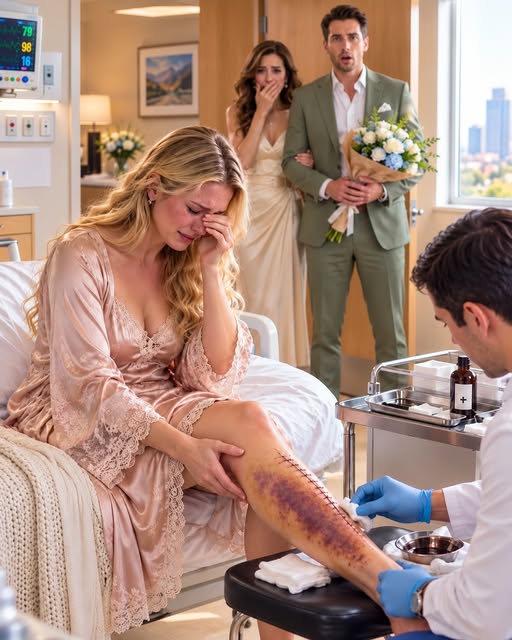
Inside were photographs of my ankle from the moment I arrived.
I had never seen them before.
The black streaks looked worse in the photographs than they had in my memory.
“This is why I called the police,” she said.
She pointed to the wound.
“Some infections can progress rapidly on their own. But the distribution here, combined with your blood work and the history you gave us, raised another concern.”
“What concern?”
“That something may have been introduced into the wound.”
The room seemed smaller.
“Something?”
“We don’t know exactly what yet.”
The officer leaned forward.
“But we found traces of a chemical compound in the material taken from the wound.”
My stomach turned.
“Chemical?”
Dr. Mensah nodded.
“Not something we would expect from a simple scrape.”
I stared at the photographs.
For several seconds, nobody spoke.
Then I remembered the bandage.
Tristan’s hands.
His calm voice.
You’re not in immediate danger.
We’ll deal with it tomorrow.
A cold feeling moved through me despite the fever.
“Can you test the old bandage?”
The officer looked at me.
“Do you still have it?”
“I think so.”
“Where?”
“At home.”
The words had barely left my mouth when the officer’s phone rang.
He answered.
His expression changed before he said a word.
“Detective?”
He listened.
Then he looked directly at me.
“We have a problem.”
“What?”
“The hospital security desk says a man identifying himself as your husband is downstairs.”
My stomach dropped.
“Tristan?”
The officer stood.
“He wants to see you.”
Dr. Mensah immediately shook her head.
“No.”
The officer looked at her.
“He isn’t coming into this room.”
A minute later, security confirmed that Tristan had refused to leave.
He had apparently told them I was confused, that I was seriously ill, and that he was my husband.
He wanted to speak to the doctor.
He wanted to know what medications I had received.
Most of all, he wanted to know whether I had told anyone what happened at home.
That last question was enough for the officer to request additional security.
I lay still, listening to footsteps in the hallway.
For the first time since I had married Tristan, I understood something that frightened me more than his anger.
He wasn’t worried about me.
He was worried about what I might say.
The police did not let him into my room.
Instead, an officer met him at the nurses’ station.
I couldn’t hear every word through the closed door, but I heard Tristan’s voice.
“I just want to take care of my wife.”
The officer answered.
“You can do that by cooperating with the investigation.”
Tristan’s voice became sharper.
“This is a family matter.”
“No,” the officer said. “It became a police matter when a physician requested our presence.”
The hallway went quiet.
Then Tristan asked something I could not hear.
The officer replied.
“We need to speak with you about the injury.”
There was another silence.
Then Tristan said, very calmly, “She has been confused for days.”
My eyes opened.
Confused.
That was his story now.
Dr. Mensah came back into the room and closed the door behind her.
“He’s trying to establish that you’re unreliable.”
I laughed once.
It hurt.
“I have a 104-degree fever.”
“I know.”
“And I’m supposed to be confused?”
“You’re awake, oriented, and answering questions appropriately.”
She paused.
“But don’t worry about proving anything tonight. Your job is to survive this.”
The next several hours blurred into surgery, medication, blood draws, and nurses checking my vital signs.
The doctors removed infected tissue from my leg.
They told me the infection had progressed far enough that waiting even another night could have resulted in permanent damage.
I kept thinking about the sentence Tristan had repeated.
We’ll deal with it tomorrow.
There might not have been a tomorrow for me.
By morning, the police had obtained permission to collect evidence from our home.
I asked about the old bandage.
The officer returned several hours later.
He didn’t have to tell me what they found.
His face did it first.
“The bandage contained traces of the same compound we detected in the wound.”
I stared at him.
“So it wasn’t just an infection.”
“No.”
“Someone put it there.”
“We’re treating that as a serious possibility.”
I looked down at my hands.
“Did you find anything else?”
“Yes.”
He placed a photograph on the table.
It showed the medicine cabinet in our bathroom.
Several containers were missing.
One prescription bottle had been opened.
And beside it was a small plastic container I had never seen before.
“What is that?”
“We don’t know yet.”
“Where was it?”
“In the drawer where your husband keeps his travel supplies.”
Travel.
The word hit me.
Vancouver.
His vacation.
His mistress.
The phone call.
The $10,000 hospital check.
I suddenly understood why that threat had sounded so strange.
He hadn’t simply wanted me to stay home.
He had wanted me available.
He wanted me healthy enough to do what he demanded, but too frightened to challenge him.
And when I refused, he had tried to take away my access to money.
The officer watched my face.
“What are you remembering?”
I told him about Vancouver.
About his mistress.
About the crash.
About the demand that I fly there and take care of them.
About the threat to cancel the check for our child’s hospital bill.
The officer frowned.
“You received that call when?”
“Earlier that evening.”
“Before or after your fever worsened?”
“Before.”
He wrote it down.
Then he asked the question that made my blood run cold.
“Did Tristan tell you what happened in Vancouver?”
“He said he crashed.”
“Anything else?”
“He said his leg was injured.”
“And the woman?”
“His mistress was with him.”
The officer nodded.
“Did he tell you her name?”
“Yes.”
I gave it to him.
He left the room.
For the next hour, nobody explained what was happening.
Then Detective Harris returned.
He pulled a chair beside my bed.
“We contacted the authorities in Vancouver.”
I waited.
“Your husband’s account of the crash doesn’t match what they have.”
I felt the room tilt slightly.
“What do you mean?”
“He wasn’t the only person involved in the accident.”
I stared at him.
“The woman with him was driving.”
I said nothing.
“She survived with minor injuries.”
“And Tristan?”
“His injuries were not as severe as he claimed.”
My mouth went dry.
“Then why did he tell me to come?”
Detective Harris looked at me for a long moment.
“We’re still determining that.”
That answer stayed with me.
Because I knew Tristan.
He did not create complicated plans without a reason.
He liked control.
He liked having every person around him believe they needed him.
And for years, I had helped him maintain that illusion.
I had paid bills.
Managed schedules.
Covered for him.
Explained his absences.
I had even learned to apologize when he was the one who had hurt me.
But there was one thing I had never done.
I had never believed he would deliberately put my life at risk.
Now I wasn’t sure what I believed anymore.
The investigation continued for days.
The tests from the wound were sent to a laboratory.
The police examined the bathroom, the bandages, the medication cabinet, and Tristan’s messages.
They found more than enough evidence to keep asking questions.
But the piece that changed everything came from his phone.
There were messages between Tristan and the woman in Vancouver.
At first, they were ordinary.
Plans.
Travel details.
Hotel reservations.
Then the tone changed.
She had asked him whether I knew about the affair.
He had answered that I suspected something, but that I wouldn’t leave because of our child’s medical expenses.
Then she asked about the money.
He told her he could control that.
One message was only seven words long.
“She won’t risk losing the hospital money.”
I read it twice.
Then I put the phone down.
I didn’t cry.
Not because it didn’t hurt.
It did.
But by then, the pain had become different.
The fever had broken.
The surgery had stabilized my leg.
And something inside me had finally stopped negotiating with the man who had caused it.
Tristan was arrested after investigators found enough evidence to connect him to the contaminated dressing.
He denied everything.
He said he had been trying to help me.
He said the messages were being misunderstood.
He said our marriage had been under enormous stress.
He said I was emotional.
He said he loved me.
None of those statements changed the photographs.
None changed the laboratory results.
None changed the canceled rides.
And none changed the fact that he had stood between me and an emergency room while my leg was turning black.
The legal process took months.
There were hearings.
Interviews.
Medical records.
Bank statements.
Phone records.
Every private thing we had spent years keeping private became evidence.
The $10,000 hospital check became part of the investigation too.
He had used our child’s medical expenses as leverage.
The money was eventually secured through another account, and our child’s treatment continued.
That mattered more to me than anything else.
I never asked the police to make Tristan suffer.
I never demanded revenge.
I wanted distance.
I wanted safety.
I wanted my child to get better.
And I wanted to stop waking up every morning wondering whether the person beside me was going to decide whether I deserved medical care.
Months later, I returned to the hospital for another procedure.
My leg still hurt when the weather changed.
The scars were impossible to miss.
I used to hate looking at them.
Eventually, I stopped.
They weren’t beautiful.
They weren’t inspirational.
They were simply proof that I had listened to myself when someone else told me not to.
The last time I saw Tristan was at a court hearing.
He looked smaller than I remembered.
For years, I had thought of him as the person who controlled everything.
The accounts.
The house.
The plans.
The decisions.
That day, he asked if I would speak with him privately.
I said no.
He looked at me for several seconds.
Then he asked, “You really don’t believe me?”
I looked down at the scar along my ankle.
“I believed you once.”
That was all I said.
I walked away.
Later that evening, I returned home and opened the bathroom cabinet.
The old medical tape was gone.
The contaminated bandage was gone.
The little plastic container was gone too.
Everything that had once frightened me had been collected, labeled, and stored as evidence.
I stood there for a moment.
Then I took a fresh roll of medical tape from the shelf.
I put it beside the first-aid kit.
Not because I expected another emergency.
Because I wanted the cabinet to belong to me again.
From the kitchen came the sound of my child laughing.
I closed the cabinet door.
For the first time in a long time, I didn’t check whether Tristan was going to approve of what I did next.
I walked toward the sound of that laughter and left the bathroom light on behind me.