The Wife He Abandoned Had Turned His Empty Manor Into a Refuge
PART 3 (FULL STORY)
Roman stared at the document on my desk without touching it.
The date at the top was December 17, three years earlier.
The day after he had left me at Grayhaven.
His eyes moved down the page, and I watched the color drain from his face.
“What is this?”
“A copy of the first repair estimate.”
He looked up.
“I thought you said the property was bought six months ago.”
“It was.”
“That isn’t what I asked.”
“No,” I said. “It isn’t.”
I walked around the desk and pulled another folder from the cabinet.
“When you left, Grayhaven was worth less than the debt attached to it. Your lawyers told me the property was mine to maintain but that you didn’t intend to spend another dollar on it.”
“I never said that.”
“You didn’t have to.”
I opened the folder.
There were photographs inside.
The first showed the northern wing exactly as I had found it: broken windows, black mildew spreading along the walls, and snow collected beneath a gap in the roof.
The second showed Martha standing beside a bucket catching water from the ceiling.
The third showed Caleb replacing boards along a window frame.
Roman looked at the photographs without speaking.
“You left us with a house that was trying to kill itself,” I said.
“You could have left.”
“I almost did.”
That made him look at me.
“For the first three months, I kept waiting for someone from your office to tell me where I was supposed to go.”
“You had an account.”
“An expense account.”
His expression tightened.
“It covered groceries.”
“It covered whatever you needed.”
“It covered nothing that mattered.”
I closed the folder.
“The furnace broke on January 4.”
Roman said nothing.
“Martha was seventy years old and trying to keep the kitchen warm with two space heaters.”
He looked toward the fireplace.
“You fixed it.”
“I learned how.”
The words came out more calmly than I expected.
“I learned how to bleed radiators. I learned how to patch windows. I learned which pipes froze first. I learned how to read the boiler gauge and how to make bread when the roads were closed.”
I smiled faintly.
“And I learned that people are surprisingly generous when they believe you are actually trying.”
Roman looked at the photographs again.
“Who are the children?”
“That started later.”
“How much later?”
“About eight months.”
I moved to the window.
A small boy was running across the snow-covered lawn outside, wearing a red coat several sizes too large.
A girl followed him, laughing as she tried to catch him.
“They belonged to a woman who worked at one of my father’s restaurants,” I said.
Roman’s eyes shifted toward me.
“She lost her apartment after the restaurant closed.”
“I didn’t know.”
“Of course you didn’t.”
I didn’t say it cruelly.
That was what made him look away.
“The children needed somewhere to stay,” I continued. “Martha offered them the guest room for a few nights.”
“And they stayed.”
“Yes.”
“Then more came.”
“Yes.”
Roman rubbed a hand over his jaw.
“How many?”
“Twelve right now.”
He stared at me.
“You have twelve children living here?”
“Not all permanently.”
I picked up another file.
“Some stay for a week. Some stay for months. A few have gone to relatives. Three have been placed with foster families.”
“You built a shelter.”
“I built a home.”
The distinction mattered to me.
It apparently mattered to him too.
He looked toward the staircase again.
A child’s laughter floated down from above.
For the first time since he had arrived, Roman seemed uncertain about where he belonged in the room.
His phone vibrated again.
He answered.
“What?”
A pause.
“No.”
Another pause.
“Don’t move anything until I get there.”
He ended the call.
“What happened?” I asked.
“My Detroit operation has a problem.”
I almost laughed.
“Your business has always had problems.”
“This is different.”
“Because your accounts are frozen?”
His eyes sharpened.
“You knew.”
“I knew someone was investigating the companies.”
“Who?”
“Federal agents.”
His face went still.
I had expected anger.
Instead, he looked tired.
“How?”
“Three years ago, I started going through your property records.”
“Why?”
“Because I wanted to know what kind of man had married me.”
He said nothing.
“And because I didn’t trust the people handling my father’s debt.”
I pulled out a final folder.
“Your late father’s companies were mixed into several operations that were not properly documented.”
Roman stared at me.
“I know.”
That answer surprised me.
“You knew?”
“I suspected.”
“Then why leave?”
He looked toward the fire.
“Because I thought distance would keep you out of it.”
I folded my arms.
“You abandoned me in a freezing house.”
“I thought Grayhaven was the safest place I had.”
“It wasn’t safe.”
“I know that now.”
“You didn’t even call.”
His mouth tightened.
“No.”
“You didn’t send anyone.”
“No.”
“You didn’t ask whether I was alive.”
His eyes finally met mine.
“I called.”
I frowned.
“What?”
“I called the house.”
“Martha never told me.”
“She wasn’t supposed to.”
“Why?”
“Because I couldn’t hear your voice.”
The admission was so quiet that I almost missed it.
He looked down at the floor.
“Every time I called, I asked Martha whether you were coughing.”
I stared at him.
“She said you were fine.”
“I wasn’t.”
“I know.”
“And you still stayed away.”
“Yes.”
“Why?”
He took a long breath.
“Because three days after our wedding, someone tried to follow me from Buffalo.”
I said nothing.
“I thought the debt problem was the reason they were watching me,” he continued. “Then I found out my father’s former partner had been using some of our companies without my knowledge.”
I remembered the former partner my father had mentioned.
The lawsuit.
The loans.
The paperwork that never quite made sense.
Roman continued.
“I couldn’t tell who inside my organization was loyal to me.”
“So you disappeared.”
“I put Grayhaven outside my normal routes. I left you there because I believed nobody connected you to me closely enough to look for you.”
I shook my head.
“You didn’t leave me somewhere safe.”
“No.”
“You left me somewhere forgotten.”
His silence was answer enough.
I turned back toward the window.
Three years ago, I had wanted him to come back.
Now I wanted something much simpler.
The truth.
“So why are you here?”
Roman didn’t answer immediately.
Then he said, “Because the man who caused the problems is dead.”
I turned.
“What?”
“He died two weeks ago.”
“And?”
“Before he died, he gave investigators records.”
My stomach tightened.
“What records?”
“Everything.”
The word sat between us.
Roman walked toward the desk.
“The companies. The money. The names.”
“Your name?”
“Yes.”
“Your father’s?”
“Yes.”
“My father’s?”
He nodded.
“Thomas Hart’s loans were part of it.”
I stared at him.
“My father wasn’t ruined because he was careless.”
“No.”
“He was targeted.”
“Yes.”
I felt the room change around me.
For three years, I had believed my father’s failure had been a chain of bad decisions.
Now I understood that someone had been pulling the chain.
“Did my father know?”
“I don’t think so.”
“And you?”
“I knew enough to suspect.”
“But not enough to tell me.”
“I was trying to keep you alive.”
I looked at him.
“You failed.”
He lowered his eyes.
“Yes.”
That was the first time Roman Calder had admitted failure to me.
Not as a powerful man.
Not as the owner of half the businesses people whispered about.
Just as the man who had left his wife alone in a freezing house.
The front door opened.
Martha came in carrying a stack of folded blankets.
She stopped when she saw Roman.
“Still here?”
He almost smiled.
“Apparently.”
“You’ll need to speak to Caleb.”
“About what?”
Martha set the blankets down.
“He found something in the old carriage house.”
Roman’s expression changed.
“What?”
“A box.”
“What kind of box?”
“The locked kind.”
She looked at me.
“I told him not to open it.”
Roman turned toward the hallway.
“Where is it?”
“Carriage house.”
He started walking.
I followed.
He stopped.
“You don’t have to come.”
“I know.”
I kept walking.
The carriage house stood behind the manor, half-hidden by snow and bare trees.
Caleb was waiting beside the old workbench.
He was older now, his hair more gray than I remembered.
He pointed toward a wooden crate.
“Found it beneath the floor.”
Roman crouched and examined the boards.
“Why didn’t you tell me sooner?”
“I didn’t know you were coming.”
Roman looked at me.
I shrugged.
“Open it.”
Caleb pried up the lid.
Inside were ledgers, envelopes, and several old photographs.
Roman picked up the first ledger.
His face changed.
I stepped closer.
The handwriting belonged to my father.
Not the signature.
The notes in the margins.
Thomas Hart had kept records.
Dates.
Payments.
Names.
And one sentence written repeatedly beside several transactions:
I never agreed to this.
Roman turned the page.
There was a second note.
If anything happens to me, tell Elena.
My breath caught.
Elena was my mother.
Roman looked at me.
“Your father knew.”
I touched the page.
“He knew someone was using his name.”
“And he was trying to prove it.”
We searched the box for almost an hour.
There was no miracle inside it.
No single piece of paper that magically fixed everything.
There were records.
Proof.
Enough to explain the missing money and the false debts.
Enough to show that my father’s former partner had redirected payments through companies tied to Roman’s family.
Enough to show that Roman’s father had benefited without fully understanding the scheme.
And enough to explain why my father had been desperate enough to accept the marriage arrangement.
The final envelope contained a letter addressed to me.
My hands shook before I opened it.
My father’s handwriting filled the page.
He apologized.
Not for asking me to marry Roman.
For believing that sacrificing my happiness was the only way to save everyone.
He had never known what would happen to me after the wedding.
He had simply been afraid.
I folded the letter carefully.
Roman watched me.
“I should have stopped him,” he said.
I looked at him.
“Yes.”
He accepted that without defending himself.
Outside, the children were calling for Caleb.
A small face appeared through the carriage house window.
“Dinner!”
Martha shouted from the manor.
Roman glanced toward the house.
“You have dinner at six?”
“Every night.”
“How many people?”
“Depends.”
“On what?”
“Who needs a place to eat.”
He stood.
I expected him to leave.
Instead, he asked, “Can I stay?”
The question surprised me more than anything else that evening.
“You can eat.”
His eyes met mine.
“And after?”
“After dinner, you leave.”
He nodded.
“That seems fair.”
It was the first fair thing between us in three years.
At the table, the children talked over one another.
One complained about peas.
Another wanted more bread.
Someone knocked over a glass.
Martha scolded him.
Caleb laughed.
Roman sat at the far end, almost painfully quiet.
No one knew who he was.
To them, he was simply the strange man who had arrived in a black SUV.
One little girl finally looked at him.
“Are you staying?”
Roman glanced at me.
I kept eating.
He looked back at her.
“Not tonight.”
She nodded as if that answer made perfect sense.
After dinner, Roman helped Caleb carry firewood.
I watched from the kitchen window.
Three years earlier, he had walked out through the front door while snow blew behind him.
That night, he walked back through the same doorway carrying a bundle of wood against his shoulder.
He stopped beside me.
“I’ll repay what your father lost.”
“You can’t repay three years.”
“I know.”
“You can’t repay what happened to my lungs.”
“I know.”
“You can’t buy your way back into my life.”
“I know.”
I looked at him.
“What do you want?”
He was silent for a moment.
“Nothing you don’t want to give.”
That answer was different from the man I remembered.
Not better.
Not forgiven.
Just different.
Over the next several months, the investigation continued.
Roman cooperated.
Companies were sold.
Accounts were surrendered.
People who had once hidden behind the Calder name began answering questions.
My father’s name was cleared of the debts created through the fraudulent transactions.
The restaurants were gone.
That part of our old life could not be restored.
But my father had left me something more useful than a business.
He had left me the ability to rebuild.
Grayhaven became officially independent from Roman.
The foundation owned it.
The house remained open to families who needed temporary shelter.
Roman never tried to take it back.
He never asked me to move.
He never demanded another chance.
He simply began showing up when he said he would.
Sometimes he brought lumber.
Sometimes groceries.
Once, he arrived with a new furnace part because he had remembered exactly which one had broken three winters earlier.
I didn’t thank him.
Not then.
Trust was not something he could purchase.
It was something he would have to build.
Slowly.
The way I had rebuilt Grayhaven.
One board.
One window.
One warm room at a time.
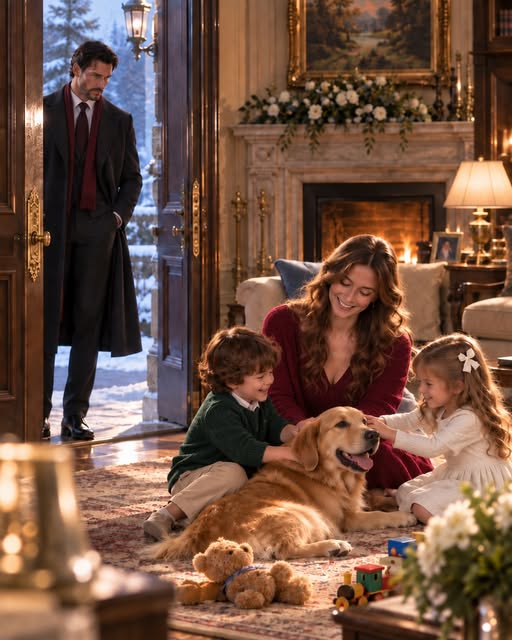
A year after his return, I found him standing in the entrance hall late one evening.
The children had gone upstairs.
The fireplaces were burning.
Fresh bread was cooling in the kitchen.
Snow pressed against the windows.
Roman looked around the room.
“You really did all this.”
“No.”
I shook my head.
“We did.”
He looked at me.
I understood what he was asking without him saying it.
Not whether I loved him.
Not whether I forgave him.
Only whether there was a place for him in the life I had built.
I walked to the front door and opened it.
Cold air entered the hall.
Roman looked at me.
I smiled faintly.
“Don’t wait for me.”
He gave a quiet laugh.
“I won’t.”
Then he stepped outside.
A few seconds later, he turned back.
“Good night, Elena.”
I closed the door.
For a long moment, I stood with my hand resting on the brass handle.
Three years ago, that door had been the last thing I saw before Roman disappeared into the snow.
Now the same door was warm beneath my palm.
Behind me, someone upstairs began laughing.
The furnace hummed steadily through the walls.
And from the kitchen came the familiar smell of fresh bread.
I turned the lock, not to keep the world out, but to remind myself that this time, I was the one deciding who came through the door.