The Wife Behind His Empire Had Been Written Out of the Company’s History
PART 3 (FULL STORY)
The name was mine.
Nora Pembroke.
For several seconds, nobody moved.
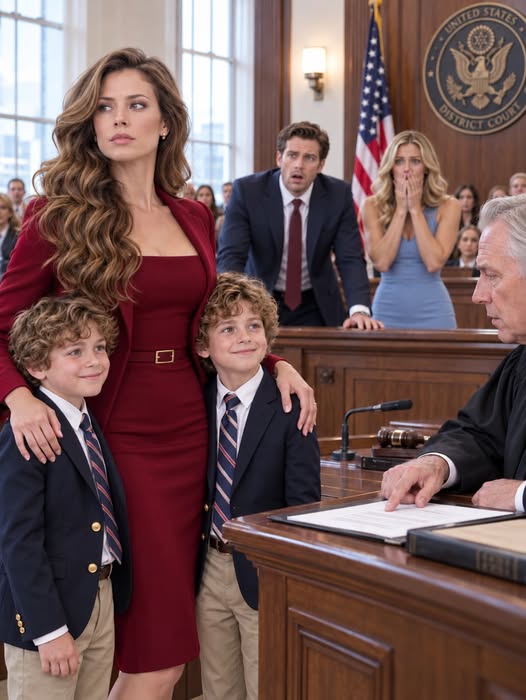
Judge Callahan leaned closer to the monitor while the clerk enlarged the scanned document. The date at the top was thirteen years earlier, before Pembroke Freight Systems had a fleet, before Tristan had a television interview, before the charity dinners and magazine profiles.
Carlton stepped toward the bench.
“Your Honor, we need to establish the authenticity of that filing before drawing any conclusions.”
Judge Callahan did not look at him.
“That is exactly what we are doing.”
She turned another page.
The original articles of incorporation listed me as the organizer and initial majority owner of Pembroke Freight Systems.
Tristan was listed as an officer.
Not the founder.
Not the sole owner.
Not even the person who had contributed the original capital.
I could feel Mason watching me.
Lucas had stopped squeezing my hand.
They knew the truth now, but they did not yet understand how much of their childhood had been built around a lie.
Judge Callahan looked at me.
“Mrs. Pembroke, explain.”
I sat down before answering.
“Thirteen years ago, Tristan had an idea for a regional freight company. He had experience in logistics, but he didn’t have enough capital to start it.”
Tristan finally spoke.
“That isn’t what happened.”
I turned toward him.
“You asked me for the money.”
His jaw tightened.
“I asked my wife to invest in my business.”
“No,” I said quietly. “You asked me to build it with you.”
Carlton objected again, but Judge Callahan raised one hand.
“Mr. Briggs, I will hear the parties before I decide what is relevant.”
I opened my briefcase.
There were more documents inside.
Bank records.
Wire transfers.
Early company contracts.
Meeting notes.
Tax documents.
And a thin folder containing the first version of the company’s operating agreement.
I placed them on the table.
“I kept copies because the originals were stored at the company office.”
Tristan stared at the folders.
“You’ve been collecting these?”
“I’ve been keeping records.”
“That isn’t the same thing.”
“It became the same thing when you started telling people I had never been involved.”
His expression hardened.
“You stopped working.”
“I stopped going to the office every day.”
I looked toward the judge.
“That was different.”
The difference had begun shortly after Mason and Lucas were born.
Before the twins arrived, I had been handling the company’s finances, contracts, vendor negotiations, and administrative operations while Tristan worked in the field and built relationships with carriers.
When the boys were born six weeks early, everything changed.
I stayed home.
Tristan stayed at the company.
At first, we agreed it would be temporary.
Then temporary became a year.
Then three.
Then eight.
By the time the company became profitable, Tristan had learned how to describe the entire history without mentioning me.
He called himself the founder.
People repeated it.
Eventually, even some employees believed it.
I had never corrected the story publicly.
Not because I agreed with it.
Because I thought our marriage mattered more than being credited.
That had been my mistake.
Judge Callahan examined the original operating agreement.
“This document gives Mrs. Pembroke a controlling ownership interest.”
Carlton cleared his throat.
“Your Honor, the parties subsequently entered into a prenuptial agreement.”
Judge Callahan looked at him.
“I am aware.”
“The prenup clearly states that Mr. Pembroke’s business interests remain separate property.”
“I am aware of that too.”
Carlton smiled faintly, as though he had finally reached the part of the argument he trusted.
“That is precisely why these old documents do not alter the fundamental financial arrangement between the parties.”
I waited.
Judge Callahan looked back at the documents.
“Mr. Briggs, the question is not whether the prenup exists.”
She tapped the incorporation papers.
“The question is what Mr. Pembroke actually owned when that agreement was signed.”
Carlton stopped smiling.
Tristan looked at me.
“You told me you didn’t want anything.”
“I told you I didn’t want to destroy the family.”
“You signed the prenup.”
“I signed what you gave me.”
“And you never claimed the company was yours.”
I held his gaze.
“You never told me you had changed the ownership records.”
That was when the courtroom changed.
Judge Callahan asked for the company’s current ownership filing.
The clerk searched the state records.
A minute later, another document appeared.
The original filing showed me as majority owner.
The later filing showed Tristan as sole controlling owner.
The date of the transfer was seven years earlier.
I remembered that year.
Mason had broken his arm.
Lucas had started having trouble at school.
Tristan had been traveling constantly.
He had brought me a stack of documents one evening and told me they were corporate restructuring papers.
He said the lawyers needed signatures.
I had signed several pages.
I had trusted him.
But the document before the judge showed something different.
My ownership had not simply been reorganized.
It had been transferred.
And attached to the transfer was a signature bearing my name.
Judge Callahan stared at it.
Then she looked at me.
“Did you sign this?”
I leaned toward the monitor.
“No.”
Tristan stood.
“Nora—”
Judge Callahan’s voice cut through the room.
“Mr. Pembroke, sit down.”
He sat.
Carlton began speaking rapidly.
“Your Honor, there may be an innocent explanation. The company used multiple attorneys and administrative staff during that period.”
Judge Callahan nodded.
“That is possible.”
Then she looked at the clerk.
“Please flag the filing for authentication and preserve the original submission records.”
Tristan’s confidence was gone.
Chloe leaned toward him.
“What does that mean?”
He didn’t answer.
I did.
“It means someone is going to have to explain how my name got on a document I never signed.”
Chloe looked at me for the first time without amusement.
The woman who had entered the courtroom believing she was already replacing me suddenly looked uncertain.
Judge Callahan returned to the custody issue.
“Mr. Briggs, you argued that Mr. Pembroke’s financial position demonstrates that he is better equipped to provide stability for the children.”
“Yes, Your Honor.”
“You also argued that Mrs. Pembroke’s lack of employment demonstrates limited financial independence.”
“Yes.”
Judge Callahan folded her hands.
“Yet the evidence before me suggests Mrs. Pembroke may have created the company that generated much of the wealth you are using to make that argument.”
Carlton said nothing.
The judge turned toward Tristan.
“Mr. Pembroke, how involved was your wife in the business during the first several years?”
He looked at me.
Then at the judge.
“I don’t remember.”
I almost laughed.
Not because it was funny.
Because I remembered everything.
I remembered sleeping on an office couch during the first six months.
I remembered negotiating fuel contracts at midnight.
I remembered driving through a snowstorm to meet a lender because Tristan was stranded in another state.
I remembered the first company check.
I remembered the first truck.
I remembered Tristan standing beside me in our tiny apartment kitchen, promising that someday the company would give our children everything we never had.
And I remembered believing him.
Judge Callahan ordered a temporary pause on any transfer of major marital assets until the ownership questions could be examined.
She also rejected Tristan’s immediate request for primary custody.
Instead, she ordered a shared interim schedule while the court reviewed the financial evidence and the children’s circumstances.
It was not a victory.
It was simply the court refusing to accept Tristan’s version of reality before examining the records.
But for the first time that morning, I saw him without the shield of his lawyers.
He looked like a man who had just discovered that the past had been keeping receipts.
Outside the courtroom, reporters waited in the hallway.
Tristan’s attorneys surrounded him immediately.
Chloe stood several feet away.
She looked at him.
Then at me.
Then at the folder in my hands.
“You knew all along,” she said.
“I knew what I had signed.”
Her voice dropped.
“Did you know about the transfer?”
“No.”
She looked toward Tristan.
He wouldn’t meet her eyes.
That answered more than I could.
Mason and Lucas waited beside the courthouse doors.
Mason looked up at me.
“Mom?”
“Yes?”
“Did Dad steal your company?”
I crouched in front of him.
“I don’t know what the court will decide.”
He frowned.
“But you made it.”
I looked at Lucas.
Then back at Mason.
“I helped build it.”
Lucas slipped his hand into mine.
“Then why didn’t you tell us?”
That question hurt more than anything Tristan had said.
“Because I thought keeping peace was the same as keeping you safe.”
Mason looked toward the courtroom.
“Was it?”
I took a breath.
“No.”
It was the first time I had admitted that aloud.
The next several weeks were not dramatic in the way newspapers wanted them to be.
There were no screaming matches.
No grand public revenge.
There were depositions, financial reviews, forensic document examinations, and meetings with attorneys.
The original incorporation records were authenticated.
The early bank transfers matched my records.
The first capital contribution had come from an account in my name.
The later ownership transfer became the subject of a separate legal investigation because the signature on it could not be authenticated as mine.
Tristan’s attorneys eventually stopped calling the prenup an ironclad shield.
The prenup remained part of the case.
But it could not magically transform property Tristan never owned into property that had always belonged exclusively to him.
The custody dispute also changed.
The court examined the children’s school records, medical schedules, daily routines, and each parent’s involvement in their lives.
Money mattered.
So did stability.
So did who had actually been there.
For thirteen years, I had thought nobody noticed the ordinary things I did.
Apparently, records notice.
Teachers notice.
Doctors notice.
Children notice.
Eventually, Tristan did too.
One afternoon, months after the first hearing, he came to the house to collect some personal belongings.
The mansion felt strangely quiet.
Most of his things were already gone.
He stood in the hallway beside the framed photograph from the company’s first year.
It showed three people.
Tristan.
Me.
And a battered delivery truck behind us.
He stared at it.
“I should have left that picture.”
I didn’t answer.
“You were always better with the numbers,” he said.
“You were better with people.”
“We were good together.”
“We were.”
He lowered his eyes.
“I ruined it.”
I didn’t tell him he was forgiven.
I didn’t tell him he wasn’t.
Some things didn’t need a speech.
The divorce was finalized later that year.
The court determined the financial interests according to the evidence and the parties’ agreements as legally applicable, while the disputed corporate ownership issues were handled through the appropriate proceedings.
I did not walk away with everything.
Neither did Tristan.
The company continued operating.
The children remained in both our lives, although their routines changed.
And I finally returned to the work I had once abandoned.
Not as Tristan Pembroke’s wife.
Not as the woman behind the successful man.
As Nora.
The person whose name had been on the first page.
Months later, I visited the company’s original office.
The building was smaller than I remembered.
The old conference room still had the same scratched wooden table.
I ran my fingers across its surface.
There was a faint circle near the corner where I had once placed my coffee cup during a twelve-hour contract negotiation.
I smiled.
Not because everything had worked out perfectly.
It hadn’t.
But because I no longer needed anyone else to tell me what I had contributed.
Mason and Lucas were waiting outside.
“Mom,” Lucas called.
I turned.
He held up a paper.
“Can we go home?”
I nodded.
As we walked toward the car, Mason looked back through the office window.
“Are you going to work there again?”
“Maybe.”
“Will you be the boss?”
I smiled.
“I’ll be something better.”
“What?”
I opened the car door for him.
“The person who reads every page before signing her name.”
He laughed.
Lucas climbed into the back seat.
I closed the door and looked once more at the old office.
Inside my briefcase was a copy of the original incorporation document.
The first page was worn at the edges now.
But my name was still there.
Nora Pembroke.
Not hidden.
Not erased.
Just waiting for someone to finally read it.