The Whole Street Voted to Silence the Barking Dog FULL STORY
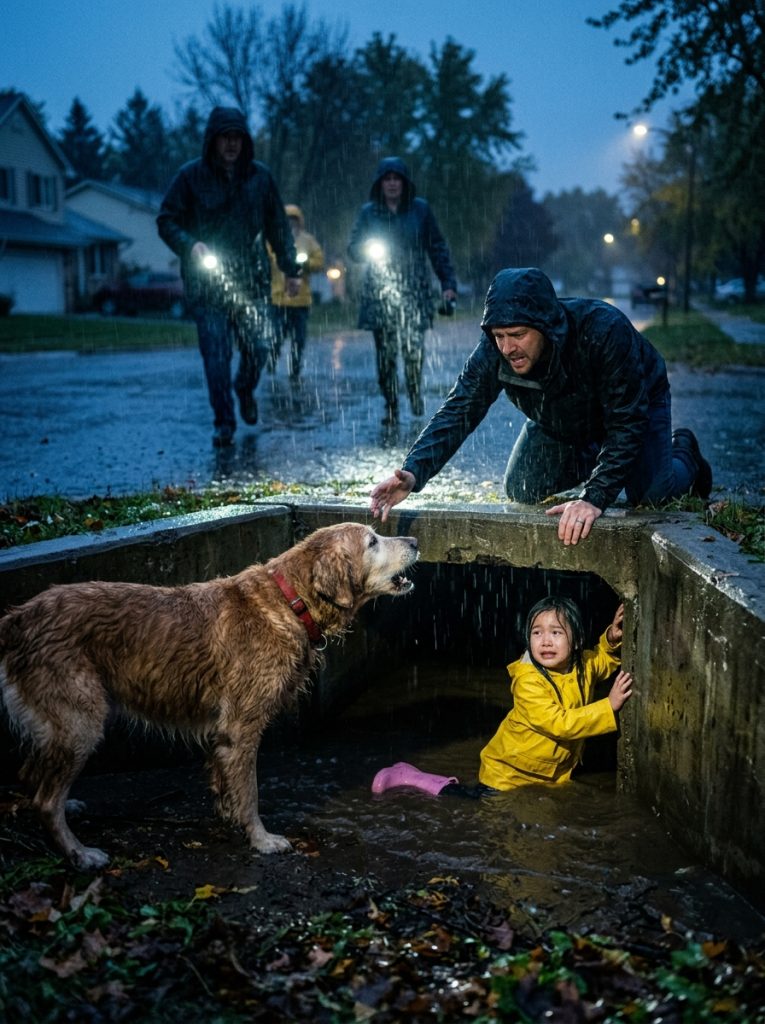
“Help.”
That was the word that came up out of the storm drain. Small. Swallowed by water.
I went down on my stomach in the mud and pointed the flashlight into the culvert. The beam caught a yellow rain slicker. A little face. A child wedged against the concrete lip where the pipe narrowed, water climbing past her waist, one small pink boot spinning away from her in the current.
“I’m here!” I shouted. “I’ve got you, stay still!”
It was Lily Nguyen. Six years old. She lived two streets over. Her parents would later tell me she’d chased her cat toward the drainage ditch after dinner, slipped on the wet bank, and slid into the mouth of the culvert where nobody could see her from the road.
Nobody could see her.
But Scout could hear her.
For three nights he’d stood at that fence and barked at the road, and we’d all decided he was a nuisance. He wasn’t barking at nothing. He was barking at this. A child’s voice the rest of us were too far away, too annoyed, too human to hear.
I couldn’t reach her. My arm was a foot short and the water was rising.
So I did the only thing left. I screamed for help, and for the first time in three weeks, Birchwood Lane answered.
Porch lights came on. Mrs. Pearson — the same Mrs. Pearson who filed the noise complaint — came running in her robe with her husband’s longest ladder. The Coopers brought rope. Someone called 911. Within minutes there were a dozen flashlights bobbing through the rain, all of them pointed at the dog who’d led us there.
We made a chain. I went in headfirst, two men holding my legs, and I got my hands around Lily’s wrists just as the water reached her chin. We pulled her out cold and shaking and alive.
Her mother arrived as the ambulance did. She fell into the mud holding her daughter and couldn’t make any sound at all.
It was Scout who wouldn’t move.
He’d planted himself at the mouth of the culvert through the whole rescue, barking, making sure we didn’t stop. And when it was over — when Lily was wrapped in foil blankets and safe — the old dog finally sat down in the cold water.
Then he lay down.
Twelve years old. Three nights of barking himself raw. A body that had already lost the one person it lived for. He’d held on long enough to finish the job.
“Scout,” I said, scooping him up. He was so heavy and so still. “Scout, no. Not tonight.”
Mrs. Pearson didn’t hesitate. “My car’s right here. Get in.”
The woman who wanted him gone three hours earlier drove ninety miles an hour to the emergency vet with my grandfather’s dog soaking her back seat, and she cried the whole way.
He made it.
Hypothermia, exhaustion, a heart that scared the vet for two days. But he made it.
When I finally brought him home, the street was waiting. Not with complaints this time. With a heated dog bed from the Coopers. A casserole from the Pearsons. A hand-lettered sign the neighborhood kids taped to my fence: SCOUT THE HERO LIVES HERE.
The HOA never did rehome him. At the next meeting, the vote to remove him was struck from the record. In its place they passed something new — a small fund, in Walter’s name, for the animal shelter one town over.
I stood up at that meeting and said the thing I’d been carrying.
“Three weeks ago my grandfather died and not one of you came,” I said. “I was angry about that. So when you complained about his dog, I was angry too, and I raised my hand with you instead of asking why an old dog was barking at the road every single night.”
The room was quiet.
“He was barking because he could hear a child none of us could. He was being exactly who Walter raised him to be. And we voted to get rid of him for it.”
Mrs. Pearson stood up, this woman who started the whole complaint.
“You’re right,” she said. “We owe Walter an apology we can’t give him anymore.” She looked at me. “So we’ll give it to his dog instead.”
That’s the bittersweet of it. We made it right with Scout. We never got to make it right with Walter.
Some debts you can only pay forward.
These days Scout walks slow, and only as far as the corner. But every evening he still stops at the storm drain and stands there a moment, ears up, listening.
I used to pull him along. Now I just wait with him.
Because I finally understand. A dog like that doesn’t bark at nothing.
We were the ones who weren’t listening.