The Washing Machine Ring That Led Police To A Secret From Twenty-Three Years Ago
PART 3 (FULL STORY)
I stared at the envelope in the photograph until the letters blurred.
My name.
Cade.
Written in dark blue ink across yellowed paper.
“I didn’t find that,” I said.
The officer nodded. “We know.”
That answer unsettled me more than anything else.
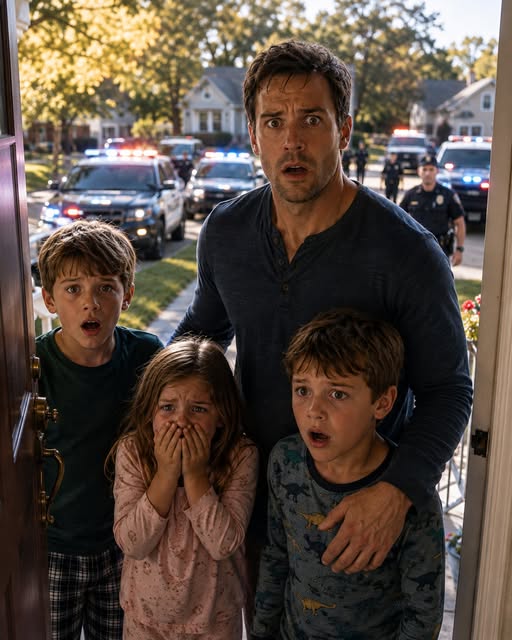
He introduced himself as Detective Harris and asked me to come inside with him while the other officers remained outside. I looked back through the doorway. My oldest daughter was standing halfway down the hall, trying to look brave while my two younger children stayed behind her.
“Are my kids safe?”
“They’re safe,” Harris said. “And you are not under arrest.”
I stepped back inside.
The detective placed the photograph on my kitchen table.
“That washing machine was donated yesterday,” he said. “We confirmed the serial number this morning. Twenty-three years ago, it belonged to a man named Samuel James Mercer.”
I looked at the initials engraved inside the ring.
S + J.
“Samuel James?”
“Yes.”
I thought about the elderly woman.
“She said her husband gave her that ring.”
“He did.”
Harris opened a folder.
“His name was Samuel Mercer. He disappeared twenty-three years ago.”
I sat down slowly.
The room seemed suddenly much smaller.
“She told me he died.”
“She believed he did.”
That sentence stayed between us.
I looked at the photograph again.
The young woman beside Samuel was the same woman who had hugged me the day before.
Her name was June Mercer.
She had spent twenty-three years believing her husband was dead.
Harris explained that Samuel had vanished without warning after leaving work one evening. His car was found abandoned near the river. There was no body, no confirmed sighting, and no clear explanation.
“At the time,” Harris said, “everyone assumed he had been killed.”
“Then why was his wedding ring inside her washing machine?”
“That’s what we’re trying to understand.”
I remembered the moment I had pulled the ring from the drum.
It had been wedged deep inside, somewhere no one would normally look.
Harris continued.
“After Samuel disappeared, investigators searched their house several times. They found nothing useful. June eventually moved, and the house changed hands more than once. The washing machine was old even then.”
“So how did you find it?”
“The ring.”
He leaned forward.
“When you returned it to June, she contacted us.”
I blinked.
“She called the police?”
“She called the same department that investigated her husband’s disappearance.”
Harris said June had never stopped hoping for answers.
She had kept every document connected to Samuel.
Every photograph.
Every letter.
Every report.
And when she saw the ring again, she realized something she had forgotten.
Samuel had always been terrified of losing it.
“He took it off only when he worked on machinery,” Harris said. “And he used to joke that if he ever disappeared, she should look inside the washing machine.”
I frowned.
“That sounds like a strange thing to joke about.”
“It does.”
Harris opened another folder.
“But Samuel worked as an accountant for a company that was later investigated for fraud.”
I felt a chill move through me.
“What kind of fraud?”
“Money laundering. Forged records. Missing funds.”
The detective showed me a photocopy of an old newspaper article.
Samuel had apparently discovered irregularities in the company’s accounts shortly before he disappeared.
“He told a coworker he had proof,” Harris said.
“Then he vanished.”
I looked at the photograph again.
The envelope.
My name.
“How does any of this involve me?”
Harris didn’t answer immediately.
Instead, he pulled out a second photograph.
This one showed Samuel standing outside a small apartment building.
There was a little boy beside him.
The boy was maybe seven years old.
I stared at the picture.
Something about the child’s face bothered me.
Not because I recognized him.
Because I recognized myself.
Same dark eyes.
Same crooked smile.
Same small scar above the left eyebrow.
I pushed the photograph away.
“No.”
Harris watched me carefully.
“Cade, how old were you when you were born?”
“Thirty.”
“Do you know your biological father’s name?”
My mouth went dry.
“My mother never told me.”
The detective nodded slowly.
“That’s because she wasn’t your biological mother.”
I stood so quickly that the chair scraped against the floor.
“What?”
Harris immediately raised a hand.
“I know this is a lot. We verified it before coming here.”
He placed a document on the table.
It was an old birth record.
The mother’s name was familiar.
But the father’s name made my hands start shaking.
Samuel James Mercer.
I couldn’t speak.
For thirty years, I had believed my father had abandoned us before I was born.
My mother had always told me he left.
She never gave me his name.
Never showed me a photograph.
Never explained why she refused to discuss him.
And now a detective was telling me that the missing man whose wedding ring I had returned was my father.
I stared at the birth certificate.
Then I looked toward my children.
They were watching from the hallway.
My entire understanding of my own life had shifted in less than five minutes.
“Is he alive?”
Harris didn’t answer immediately.
That was when I knew the truth was worse than I had imagined.
“We believe he may have survived his disappearance.”
“May have?”
“We found a lead this morning.”
He explained that the envelope had been hidden inside the washing machine decades ago, but not by June.
The original washing machine had been moved between several locations over the years.
When Samuel disappeared, he had apparently hidden evidence inside it before leaving home.
The ring had been caught in the same internal compartment.
The envelope was still missing.
Until that morning.
Police had found an old storage record connecting the machine to a second appliance warehouse.
And inside a damaged service panel, they discovered a handwritten note.
The note contained one sentence.
“If anything happens to me, find my son.”
My son.
Not June.
Not the police.
His son.
Me.
Harris explained that Samuel had apparently learned my mother was pregnant shortly before he disappeared.
He had intended to leave money and evidence behind for me.
But something happened before he could return.
The men involved in the fraud discovered what Samuel knew.
He disappeared.
My mother was warned to stay silent.
And Samuel never came home.
I sat at the kitchen table for a long time.
I couldn’t decide what hurt more.
Learning that my father had disappeared.
Or learning that he had spent years trying to find a way back to me.
Then Harris said something that changed the room again.
“We found a current photograph of Samuel.”
I looked up.
“Current?”
He nodded.
“He may still be alive.”
My throat tightened.
“Where?”
“We don’t know yet.”
“But we have reason to believe he has been living under another name.”
The detective slid the photograph toward me.
It showed an older man sitting alone at a diner.
Gray hair.
Thin face.
A familiar crooked smile.
I stared at him.
I had never seen my father before.
Yet somehow, I knew.
Not because someone had told me.
Because I saw my own face in his.
Harris said the photograph had been taken three months earlier.
Samuel was alive.
And he had been living less than two hundred miles away.
I couldn’t process it.
For thirty years, I had thought I was raising my children without ever knowing where I came from.
Now I knew my father had been somewhere in the world all this time.
The strange part was that he had apparently been searching for me too.
Harris explained that Samuel had left instructions with an attorney years earlier.
If the evidence was ever recovered, the attorney was supposed to contact the police.
But the attorney had died.
The records were lost.
And Samuel had disappeared again.
Until the ring brought everything back.
I asked the question I had been afraid to ask.
“Does June know?”
Harris nodded.
“She knows some of it.”
I looked toward the front door.
“She must be devastated.”
“She is.”
Later that afternoon, Harris drove me to June’s house.
She was sitting at her kitchen table with the ring in front of her.
When she saw me, she stood.
For a few seconds, neither of us spoke.
Then I asked, “Did you know?”
She looked at the ring.
“I knew there was something Samuel never told me.”
“What?”
She took a trembling breath.
“Before he disappeared, he told me he had a son.”
I stared at her.
She began crying.
“He said your mother was pregnant. He said he had made mistakes, but he wanted to be part of your life.”
“Why didn’t you tell me?”
“Because I didn’t know where you were.”
She explained that Samuel’s disappearance had been followed by threats.
She had been warned not to investigate.
Not to ask questions.
Not to contact anyone connected to his old company.
And she had been terrified that whoever took him would come after her.
“I spent twenty-three years wondering if I failed him,” she whispered.
“You didn’t.”
She looked at me.
“I don’t know that.”
“You returned his ring to me,” I said. “You gave me the one thing he left behind.”
She touched the engraved words.
“S + J. Forever.”
For the first time, I understood why she had held the ring against her chest.
It wasn’t just jewelry.
It was proof that someone had loved her.
Proof that someone had once promised to come home.
Two days later, police found Samuel.
He was living quietly under his mother’s maiden name in a small town near the coast.
When the officers told him they had found his son, he refused to believe them.
Then they showed him the photograph of me.
Samuel cried.
That was what Harris told me afterward.
He cried before saying a single word.
When I finally met him, I didn’t know what to say.
He looked older than the man in the photographs.
Of course he did.
Twenty-three years had passed.
I had children of my own.
He had missed every birthday.
Every school event.
Every scraped knee.
Every Christmas morning.
Every ordinary day that makes a family a family.
He apologized.
Not once.
Not dramatically.
He apologized for years.
For leaving.
For being afraid.
For believing he could protect everyone by disappearing.
And I listened.
I didn’t forgive him immediately.
I didn’t hate him either.
There was too much missing between us for either emotion to fit cleanly.
Instead, I asked him one question.
“Why didn’t you come back?”
He looked down at his hands.
“Because every time I got close, they found me.”
He told me he had spent years moving from place to place, collecting evidence and waiting for the people responsible to be caught.
Eventually, most of them were gone or imprisoned.
But by then, he was afraid that returning would destroy the little safety I had.
He had watched me from a distance.
He knew when I graduated.
He knew when I became a father.
He knew I had three children.
I was angry when I heard that.
“You watched me become a father?”
“Yes.”
“And you never came?”
His eyes filled with tears.
“I was ashamed.”
That answer didn’t erase anything.
But it was honest.
So I let the silence remain.
Months passed.
The investigation into the old fraud case reopened.
The evidence Samuel had hidden helped prosecutors identify money that had been stolen decades earlier.
The people responsible could no longer be prosecuted for everything they had done, but several financial records were still useful in ongoing cases.
June finally had answers about her husband.
And I finally had a father.
Not the father I had imagined.
Not the father my children would have grown up knowing.
Just a man who had made terrible choices and spent years trying to survive the consequences.
Sometimes that had to be enough.
The washing machine stayed in my house.
I could have sold it.
I could have thrown it away.
Instead, I kept it.
Not because it was worth sixty dollars.
Because it reminded me how close an ordinary life can come to hiding something extraordinary.
One evening, months later, I was doing laundry while my youngest daughter sat on the floor sorting socks.
She held up one of my old shirts.
“Dad,” she said, “do you still think that machine is lucky?”
I smiled.
“No.”
She looked disappointed.
I reached into my pocket.
The diamond ring was there.
June had asked me to keep it for a while.
She said she wanted her grandchildren to know the story.
I placed the ring in my daughter’s palm.
She read the engraving.
“S + J. Forever.”
Then she looked at me.
“Forever is a long time.”
“Yes,” I said.
“It is.”
The washing machine began its familiar cycle.
Clunk.
Clunk.
Clunk.
This time, nobody stopped it.
I just listened to the sound, watched my daughter hold the ring carefully in both hands, and understood that sometimes the things we think are lost forever are simply waiting for someone to look in the right place.