The Wallet I Returned Exposed a Secret My Family Had Buried for Twelve Years
PART 3 (FULL STORY)
The file slipped from the receptionist’s hands and landed on the marble floor.
I stared at the page, trying to understand why my name was there when I had only been alive for eight years.
Mr. Graves didn’t move.
“Close the file,” he said.
The receptionist looked at him. “Sir—”
“Close it.”
But I had already seen enough to know this wasn’t about the wallet.
It wasn’t even about the eviction notice.
It was about my mother.
I climbed down from the chair and walked toward the file before anyone could stop me. Mr. Graves stepped in front of it, but he didn’t look angry. He looked frightened.
“What is my name doing in there?”
He swallowed.
“Ruby, you need to go home.”
“My mom always says I should tell the truth.”
That made him look away.
The head of security quietly shut the office door behind us.
Mr. Graves picked up the file and carried it to his desk.
“Your mother ever tell you about a woman named Elena?”
I shook my head.
“What about Graves Energy?”
“No.”
“Has she ever mentioned me?”
I thought about it.
“She doesn’t like seeing your picture on television.”
His eyes closed for a moment.
“Why?”
“I don’t know.”
That answer seemed to hurt him more than anything else I had said.
He opened the file again.
Inside were photocopies of contracts, an old photograph, several handwritten notes, and a hospital bracelet sealed inside a plastic sleeve.
The bracelet had my name on it.
Ruby Bennett.
The date was twelve years earlier.
I stared at it.
“That’s impossible.”
Mr. Graves sat down heavily.
“It shouldn’t exist.”
I looked at him.
“What does that mean?”
He rubbed both hands over his face.
“Twelve years ago, there was an accident at one of our company facilities. Your mother worked there.”
“My mom?”
“Yes.”
“What kind of accident?”
He didn’t answer immediately.
The head of security stepped forward.
“Sir, maybe we should—”
“No.”
Mr. Graves looked at me.
“She was an accounts assistant. She discovered that money was being diverted through a contractor we used for several years.”
“Someone was stealing?”
“Millions.”
The word sounded enormous to me.
“She reported it.”
He opened another folder.
“There was an investigation. Then there was a fire.”
My stomach tightened.
“My mom was there?”
“She survived.”
I didn’t know whether to feel relieved or confused.
“Then why didn’t she tell me?”
Mr. Graves looked at the hospital bracelet.
“Because she thought you were dead.”
The office seemed to shrink around me.
I shook my head.
“No.”
“Ruby—”
“No. My mom has never said I was dead.”
“Because she didn’t know.”
He pulled an old photograph from the file.
It showed a younger version of my mother standing outside a hospital.
She was crying.
In her arms was a tiny bundle wrapped in a white blanket.
I stared at the photograph.
“Is that me?”
Mr. Graves nodded.
“The hospital records said the baby died that night.”
“But I’m here.”
“I know.”
He pushed another document across the desk.
The paper was old and yellowed, but the handwriting was clear.
Someone had written a note in the margin.
TRANSFERRED BEFORE RELEASE.
I looked at Mr. Graves.
“Transferred where?”
“We don’t know.”
“Then how do you know it was me?”
He didn’t answer.
I looked down at the photograph again.
Something about the blanket bothered me.
There was a small pink stitched flower in one corner.
I had seen that flower before.
Not in the picture.
At home.
My mother kept an old white blanket in the bottom drawer of her bedroom dresser.
She had always told me never to touch it.
I suddenly remembered the pink flower sewn into its corner.
I looked up.
“The blanket.”
Mr. Graves leaned forward.
“What blanket?”
“My mom has one like that.”
His expression changed.
The head of security immediately reached for his phone.
“Sir, we need to contact Mrs. Bennett.”
“No.”
Mr. Graves stood.
“Don’t call anyone yet.”
I frowned.
“Why?”
He looked at the locked door.
“Because twelve years ago, someone wanted this record destroyed.”
A cold feeling settled in my stomach.
“And you think they’re still looking for it?”
“I know they are.”
Before I could ask another question, the receptionist knocked once and entered without waiting.
“Sir, there’s a problem.”
Mr. Graves turned.
“What?”
“The police are downstairs.”
His face tightened.
“They’re here for the wallet?”
“No.”
She looked at me.
“They asked for Ruby Bennett.”
I froze.
Mr. Graves walked to the window overlooking the street.
Two police cars had stopped outside Graves Tower.
A third vehicle was pulling in behind them.
“Who called them?” he asked.
The receptionist shook her head.
“Nobody from this building.”
Mr. Graves turned back toward me.
For the first time, I saw something in his expression that wasn’t fear for himself.
It was fear for me.
“Ruby, listen carefully.”
I nodded.
“Whatever happens next, don’t tell anyone about the file.”
“Why?”
“Because the person who took you from that hospital twelve years ago may know you’re alive now.”
My mouth went dry.
“But how would they know?”
He looked at the wallet lying on his desk.
Then at the eviction notice.
“The notice.”
I didn’t understand.
He pointed toward my backpack.
“That isn’t just an eviction notice.”
He unfolded the pink paper carefully.
There was a printed landlord’s address at the top, followed by the usual warning about overdue rent.
But beneath it was a handwritten number.
Mr. Graves stared at it.
“Where did you get this?”
“My landlord left it on our door.”
“Did anyone else touch it?”
“I don’t know.”
He turned the paper over.
On the back was a faded company stamp.
Graves Energy Corporation.
My voice dropped.
“Why is your company on my eviction notice?”
He didn’t answer.
Instead, he picked up the phone and called someone.
“Find everything connected to Aldridge Street,” he said. “Property records, contractors, old employees, all of it.”
He hung up.
Then he looked at me.
“Your family didn’t simply fall behind on rent.”
“What do you mean?”
“The building where you live used to belong to one of our shell companies.”
I stared at him.
“Why?”
“Because twelve years ago, it was used as a temporary residence for employees involved in the investigation.”
My mother’s face flashed through my mind.
The bathroom door.
The quiet crying.
All those nights she thought I was asleep.
I had always assumed she was crying because we were poor.
Maybe poverty was only part of it.
A knock came from the lobby.
Then another.
“Mr. Graves!” a man’s voice called.
The head of security looked through the office camera.
“It’s Detective Cole.”
Mr. Graves nodded.
“Let him in.”
The door opened.
A broad-shouldered detective stepped inside with two officers behind him.
He looked at Mr. Graves first.
Then at me.
His expression barely changed.
“We need to speak with the child.”
Mr. Graves stood between us.
“On what grounds?”
“Her mother filed a missing-person report.”
I frowned.
“My mom knows where I am.”
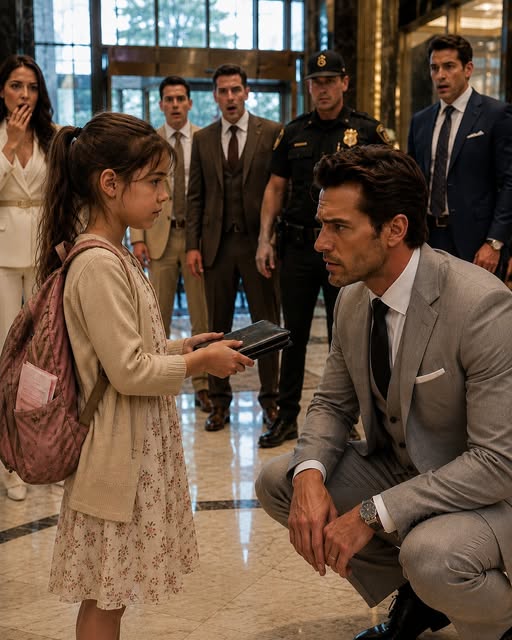
The detective looked at me.
“Does she?”
I didn’t like the way he said it.
Mr. Graves noticed too.
“Detective, when was this report filed?”
Cole glanced at his partner.
“Twenty minutes ago.”
Mr. Graves looked at the clock.
It had been less than an hour since I walked into the building.
He slowly turned toward me.
“Ruby, did you tell anyone you were coming here?”
“No.”
“Did you call your mother?”
“No.”
The detective’s eyes narrowed.
“Then somebody knew where she was going.”
Nobody spoke.
I suddenly remembered the bus.
The man standing near the stop.
The gray jacket.
The way he’d watched me counting coins before I boarded.
I hadn’t thought anything of it.
Now I did.
“There was a man,” I whispered.
Mr. Graves immediately crouched beside me.
“What man?”
“At the bus stop.”
“Tell me everything.”
I described the gray jacket.
The silver watch.
The scar near his left eyebrow.
Detective Cole’s face changed.
“You’ve seen him before?”
“No.”
Mr. Graves stood.
“Have you?”
Cole didn’t answer.
Instead, he asked his partner to step outside.
A minute later, the officer returned with a photograph.
He placed it on the desk.
My stomach dropped.
It was the man from the bus stop.
Mr. Graves stared at the picture.
“That’s Daniel Voss.”
I didn’t know the name.
Cole did.
“He was a security contractor for Graves Energy twelve years ago.”
Mr. Graves’s jaw tightened.
“And he’s been missing for eleven years.”
The office went quiet.
I looked from the photograph to the old file.
“Why would a man who disappeared eleven years ago be watching me today?”
Mr. Graves looked at me for a long moment.
Then he reached into the file and pulled out one final photograph.
This one was different.
It showed my mother outside the hospital.
She was holding the same white blanket.
Beside her stood a younger Nathaniel Graves.
And beside Nathaniel was Daniel Voss.
I stared at the picture.
“You knew my mother.”
“Yes.”
“You knew me.”
Mr. Graves’s eyes filled with something I couldn’t name.
“Yes.”
“Then why did you let us live like that?”
He looked down.
“Because I thought keeping you hidden was the only way to keep you alive.”
I didn’t understand.
He finally told me the part that had never appeared in any company record.
Twelve years earlier, my mother had discovered that a group inside Graves Energy was laundering money through properties owned by the company.
Daniel Voss had been hired to intimidate employees who asked questions.
When my mother refused to withdraw her complaint, the warehouse fire was arranged to destroy the evidence.
But there was another problem.
My mother had given birth to me that same week.
The people behind the scheme believed the baby had been used to identify where she was staying.
Nathaniel Graves had learned what was happening too late.
He had helped move my mother to another hospital.
He had ordered the records sealed.
But during the chaos, one of the nurses disappeared.
So did the original birth record.
The hospital later reported that the infant had died.
My mother believed it.
Nathaniel believed it.
And whoever had taken the missing record believed the secret was buried forever.
Until an eight-year-old girl walked into Graves Tower carrying a pink eviction notice.
I looked at him.
“Why didn’t you find me?”
His answer was quiet.
“Because I didn’t know where you were.”
“Then how did you know the eviction notice?”
He looked at the paper.
“Because that property was recently transferred.”
“To who?”
He didn’t answer.
Detective Cole did.
“A company registered three months ago.”
He placed another document on the desk.
The name belonged to a holding company.
The registered agent was Daniel Voss.
I felt the room tilt.
“He found us.”
Mr. Graves nodded.
“And when you brought me that wallet, you accidentally brought the only proof he needed to know the old secret was still alive.”
I looked at the wallet.
“How?”
Mr. Graves opened the inside pocket.
There was a second card behind the business card.
It was tiny.
Almost hidden.
A handwritten address was on it.
Aldridge Street.
My home address.
I stared at it.
The wallet had never been lost by accident.
It had been planted.
The nine hundred dollars had been bait.
Someone wanted the wallet found.
Someone wanted whoever found it to bring it to Nathaniel Graves.
And they had chosen the wrong child.
Because I had come carrying something else.
The pink eviction notice.
The paper that connected my family to the property.
The property connected to the old investigation.
And the old investigation connected to Daniel Voss.
Mr. Graves finally understood.
So did Detective Cole.
The wallet wasn’t the secret.
I was the message.
They had wanted Nathaniel Graves to see my name.
Instead, they had exposed themselves.
Detective Cole immediately sent officers to our apartment.
They found the landlord waiting outside.
They also found Daniel Voss’s car two blocks away.
He ran when officers approached.
He didn’t get far.
By the time my mother arrived at Graves Tower, I was sitting beside the office window with the pink eviction notice folded neatly in my lap.
She ran to me.
She didn’t ask about the wallet.
She didn’t ask about the money.
She just held me so tightly I could barely breathe.
Then she saw Nathaniel Graves.
Her face went still.
“How did you find her?”
He shook his head.
“She found me.”
My mother looked at the wallet on his desk.
Then at the file.
Then at me.
Her eyes filled with tears.
For years, she had believed that honesty meant accepting whatever life handed us without complaint.
That night, I finally understood what she had been trying to teach me.
Honesty wasn’t always safe.
Sometimes doing the right thing opened a door you were terrified to walk through.
But it could also lead you toward the truth.
The investigation into Graves Energy reopened.
Daniel Voss was charged for the crimes connected to the old case, along with the new attempt to manipulate the investigation.
Several company officials were questioned.
The shell company that owned our building was dissolved.
My mother was offered financial assistance, but she refused to let Nathaniel simply erase what had happened to us.
Instead, he helped her find work on her own terms.
He also admitted publicly that his company had failed her twelve years earlier.
He never called himself my savior.
Neither did I.
He was simply a man who had finally stopped looking away.
Months later, our lights stayed on.
The eviction notice was gone.
My mother kept the old hospital photograph in a drawer beside the white blanket.
She no longer hid it from me.
And the wallet?
Nathaniel returned it to me one afternoon.
The nine hundred dollars were still inside.
“I can’t take this,” I told him.
“You returned it when you needed it most.”
He smiled.
“That money belongs to you now.”
My mother wanted me to accept only after we understood where it came from.
It had been declared unclaimed property during the investigation and legally returned to its owner.
Nathaniel insisted I use it for something that mattered to me.
So I bought a small wooden box.
I placed the hospital bracelet inside.
Then the photograph.
Then the old pink eviction notice.
The wallet went on top.
Years later, I still kept that box.
Not because it reminded me of being poor.
Not because it reminded me of a billionaire.
It reminded me of the moment I had been eight years old, hungry and frightened, standing beneath a rusty bus bench with nine hundred dollars in my hands.
I could have walked away.
Instead, I listened to my mother’s voice.
“We may not have much, Ruby, but we always have our honesty.”
She had been right.
The truth had taken twelve years to find me.
But when it finally did, it arrived inside a dirty wallet beneath a broken bus bench on Aldridge Street.