The Twenty-Nine-Year-Old Who Refused to Let Five Siblings Become Strangers
PART 3 (FULL STORY)
Judge Miller kept one hand on the folder while the social worker stood beside him, breathing hard from having crossed the courthouse so quickly.
“What is it?” I asked.
He looked at the five children before answering.
“The placement registry was incomplete,” he said. “There is additional information in the original case file.”
My attorney stood. “Your Honor?”
Judge Miller raised a hand, asking him to wait.
Then he looked at me again.
“These children have already been separated once.”
The words landed harder than I expected.
The oldest boy stopped wiping his sister’s face.
The little girl looked down at her shoes.
Judge Miller continued carefully. “Their mother was hospitalized three weeks ago. Their father is deceased. But before that, there was an earlier intervention involving the family.”
I glanced at the social worker.
She nodded.
“For eleven days,” she said, “the children were placed in different emergency homes.”
The courtroom suddenly felt smaller.
I looked at the five children again.
That explained the picture.
It explained why they had been holding onto each other so tightly in that photograph.
It explained why the oldest boy had looked frightened rather than simply sad.
They had already learned what it meant to wake up and discover that one of the people you loved was gone.
“What happened?” I asked.
The social worker swallowed.
“They were reunited after their mother was released, but her condition deteriorated. When she was hospitalized again, we had to place them immediately.”
“And now you’re going to separate them again?”
No one answered.
I looked at Judge Miller.
He looked down at the file.
Then he said, “That was the recommendation.”
I felt my hands tighten at my sides.
“That was the recommendation before you walked into this courtroom,” he added.
My attorney leaned toward me.
“Let the judge finish.”
I nodded.
Judge Miller turned another page.
“There is another problem.”
The oldest boy suddenly spoke.
“Please don’t send us away.”
His voice was so quiet that everyone had to lean forward to hear him.
“I can take care of them.”
Judge Miller looked at him.
“You shouldn’t have to.”
The boy stared at the floor.
“Yes, sir.”
His little sister reached for his hand.
He immediately took it.
I had seen that gesture before.
In the registry photograph.
In the hallway.
On the bench.
Every time one of the younger children became frightened, the oldest one reached for them.
He wasn’t acting like a seven-year-old brother.
He was acting like someone who had been forced to become the adult in the room.
And suddenly, I understood something that had bothered me since the day I first saw their photograph.
I hadn’t fallen in love with five children I barely knew.
I had recognized something.
A child trying to protect a younger sibling because he believed nobody else would.
That was the reason I couldn’t walk away.
When I was six, my younger brother had been taken to a different home.
I still remembered the hallway.
The blue plastic trash bag containing my clothes.
The social worker telling me everything would be okay.
The sound of the car door closing.
And my brother’s face disappearing behind the window.
Adults had explained everything in words I was too young to understand.
They had called it temporary.
They had called it necessary.
They had called it the safest option.
None of those words changed what a six-year-old understood.
My brother was gone.
For eleven days, I didn’t know where he slept.
I didn’t know who tucked him in.
I didn’t know whether he cried.
Most of all, I didn’t know whether he thought I had left him.
When we were finally reunited, he wouldn’t let go of my shirt.
I never forgot that.
But I had never told anyone in the county about it.
Not because I was ashamed.
Because I didn’t want my childhood to become the reason someone approved me.
I wanted them to judge me on what I could provide now.
A stable home.
A steady job.
A willingness to learn.
A support network.
And, most importantly, the determination not to confuse convenience with what was best for the children.
Judge Miller seemed to understand that.
He closed the folder.
“Mr. Carter, the court has concerns about placing five children with a single twenty-nine-year-old man.”
“I understand.”
“You will need help.”
“I have already arranged it.”
The state’s attorney stood.
“Your Honor, arranging furniture and buying car seats doesn’t establish that he can manage five traumatized children.”
“No,” I said.
“It doesn’t.”
Everyone looked at me.
“I don’t know how to do everything.”
I looked toward the children.
“But I know how to ask someone who does.”
My attorney placed a document on the table.
I had spent the previous three weeks preparing it.
My employer had agreed to change my schedule.
My sister had offered to help with school transportation.
A licensed child therapist had agreed to take the children as a group and individually.
My neighbor, an elementary school teacher, had volunteered to help with homework.
A local church had offered meals for the first month.
None of them were magical solutions.
They were simply people willing to stand beside me.
Judge Miller read through the list.
Then he asked the social worker, “What do the children say they want?”
She hesitated.
“Their preference has been consistent.”
“What is it?”
“They want to stay together.”
The youngest child had been silent the entire morning.
Now she lifted her head.
“Can we go with him?”
I couldn’t answer immediately.
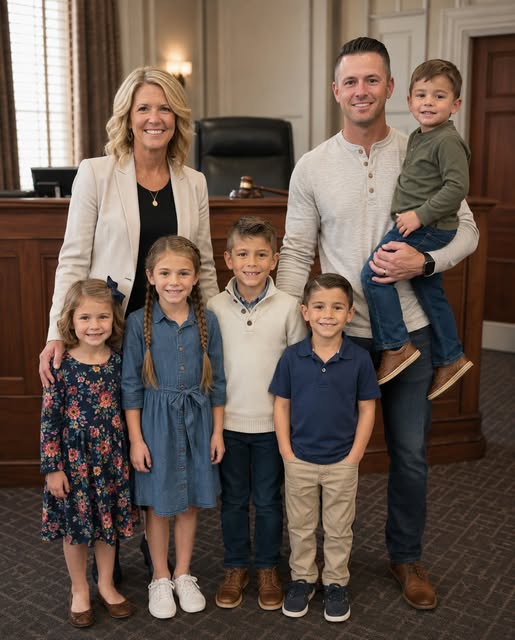
Judge Miller looked at me.
I nodded.
“If the court allows it, I’ll take them home.”
The judge looked at the five children.
Then he looked at the state’s attorney.
“I am not persuaded that separating siblings who have already experienced separation is automatically the safest option.”
The state’s attorney began to object.
Judge Miller stopped him.
“But neither am I prepared to approve a permanent arrangement based on emotion.”
I understood.
He wasn’t giving me a victory.
He was giving me a responsibility.
The judge ordered an emergency kinship-style placement assessment, additional home visits, therapy, and ongoing supervision.
For the first time that morning, I allowed myself to breathe.
Then he said something I wasn’t expecting.
“You may take them home together tonight.”
The little girl began crying.
Not the frightened crying I had seen earlier.
This time, she smiled through it.
The oldest boy stared at me.
“Together?”
“Together,” I said.
He looked at his brothers and sisters.
Then he finally let himself smile.
Outside the courthouse, five small hands reached for mine.
I had expected chaos.
Instead, there was a strange quiet.
The youngest held my index finger.
The next child carried a worn backpack.
Another kept asking whether the bunk beds were really for them.
The oldest walked beside me without saying anything.
When we reached my truck, he stopped.
“You said you had five car seats.”
“I do.”
He looked through the window.
“Why?”
I smiled.
“Because I was hoping we’d need them.”
That was the first time he laughed.
It was a small sound.
But I remembered it.
The first night at my house was difficult.
One child couldn’t sleep.
Another wanted the hallway light on.
Someone spilled juice.
Someone else cried because the blanket felt unfamiliar.
At two in the morning, I found the oldest boy sitting beside his youngest sister’s bed.
He was holding her hand.
“You can sleep,” I whispered.
“I need to make sure she’s okay.”
I sat beside him.
“She is.”
He looked at me suspiciously.
“How do you know?”
“Because I’m here.”
He didn’t answer.
A few seconds later, he climbed into his own bed.
I turned off the light.
For the first time since they had arrived, all five children were sleeping under the same roof.
I stood in the doorway for a while.
The room was small.
The bunk beds were homemade.
The paint wasn’t finished.
There were backpacks on the floor and shoes scattered near the wall.
It wasn’t the perfect home.
But nobody had been taken away.
Over the following months, the case became harder before it became easier.
There were therapy appointments.
Nightmares.
School meetings.
Court reviews.
Forms.
Home inspections.
Days when I wondered whether I had made a mistake.
There were mornings when five children were late getting dressed and evenings when everyone seemed to need something at the exact same moment.
I learned that love didn’t make parenting easy.
It simply made the difficult parts worth returning to.
The children changed too.
The youngest stopped asking every night whether someone was coming to take her away.
The middle children started arguing about ordinary things.
Toys.
Television.
Who got the last pancake.
Those arguments were beautiful.
They were normal.
The oldest boy changed the most.
Slowly, he stopped checking on everyone before he went to bed.
One evening, I noticed his sister had fallen asleep on the couch.
He looked at her.
Then he looked at me.
“Can you carry her?”
“Of course.”
He nodded.
And walked away.
He didn’t stay behind to make sure I did it.
He trusted me.
That was the moment I realized what had really happened.
I hadn’t saved these children.
They had survived.
I had simply been given the chance to make sure they didn’t have to survive everything alone.
Nearly a year after the original hearing, we returned to Judge Miller’s courtroom.
The children sat together again.
This time, nobody was crying.
The youngest wore a yellow sweater.
One of the boys had lost a front tooth.
The oldest had grown several inches.
Judge Miller smiled when he saw them.
“How are things at home?”
Five voices answered at once.
“Good.”
He laughed.
Then he looked at me.
“And how are you doing, Mr. Carter?”
I thought about the savings I had spent.
The workshop I had given up.
The plans I had postponed.
The quiet apartment that no longer existed.
I thought about how frightened I had been that first morning.
“I’m tired,” I said.
The judge smiled.
“But?”
I looked at the five children.
“But I wouldn’t change it.”
The court finalized the arrangement that day, subject to the continuing protections and services already in place.
It wasn’t a fairy tale.
Their mother still needed care.
There were still difficult conversations ahead.
There would be therapy sessions and paperwork and days when the past returned without warning.
But the five children would face those things together.
After court, the oldest boy walked beside me toward the parking lot.
He was quiet for a while.
Then he asked, “Do you remember what you told the judge?”
“I remember.”
“You said you knew what it felt like.”
“Yes.”
He looked down at the pavement.
“I’m glad you knew.”
I didn’t say anything.
He slipped his hand into mine.
Behind us, his siblings were arguing about who would get the window seat.
The sound followed us across the parking lot.
When we reached the truck, I opened the doors.
Five car seats were waiting.
The same five I had bought before the first hearing.
They were scratched now.
Covered with crumbs.
One had a tiny sticker peeling from the side.
They weren’t new anymore.
Neither was my life.
I looked back at the children climbing inside, one after another, without fear that someone would be placed in another car.
Then I closed the final door.
For years, I had remembered the sound of a car door closing behind my little brother.
That day, for the first time, I heard five car doors close together.
And instead of feeling like a goodbye, the sound felt like home.