The Town Called Us Factory Trash FULL STORY
Walt Brennan walked me through the gate I’d been afraid of my whole childhood.
The deal closed Thursday. One day before the auction would have sold Haverford Tool & Die for parts and shipped its bones to a scrapyard overseas.
I didn’t buy it cheap, and I didn’t buy it for sentiment. I’d spent twenty-three years building a manufacturing and logistics company from a single leased truck. I knew what those machines were worth, what the contracts could become, what six hundred trained hands actually mean in a country that forgot how to make things.
The vulture funds wanted the copper and the real estate. I wanted the plant.
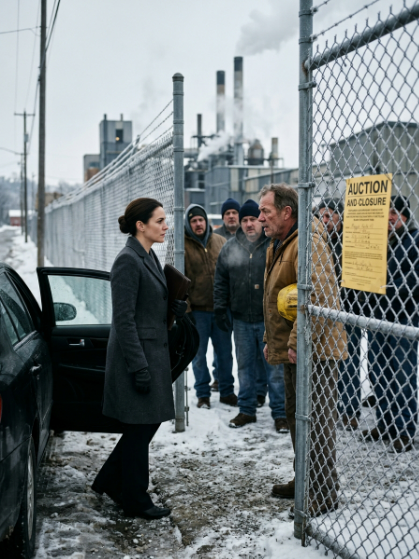
So I outbid them, and Friday morning I stood on the loading dock and watched Walt tell the crowd the line wasn’t closing. That nobody was losing their job. That the new owner intended to retool, not tear down.
Six hundred people. Some of them cried. A few of them I’d gone to school with — the ones who used to whisper “factory trash” had grown into tired adults in the same coats their fathers wore, and now they were clapping for the girl they’d laughed at, most of them not even knowing it was her.
I didn’t tell them. I didn’t need them to know. The reversal isn’t in the speech. It’s in the paychecks that don’t stop.
But the town being the town, the news got around fast. Maggie Doyle. Joe Doyle’s girl. The one who left.
That’s when Bradley Prescott showed up at the office trailer.
Time hadn’t been kind to the Prescotts. The bank his family owned got swallowed in the last crash. The country club sold its land to a developer. Bradley wore a good coat, but it was a few years old, and the man inside it had the careful look of someone who’d learned how fast the bottom comes up.
He didn’t recognize me at first. Then he did, and I watched him try to figure out which version of this conversation he was about to be in.
“Maggie,” he said. “I, uh. I heard. Congratulations. The town owes you.”
“What do you need, Bradley?”
He swallowed. “My daughter. Hailey. She works the second shift on the floor here. She’s twenty-two, she’s got a baby, and this job is — it’s everything for her right now. I just wanted to ask, when you make your cuts—”
“There aren’t going to be cuts,” I said.
He blinked.
“Your daughter keeps her job,” I said. “Same as everyone. I didn’t buy this place to gut it. I bought it so the kids of the people who built it have somewhere to build their own.”
He stood there a long moment. I could see him bracing for the other shoe — for me to remind him of the coat I wore at twelve, the table that laughed, the word he’d thrown at a kid in front of her teachers.
I thought about it. I’d be lying if I said I didn’t.
But here’s what I’ve learned about being the one who came back. You can spend your power humiliating the people who humiliated you, and it feels good for exactly one afternoon. Or you can spend it on something that outlives the grudge.
“Bradley,” I said. “I do remember. The coat. What you called me. I remembered it the whole drive back to Pennsylvania.”
His face went red.
“And I’m choosing to give your daughter a future anyway,” I said. “Not because you earned it. Because that’s the difference between your family and mine. We never needed the other person to be small.”
He nodded, eyes wet, and he didn’t try to defend it. “I was a stupid kid,” he said quietly. “I’m sorry, Maggie. For whatever it’s worth this late.”
“It’s worth something,” I said. And I meant it.
We retooled over the next year. New contracts, new training, the kind of wages that let a person raise a family instead of just survive one. Hailey Prescott runs a cell on the second shift now. She’s good. She doesn’t know her father once cried in my trailer, and she never will from me.
I put my father’s name on the building.
Not the company name — the line itself. The main floor where the work happens is the Joseph Doyle Line now, with a small brass plate by the door that the second shift touches on their way in, the way people touch things for luck.
Thirty years he gave that floor. They called him factory trash and he came home every night with his head up because he knew exactly what his hands were worth, even if the country club didn’t.
I stood on that floor on the one-year anniversary, machines running, six hundred people working, and I called my father in my head the way you do.
The girl they laughed at owns the gate now. And she left it open for everyone — even them.