The Thanksgiving Dinner That Finally Ended My Family’s Financial Arrangement
PART 3 (FULL STORY)
“If this is what I think it is, they lied to me about where my money went.”
Marcus didn’t touch the statement.
He knew better than to fill the silence with a conclusion before we had the records.
I pulled up the payment history from my own accounts and searched for the transfers I had made to my parents over the previous five years.
At first, the amounts looked familiar.
Property tax.
Roof repair.
Credit-card payment.
Country club assessment.
Emergency vendor balance.
Then I compared those dates with the documents Dad had sent me.
That was when the pattern became impossible to ignore.
Several of the payments I had made to my parents had been followed within days by transfers from my parents to Carter.
Not always the same amount.
Not always the same account.
But enough to establish what had happened.
My money had been going to my parents.
My parents had been sending part of it to Carter.
And they had been calling each request a family emergency.
I leaned back from the laptop.
For years, I had believed I was helping my parents survive temporary financial problems.
I hadn’t realized I was helping them maintain a system.
Marcus finally spoke.
“Do you want to confront them tonight?”
“No.”
He looked at me.
“I want the complete picture first.”
That was the difference between anger and control.
I could be angry later.
For now, I needed facts.
I called Dad the next morning and asked him to meet me at a coffee shop halfway between Manhattan and Connecticut.
He arrived alone.
He looked older than he had at Thanksgiving.
Not dramatically older.
Just tired.
He sat across from me and placed his phone on the table.
“You wanted to talk.”
“I want the truth.”
“I’ve already told you what happened.”
“No.”
I placed the printed records between us.
“You told me you borrowed $225,000 against the house because Carter needed business funding.”
Dad looked at the papers.
“That’s what happened.”
“No. You borrowed $225,000, gave Carter $200,000, and then used money I had been sending you to cover other expenses.”
His jaw tightened.
“Sloan, you don’t understand how complicated this became.”
“I understand numbers.”
He looked away.
I continued.
“How much money have I given you over the last five years?”
He didn’t answer.
I had already calculated it.
“$143,800.”
Dad’s eyes lifted.
“I didn’t realize it was that much.”
“I did.”
He rubbed his forehead.
“Your mother kept the household accounts.”
“And Carter?”
Dad sighed.
“He was struggling.”
“He was spending.”
“He believed the next company would work.”
“You believed him.”
“He’s your brother.”
I looked at him.
“That isn’t an answer.”
Dad stared down at the table.
“No.”
It was the first honest thing he’d said.
“You’re right,” he admitted. “We kept believing him.”
I waited.
“And when you started helping us, it became easier to keep believing him.”
That sentence hurt more than the Thanksgiving argument.
Not because it surprised me.
Because it confirmed what I had been trying not to see.
My father hadn’t thought of me as a bank.
He had thought of me as the person who would keep the bank open.
“Why didn’t you tell me about the equity line?”
“Your mother was afraid you’d stop helping us.”
I almost laughed.
“She was right.”
Dad closed his eyes briefly.
“The house is not in immediate danger.”
“Because?”
“We still have some savings.”
“How much?”
He hesitated.
“Not enough.”
I nodded.
“What about Carter?”
“He says the company is close.”
“Close to what?”
“I don’t know.”
That answer finally made me angry.
“You gave him two hundred thousand dollars without knowing what he was doing with it.”
Dad didn’t defend himself.
“He’s our son.”
“So am I.”
He looked at me then.
I held his gaze.
For years, I had mistaken being needed for being loved.
I wasn’t going to make that mistake again.
“I’m not paying another bill,” I said.
Dad nodded slowly.
“I understand.”
“I also won’t pay Carter’s debts.”
“I understand.”
“And if Mom calls me asking for money, the answer will be the same.”
He swallowed.
“She’ll be angry.”
“She can be.”
I gathered the papers.
Before I stood, Dad asked one question.
“Are you done with us?”
I looked at him for a long moment.
“No.”
His expression softened.
“But I’m done financing you.”
He nodded.
That was all.
There was no dramatic reconciliation.
No tearful apology.
Just a boundary finally spoken without fear.
The next problem was Carter.
Marcus and I reviewed the documents carefully.
The equity line had a variable interest rate.
The first payment had already been missed.
The business account was nearly empty.
And the “production deposit” Carter had described at Thanksgiving wasn’t due until several weeks later.
He hadn’t needed my $100,000 immediately.
He had wanted it because the other money was already gone.
I called him.
He answered on the fourth ring.
“What?”
“We need to talk.”
“About what?”
“The $225,000.”
Silence.
“You talked to Dad.”
“Yes.”
“He shouldn’t have told you.”
“That’s your concern?”
“I didn’t want you involved.”
“You made me involved when you put my parents’ house at risk.”
“I was going to pay it back.”
“With what?”
“The company.”
“You don’t have a company producing revenue yet.”
“We’re close.”
“You’ve said that about every company.”
His voice hardened.
“You always have to be right.”
“No.”
I looked at the spreadsheet in front of me.
“I just need you to stop pretending the numbers are different.”
He didn’t answer.
I continued.
“You have two choices.”
“What choices?”
“You can shut the business down before you lose more money, or you can find legitimate investors who are willing to take the risk.”
“You’re telling me to quit.”
“I’m telling you not to gamble our parents’ house on a business you haven’t proven.”
“You never believed in me.”
“That isn’t true.”
“It is.”
I paused.
“I believed you could build something.”
His voice softened.
“Then help me.”
“I already did.”
“No, Sloan. I mean really help me.”
I closed my eyes.
That was the old Carter.
The brother I remembered from childhood.
The boy who could make my parents laugh.
The teenager who convinced everyone he was going to become someone extraordinary.
For a second, I wanted to say yes.
Then I remembered the equity line.
“I can help you review your numbers,” I said.
“That’s not money.”
“No.”
He was quiet.
“It’s the only help I’m offering.”
He hung up.
Three weeks later, Carter closed the company.
There was no spectacular bankruptcy.
No police.
No courtroom.
No public humiliation.
He negotiated with the manufacturer, canceled the contracts he could cancel, sold the remaining inventory, and used what was left in the business account to reduce part of the debt.
It wasn’t enough.
My parents had to sell their country-club membership.
Mom sold jewelry she hadn’t worn in years.
Dad traded in his newer car for an older one.
They refinanced the house through a bank after finally hiring an attorney and an accountant.
The equity line was not erased.
It became a debt they had to manage themselves.
For the first time in years, their monthly budget had nothing from me in it.
They struggled.
But they didn’t collapse.
And that mattered.
Carter moved into a smaller apartment and took a job with a beverage distributor.
He hated it at first.
Then, slowly, he started learning.
He discovered what margins actually meant.
He learned how contracts worked.
He learned that enthusiasm wasn’t revenue and a presentation wasn’t a business.
Six months later, he called me.
“I got promoted.”
I smiled.
“Congratulations.”
“You sound surprised.”
“I sound careful.”
He laughed.
It was the first time we’d laughed together in months.
Then he said, “I paid off the vendor balance.”
“Your vendor balance?”
“Yes.”
There was a pause.
“I wanted you to know.”
I leaned back in my chair.
“That matters.”
“I know.”
Neither of us said anything for a moment.
Then Carter asked, “Do you still hate me?”
“No.”
“Do you hate Mom and Dad?”
I looked toward the window.
“No.”
“What changed?”
I thought about Thanksgiving.
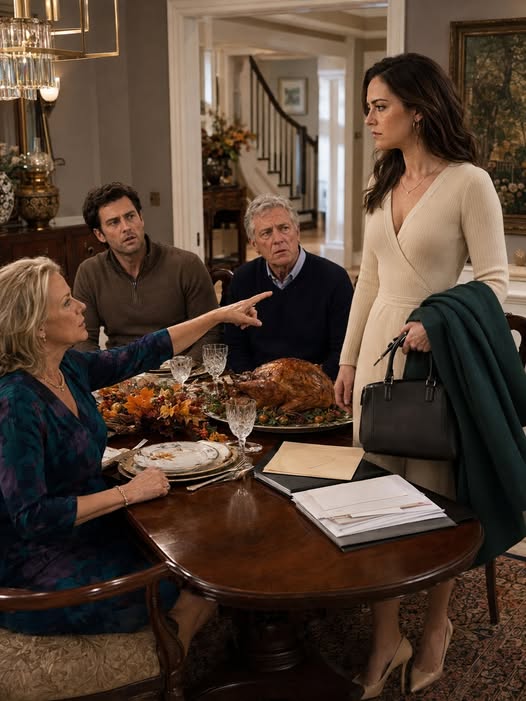
The mahogany table.
The linen napkin.
My mother’s hand pointing toward the hallway.
The sentence that had once terrified me.
There’s the door.
“I stopped confusing family with obligation,” I said.
Carter was quiet.
“I think I needed that too.”
A year after Thanksgiving, my parents invited me to dinner.
I almost declined.
Then I accepted.
When I arrived, the house looked different.
Not ruined.
Just smaller somehow.
The country-club artwork was gone from the hallway.
The expensive centerpiece on the dining table had been replaced with a simple bowl of apples.
There were no crystal wineglasses.
No glossy presentation folders.
Mom hugged me at the door.
She didn’t ask me for anything.
That was new.
Dad was already in the kitchen.
He had cooked the turkey himself.
Carter arrived twenty minutes later carrying a bottle of wine that he had bought with his own paycheck.
We sat down.
Nobody mentioned money.
Nobody mentioned investments.
Nobody asked what my portfolio had earned that year.
Halfway through dinner, Mom reached for the linen napkins.
There were only four.
She hesitated.
Then she laughed softly.
“I finally donated those expensive ones.”
I smiled.
“Good.”
She looked at me.
“I was embarrassed to admit how much I depended on you.”
“I was embarrassed that I let it happen.”
Dad shook his head.
“Don’t carry that.”
I looked at him.
He continued.
“We made those choices.”
For once, I didn’t argue.
After dinner, I helped clear the plates.
Carter stood beside me at the sink.
“You know,” he said, “I still think I have a good business idea.”
I laughed.
“Of course you do.”
“But this time, I’m writing the business plan first.”
“That’s progress.”
He smiled.
Outside, cold Connecticut air pressed against the windows.
Inside, the house was quieter than I remembered.
It wasn’t the same family.
Maybe it never would be.
But for the first time, I didn’t feel responsible for keeping everyone comfortable.
I had spent years believing the safest place in my family was at the table.
That Thanksgiving taught me something different.
Sometimes the healthiest thing you can do for a family is stop paying for the version of it that isn’t real.
Before I left that night, Mom handed me a small paper bag.
Inside was one of the old linen napkins.
“I found one,” she said.
I unfolded it in the foyer.
The fabric was still perfectly pressed.
I smiled, folded it once, and placed it back in her hands.
“Keep it.”
Then I walked out the front door.
This time, nobody told me to leave.
And I didn’t need permission to stay.