The Test Pilot Who Recognized the Failure That Once Destroyed Her Career
PART 3 (FULL STORY)
Captain Reed’s eyes stayed on me for a second too long.
“Phoenix?” he whispered.
The name sounded strange in his mouth.
Not because he was saying it incorrectly, but because I hadn’t heard it spoken by another pilot in thirty-two years.
“Don’t call me that,” I said.
Jennifer Parker was still holding the maintenance report.
“Sarah, you need to see this.”
The aircraft lurched again, and the report nearly slipped from her hands.
I caught the edge of it.
The paper had been printed from the aircraft’s maintenance system.
Several lines were highlighted.
The first warning concerned hydraulic pressure.
The second concerned the backup system.
The third was older.
Much older.
I read the date twice.
1992.
My stomach tightened.
“Where did you get this?”
Jennifer pointed beneath the console.
“There was a maintenance tablet in the storage compartment.
It was showing archived component information.
I thought it was a software error, but then I saw the Wraith reference.”
Captain Reed looked from her to me.
“What is the Wraith?”
I stared at him.
“You don’t want to know.”
“I think I do.”
The aircraft was still banking right, but the angle had stopped increasing.
That was enough for me.
A plane didn’t need to be obedient to be survivable.
It only needed to give you something you could work with.
“Listen carefully,” I said.
“Your primary controls are useless.
Stop trying to command the aircraft through them.”
Reed nodded slowly.
“You said you once flew one like this.”
“A fighter.”
“With no hydraulics?”
“With no usable hydraulics.”
“And you landed it?”
“Yes.”
“How?”
“Thrust.”
Jennifer looked at me.
“You can steer a plane with engines?”
“You can influence its direction.
Not the way you steer with a yoke.
You make the aircraft want to go somewhere, and you manage the result.”
Reed looked toward the instruments.
“Can this aircraft be landed that way?”
“I don’t know yet.”
The honesty seemed to frighten him more than anything else I had said.
I understood.
Passengers wanted certainty.
Pilots wanted options.
And right now, I had only one option.
Find out what the aircraft still obeyed.
I asked Jennifer for the engine readings.
She gave them to me.
I asked Reed for airspeed.
He answered.
Then altitude.
Then bank angle.
Then the rate of descent.
I built a picture in my head.
The old habits came back faster than I expected.
Thirty-two years had passed, but my mind had never forgotten the feel of a failing aircraft.
The cockpit was different.
The instruments were different.
The airplane was different.
But failure had a language.
And I still spoke it.
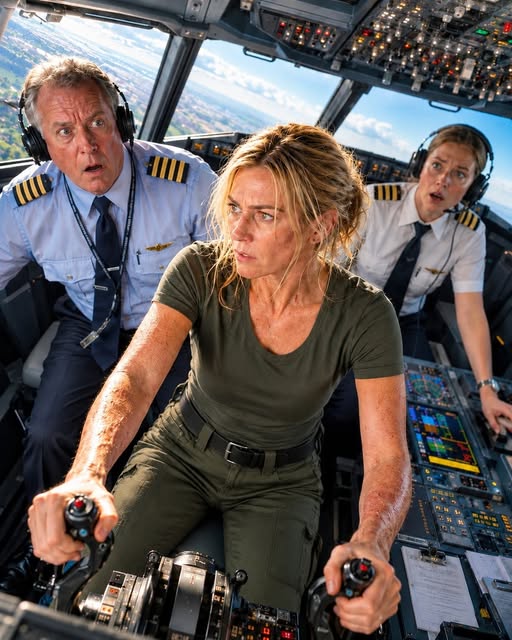
“Bring the left engine slightly higher.”
Jennifer adjusted the thrust.
The nose moved.
Barely.
But it moved.
I watched the attitude indicator.
“Again.”
She made another adjustment.
The aircraft responded.
Not enough to turn us left, but enough to prove something important.
“We have control,” I said.
Reed looked at me.
“Limited control.”
“Limited control is still control.”
A voice came through the radio.
“Southwest 2891, confirm status.”
Reed reached for the microphone.
Before he could speak, I stopped him.
“Tell them you have a complete hydraulic failure.”
He looked at me.
“That’s already in the record.”
“Tell them we’re attempting an engine-thrust-controlled recovery.”
Jennifer turned toward me.
“They’ll think you’re crazy.”
“They can think that after we land.”
Reed transmitted the message.
The controller asked who was flying.
There was a pause.
Reed looked at me.
“An experienced test pilot is assisting us.”
That was all he said.
Then the radio crackled again.
“Southwest 2891, rescue aircraft are being positioned.
Do you require immediate diversion?”
Reed looked at the instruments.
I looked at the fuel.
Seattle was no longer the question.
Getting low enough to land was.
“Nearest suitable runway,” I said.
Jennifer began searching the navigation display.
“There’s an airport ahead.”
“How long?”
“Twenty-three minutes.”
“Too long if the descent rate increases.”
She checked again.
“There is another one.
Fourteen minutes.”
Reed looked at the runway information.
“It’s shorter.”
“How short?”
“Six thousand feet.”
I nodded.
“That’s enough if we can arrive stable.”
For the first time since I had entered the cockpit, Reed looked less like a captain waiting to die and more like a pilot doing his job.
He turned toward me.
“You take the engines.”
“You keep the instruments.”
Jennifer looked at both of us.
“And me?”
“You tell us everything the airplane is doing before it does it,” I said.
She nodded.
The cabin was still frightened.
Nobody back there knew that the aircraft had stopped getting worse.
They only knew it was descending.
Linda came over the intercom from the cabin.
“Captain, passengers are asking if we’re going to make it.”
Reed looked at me.
I nodded.
He keyed the microphone.
“We are working through an emergency.
Remain seated and follow the crew’s instructions.”
It wasn’t a promise.
It wasn’t a lie.
For now, that was enough.
Then Jennifer spoke quietly.
“Sarah.”
I looked over.
She was holding the old report again.
“There are more pages.”
She spread them across the console.
The first pages were from the Wraith investigation.
I recognized the formatting immediately.
My own name appeared in the margin.
Lieutenant Colonel Sarah Mitchell.
Test Pilot.
Phoenix.
But beneath my name was something I had never seen.
A handwritten note.
Hydraulic anomaly confirmed before final flight.
My throat tightened.
“Who wrote that?” Reed asked.
“I don’t know,” Jennifer said.
“It isn’t in the official report.”
I knew exactly what that meant.
Someone had recorded the truth before the investigation began.
Then someone had removed it.
“Sarah,” Jennifer said, “there’s a signature.”
I looked down.
My eyes stopped moving.
The signature belonged to Daniel Voss.
I hadn’t heard that name since 1992.
Voss had been the chief engineer responsible for the Wraith’s hydraulic architecture.
He had testified against me.
He had told the board that the system had performed within expected parameters.
He had said I had overreacted.
He had said the crash happened because I had mishandled the aircraft.
And now his name was on a document stating the hydraulic anomaly had been confirmed before my final flight.
Reed stared at me.
“You knew him.”
“Yes.”
“Where is he now?”
“I don’t know.”
Jennifer turned another page.
“This isn’t all.”
There was a second signature.
This one belonged to a contractor executive.
The same contractor that had held the $12 billion Wraith contract.
I felt the old anger rise.
Not the kind that made you shout.
The kind that made your hands become very still.
“Put it away,” I said.
Jennifer hesitated.
“Why?”
“Because we’re not dying with that paper in our hands.”
She folded the report and secured it beneath the console.
The aircraft dropped suddenly.
The altimeter unwound faster.
Jennifer called the numbers.
Reed adjusted the thrust.
I watched the bank.
“Left engine down.”
“Down.”
“Right engine up.”
“Up.”
“Hold it.”
The nose steadied.
For several seconds, nobody spoke.
Then the aircraft began turning.
It was slow.
Ugly.
Nothing like a normal turn.
But it was turning.
Jennifer looked at me.
“We’re doing it.”
I shook my head.
“Not yet.”
The runway was still fourteen minutes away.
And now we had another problem.
Fuel.
The gauges were falling faster than they should.
Reed saw it at the same moment I did.
“How much?”
Jennifer calculated.
“Enough for one approach.”
“One?”
“One.”
I looked through the windshield.
The horizon was no longer spinning.
The airplane was flying.
Barely.
But flying.
“Then we get one chance.”
The approach was unlike anything Reed had ever flown.
There were no normal control inputs.
No smooth corrections.
No ability to simply point the nose where we wanted it.
Every change had to be made through thrust.
Too much on one side and the aircraft would roll.
Too little and it would drift.
A correction made too late could become unrecoverable.
I kept my eyes on the runway.
The desert appeared beneath us.
Then the airport.
The runway looked impossibly narrow.
“Gear?” Reed asked.
I looked at the indicators.
“No hydraulic pressure,” Jennifer said.
“So?”
“We can’t lower it normally.”
I thought for a second.
“Emergency extension.”
She began the procedure.
The landing gear dropped.
The indicators changed.
Three green lights.
Reed exhaled.
“Flaps,” he said.
Jennifer shook her head.
“No normal extension.”
I looked at the runway again.
“Then we land without them.”
The aircraft crossed the runway threshold too fast.
I adjusted the engines.
The nose began to rise.
“Easy,” I said.
Reed followed the thrust instructions.
The main landing gear touched first.
The aircraft bounced.
Everyone in the cockpit tensed.
I adjusted the engines again.
The nose came down.
The tires screamed against the runway.
For a few seconds, the airplane stayed straight.
Then it began drifting.
“Left,” Reed said.
“I know.”
I reduced the right engine and increased the left.
The aircraft corrected.
The runway rushed toward us.
Then the wheels stopped turning.
The airplane slowed.
Slower.
Slower.
And finally stopped.
No explosion.
No fire.
No impact.
Just silence.
For several seconds, none of us moved.
Then Reed took his hands away from the controls.
“We’re alive.”
Jennifer laughed once, almost disbelievingly.
I looked back through the cockpit doorway.
Linda was standing there.
Her eyes met mine.
Then she smiled.
The cabin doors opened after the emergency crews arrived.
Passengers stepped onto the runway in groups.
Some cried.
Some called their families.
Some simply stood there staring at the airplane that had carried them down.
I stayed in the cockpit.
I wasn’t ready to walk away yet.
Captain Reed came over.
“You saved us.”
“No,” I said.
“We all did.”
He shook his head.
“I’ve flown for thirty-eight years.
I’ve never seen anything like that.”
“Neither had I.”
He looked at me carefully.
“Why did you stop flying?”
I looked down at my hands.
The burn scars were still there.
“They stopped believing me.”
He didn’t ask who they were.
He didn’t need to.
Outside, investigators were already approaching the aircraft.
Jennifer entered carrying the folded report.
“We need to give them this.”
I nodded.
She placed it on the console.
Then she looked at me.
“Are you going to tell them about Phoenix?”
I looked through the windshield at the emergency vehicles.
For thirty-two years, I had believed that name belonged to a woman who no longer existed.
I had buried her with the Wraith.
But that woman had just saved 187 people.
“I think they already know,” I said.
By evening, the story was everywhere.
A passenger had recorded part of the emergency announcement.
Someone else had filmed the evacuation.
News crews had learned that a retired Air Force test pilot had been aboard.
The name Phoenix came back into the public record.
But this time, it didn’t come with an accusation.
It came with questions.
The old Wraith investigation was reopened.
The maintenance report from Flight 2891 was turned over to investigators.
The archived documents were authenticated.
The handwritten note was examined.
And the truth was finally given the thing it had been denied for thirty-two years.
A record.
The official review concluded that the Wraith’s hydraulic defect had existed before my final flight and that the evidence used against me had been incomplete.
The two people who died in the crash could never be brought back.
Neither could the thirty-two years I had lost.
No investigation could restore my medals to the shelf where Emily had once seen them.
No report could return the years when my daughter had believed I was responsible for the deaths.
No apology could erase the silence between us.
But Emily came to see me.
She arrived in Seattle two days after the emergency.
She didn’t knock immediately.
She stood outside my hotel room holding the wedding invitation I had carried for the entire flight.
When I opened the door, she looked at me for a long moment.
“I saw the landing,” she said.
“I thought you were getting married.”
“I am.”
She smiled faintly.
“That’s why I came.”
I didn’t know what to say.
She looked at my hands.
“The scars are worse than I remembered.”
“They’ve had thirty-two years to get worse.”
She laughed softly.
Then she cried.
I didn’t try to stop her.
I didn’t try to explain everything again.
She already knew.
After a while, she reached into her bag and pulled out an old photograph.
It was me in a flight suit beside an experimental aircraft.
Young.
Confident.
Smiling.
On the back, someone had written one word.
Phoenix.
Emily handed it to me.
“I found this with the reports,” she said.
I looked at the photograph.
“I thought I lost that.”
“You did.”
She paused.
“Then you found her again.”
I looked down at my scarred hands.
For years, I had hated those scars because they reminded me of the cockpit where everything had gone wrong.
Now they reminded me of something else.
The moment I had unbuckled my seat belt.
The moment I had stood.
The moment I had decided that thirty-two years of silence were not going to decide what happened next.
I kept the photograph.
A week later, the wedding took place.
I sat near the front.
Emily walked down the aisle.
When she reached me, she squeezed my hand.
For the first time in fifteen years, she didn’t let go.
After the ceremony, I stepped outside alone.
The evening air was cool.
Somewhere in the distance, an aircraft climbed into the darkening sky.
I watched its lights until they became small points above the horizon.
Then I looked at the old photograph in my hand.
Phoenix was smiling back at me.
I folded the picture carefully and placed it in my pocket.
I had spent thirty-two years believing my story ended in the sky.
It hadn’t.
It had simply taken that long to come home.