The Senator Who Shares My Blood FULL STORY
The cameras kept rolling. I stopped hearing them.
Senator Gregory Vance stood at the bottom of my porch steps with rain starting to freckle his navy jacket, and for a long moment he only looked at me, like a man reading the last page of a book he had been afraid to finish.
“Miss Wells,” he said. “May we talk inside. Away from all of this.”
A reporter shoved a microphone between us. “Senator, do you deny the match?”
He did not turn his head. “I deny nothing. Now step back onto the sidewalk. This is her home, not a press room.”
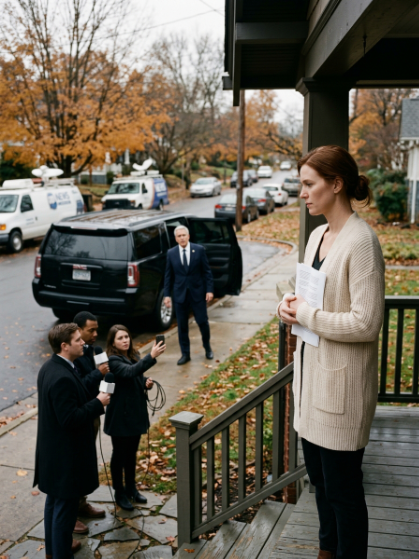
It was the first time in three days that anyone with power had stood between me and the noise.
I held the door open. He came in, wiping his shoes on the mat like a man who had been raised to.
My kitchen has a chipped table and a kettle that whistles flat. He sat down at it anyway, folded his hands, and waited while I set the unopened letter between us.
“Your mother,” he said quietly. “Was her name Ruth?”
The kettle slipped out of my grip and clattered in the sink.
“Ruth Avery,” I said. “Wells after she moved here.”
Something crossed his face that no camera ever caught on him. It looked like grief that had been waiting thirty years for a place to land.
“Read it,” he said. “Please. I think it’s hers to explain, not mine.”
So I opened the letter my mother sealed before I was old enough to ask.
Her handwriting filled four pages.
She wrote about the summer of 1990, when she was twenty-two and clerked in a state legislator’s office in Raleigh. About a young aide named Greg who brought her coffee she didn’t ask for and listened like the answers mattered. About one autumn that felt like the start of a whole life.
Then about the morning she learned she was pregnant, the same week the party machine announced his engagement to a donor’s daughter, the match that would make his career.
She wrote: I had two choices. I could be the scandal that ended a good man before he ever began. Or I could disappear and let you be nobody’s secret. I chose you. I will always choose you. He never knew. That part was mine, and I am sorry for it.
I read the last line out loud without meaning to.
Across the table, the senator pressed his knuckles to his mouth, and the most photographed man in the state cried in my kitchen where no one could see.
“I looked for her,” he said when he could speak. “After the divorce, after the money stopped mattering. I looked for a Ruth Avery for years. She was very good at not being found.”
“She was,” I said. “She raised me on a library salary and never once let me feel poor.”
He laughed, wet and broken. “That sounds like her.”
We did the test again the proper way that afternoon. A lab in Charlotte, a chain of custody, a result no blog could wave away.
It came back the same. Ninety-nine point nine.
The staffer who leaked my name had done it to wound him, a quiet act of sabotage inside his own office. It backfired in the worst way for them. Because Gregory Vance did not deny me, did not pay me off, did not vanish behind a lawyer.
He walked back out onto my porch with me three days later and read a statement into the same cameras that had called me a liar.
He said the word daughter.
He said it was the leak that was shameful, not the woman standing beside him.
He said he had missed thirty-four years he could never buy back, and he intended to spend whatever was left earning the right to the name we shared.
The blog took the post down by evening. The dark-coated reporter who shouted through my screen door sent a written apology I have not yet decided to answer.
Vance offered me things, at first. The reflex of a man used to fixing pain with resources. A house closer to the city. A position. A trust.
I told him I had a library and a porch and a mother who taught me what mattered.
What I wanted was Sundays.
So now, most Sundays, a black SUV parks on my quiet street and a silver-haired man in no tie eats flat-whistled tea and bad casserole at my chipped table, and asks me to tell him one more story about the woman he never stopped looking for.
The cameras are long gone.
We finally have all the time they cost us.
And every Sunday he leaves the same way, pausing at the bottom of the steps to look back, like he still can’t believe the porch is real.